
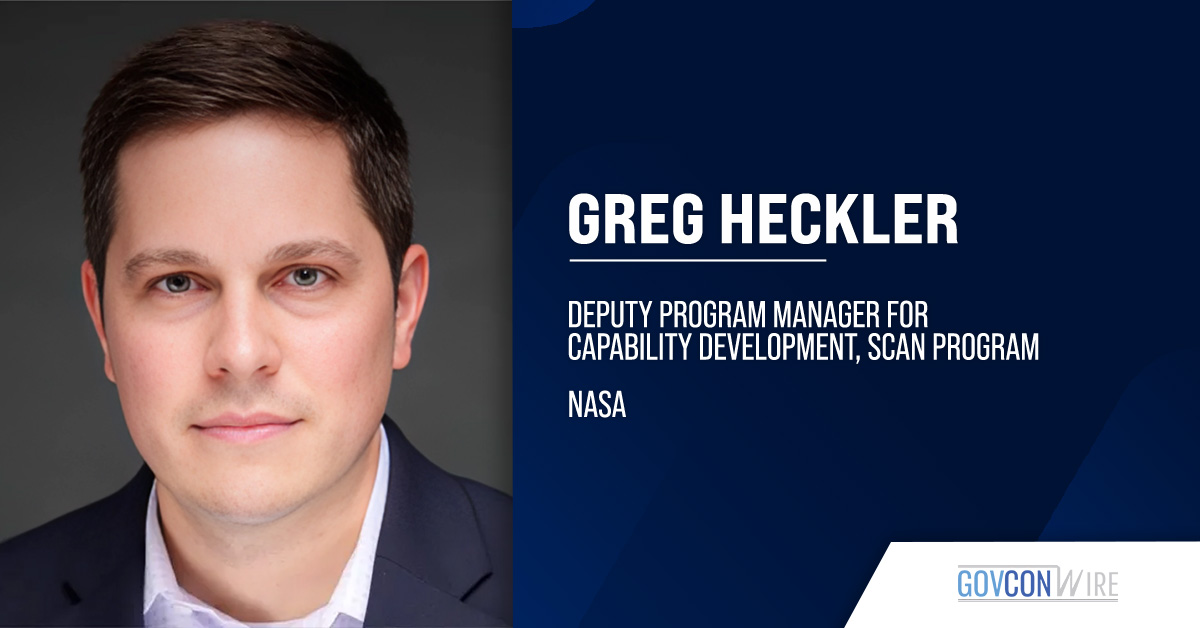

- Greg Heckler, deputy program manager for capability development for NASA’s SCaN program, spoke on a podcast about the O2O, the LCRNS and the surface network system
- The official described the current moment as the “platinum era of satellite communications,” noting that U.S. companies are making major investments in LEO, MEO and GEO systems
- Heckler will discuss the communications and navigation technologies that enable present and future space missions at the 2026 Air and Space Summit on July 30
As humanity prepares to return to the moon under the Artemis mission, Greg Heckler and his team at NASA’s Space Communications and Navigation — better known as SCaN — program, are leading efforts to develop the infrastructure that will enable the transfer of critical data across the lunar surface and to and from the Earth.
In an interview with NASA Johnson Space Center’s Houston We Have a Podcast in May, Heckler, who serves as SCaN’s deputy program manager for capability development, provided a detailed look at the technologies that enable communications and navigation on the lunar surface and support a sustainable human presence on the moon and beyond.

Heckler will explore NASA’s plan to transition to commercial space relay for Artemis and future missions at the 2026 Air and Space Summit on July 30. He is joining other space experts from government and industry on the Commercial Space Relay: Achieving Speed to Mission panel. Sign up here to join the conversation!
What Is O2O?
The Orion Artemis II Optical Communications System, also known as O2O, is an effort funded by the SCaN program to develop and test laser communications for sending data to and from space. During the Artemis II flight, the 10-centimeter-diameter terminal installed on the Orion connected to ground stations and transferred up to 260 megabits per second of data.
According to Heckler, O2O made the near-real-time exchange between astronauts and ground control possible. If the old radio frequency microwave technology of the Orion was used during Artemis II, the photos from the mission would have arrived from space to Earth much later.
“There’s a whole science team that was interacting with the astronauts in real time as they’re going on the far side of the moon, trying to [provide guidance] on what pictures to take,” he noted.
“Those pictures would not have gotten back to the Earth as quickly as they would have on the old system on Orion. They were almost able to have that interaction in real time, because the high[-resolution] photos would come off the cameras down to the ground to the science room, and they’d had that real back and forth that otherwise would not happen,” he added.
How Will the Lunar Relay Support Moon Missions?
The Apollo missions were constrained on the near side of the moon, where Earth is always visible and maintaining connections with ground stations was easier. Artemis is targeting the lunar South Pole, which creates navigation and communications challenges.
“[I]f you land on the South Pole, you don’t always see the Earth,” Heckler noted. “And so you can’t just rely on antennas on the Earth to talk to the astronauts. You need to have assets they can actually see and communicate with.”
The Lunar Communications Relay and Navigation Systems, or LCRNS, project is a cornerstone of humanity’s return to the moon. The initiative will establish a network of satellites in lunar orbit to provide communication and navigation capabilities to support moon missions.
LCRNS is designed to move data to and from the Human Landing System, rovers and other scientific instruments on the lunar surface, and mission control and data users — even when Earth is not visible.
The space agency is working with Intuitive Machines to develop lunar relay satellites under a $4.82 billion contract awarded in 2024. The first lunar relay satellite, called Altus-1, is scheduled for launch in November, Heckler shared.
How Is NASA Building’ Cellphone Towers’ on the Moon?
Also, a key component of NASA’s space communication architecture is a surface network system that, according to Heckler, will work like cellphone towers on Earth. He explained that the capability will aggregate traffic from multiple elements on the moon, such as the rovers and landers, and then move the data to the lunar relays.
The space agency is working with Nokia to deliver reliable, high-data-rate communications systems on the lunar surface. In partnership with Intuitive Machines, Nokia deployed its Lunar Surface Communications System on the moon and transmitted operational data back to Earth.
What Is the Role of the Commercial Sector in NASA’s Space Missions?
During the interview, Heckler highlighted the profound impact of the commercial sector on space communications. He noted that U.S. companies are making major investments to build systems in low, medium and geosynchronous Earth orbits, leading to what he described as the “platinum era of satellite communications.”
“I think we have the opportunity right [now] that we did not have 10 years ago, that we did not have 20 years ago, of adapting these commercial capabilities and applying them to different problems and areas,” the official said.
NASA’s Expanding Private Sector Partnerships
The commercial sector has been critical in advancing Artemis, one of NASA’s most ambitious projects yet. From Lockheed Martin developing the Orion crew capsule to Boeing and Northrop Grumman building the Space Launch System rocket, the Artemis program was made possible through industry’s innovations.
The agency, to increase investments and accelerate the development of critical space components, has teamed up with the Small Business Administration to attract capital for small businesses, SpaceNews reported in June. NASA will identify strategic aerospace technology focus areas, while SBA will mobilize private investment to support companies developing technologies needed for Artemis and other space programs.
NASA also recently announced the selection of 41 proposals from 37 companies to mature technologies that will enable the establishment of long-term human presence on the moon and support missions to Mars. Selected companies will have access to NASA software, hardware, facilities and subject matter expertise to rapidly advance their technologies.
The proposals were chosen from the 2025 Announcement of Collaboration Opportunity.
What Other Space Comms Initiatives Is NASA Pursuing?
Resilient Lunar Surface Networks
In June, NASA awarded AiRanaculus, a networking technology company, a $5 million contract under the Civilian Commercialization Readiness Pilot Program to provide its CLAIRE network management platform and INSPiRE network optimization technology in support of lunar and space communications networks. The company will work with Nokia, which has a contract with NASA to deploy a cellular network on the moon, and other industry collaborators, including NVIDIA and Dell Technologies, Via Satellite reported.
According to AiRanaculus, its technologies will provide flexible and resilient communications between lunar surface operations and orbiting systems and cislunar architectures.
Deep and Near Space Network Support
In December, SpaceNews reported that NASA wants to test SpaceX’s Starshield to support the Deep Space Network. The space agency said in procurement documents that it intends to award a sole-source contract to SpaceX for data subscriptions and seven Starshield terminals to be installed at DSN sites in California, Australia and Spain.
Earlier in 2025, NASA awarded Viasat a spot on its Near Space Network Services multiple-award contract valued at up to .$4.82 billion. The contract provides commercial ground and space relay support for missions in LEO and up to 2 million kilometers from Earth.
Contract Opportunities at NASA
- Artemis III Alternate Comm: In May, NASA issued a request for information on secondary communications technologies that would deliver 4K imagery to the agency’s Moon to Mars Program during Orion’s rendezvous and docking operations as part of the Artemis III mission in 2027. The space agency requires a system capable of providing near continuous communication with return links of at least 12 Mbps.
- Lunar Exploration Ground Sites: NASA has also conducted market research on companies interested in supporting its Lunar Exploration Ground Sites, or LEGS, public-private partnership. The agency is seeking commercially viable approaches for providing communications and navigation services for lunar and cislunar missions. The initiative will augment NASA’s existing Near Space Network.
- Commercial LEO Destinations: More recently, the space agency posted a draft request for proposals for LEO Destinations, an initiative to build a commercial space station that would replace the International Space Station. NASA intends to award firm-fixed-price, indefinite-delivery/indefinite-quantity contracts for development, certification and support services. Feedback on the draft RFP is due on July 27.
Be one of the first to hear about upcoming contract opportunities and future technology investments at NASA, National Reconnaissance Office, Defense Innovation Unit, the Air Force and the Space Force at the 2026 Air and Space Summit. Air Force Acting Assistant Secretary for Space Acquisition and Integration Tom Ainsworth will deliver a keynote at the event. Other acquisition leaders, such as GP Sandhoo, portfolio acquisition executive for missile warning and tracking and director of the Space Development Agency, and Didi Kuo, chief architect of the Geospatial Intelligence Systems Acquisition Directorate at NRO, will also be present at the summit. Get your tickets here!
Who Is Greg Heckler?
Heckler, as head of SCaN, is in charge of the planning and execution of communications and navigation technology initiatives that support present and future explorations of the Earth, moon, Mars and deep space.
Before his present role, he served as director of NASA’s Commercial Communications Services Division. Throughout his more than two-decade career at the space agency, he also held the role of engineering manager for the Network Services Division and oversaw major programs, including the TDRS, Restore-L teleoperated robotic spacecraft mission and Space Network Ground Segment Sustainment modernization effort, according to his profile on LinkedIn.
Heckler joined NASA in 2002 as an aerospace engineer at the Goddard Space Flight Center in Greenbelt, Maryland. He holds bachelor’s and master’s degrees in aerospace engineering from Purdue University.
Learn More About US Efforts to Build Space Comms Capabilities at the 2026 Air and Space Summit
Heckler will provide more insights about SCaN, TDRS and NASA’s optical communications and lunar exploration programs at the 2026 Air and Space Summit on July 30. He will join the Commercial Space Relay: Achieving Speed to Mission panel, where he will discuss NASA’s transition to commercial relay infrastructure, building interoperability across technologies to enable global operations and accelerating capability development to support missions.
Other panelists include:
- Col. Aaron Stevenson, deputy director of the Commercial Space Office at the Space Systems Command
- Samuel Sutton, director of space systems architecture at SES
- Joseph Bravman, president of Omnisat
- Jared Newton, senior solutions architect at Planet Labs
NASA Deputy Administrator Matt Anderson will also be present at the event to deliver the morning keynote. He is expected to discuss agency efforts to develop space communications networks on the moon and beyond, and other initiatives to strengthen U.S. leadership in space. Do not miss this chance to get a clearer picture of where the future of space communications is heading — get your tickets for the 2026 Air and Space Summit today!