
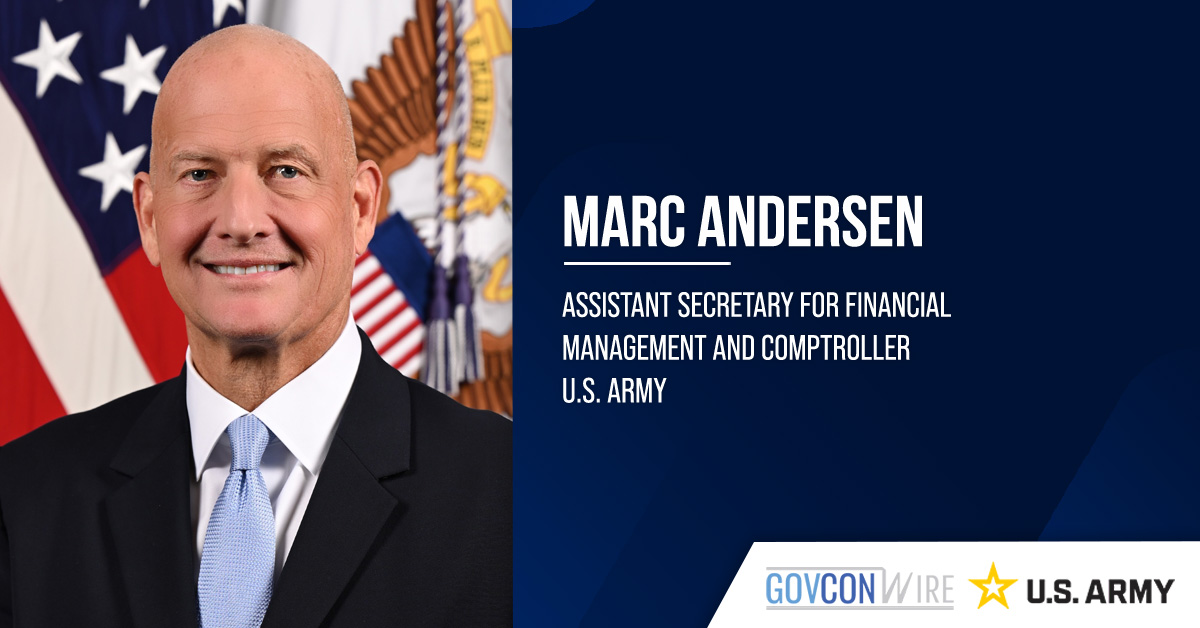

- Army Comptroller Marc Andersen has called for scaling private capital to strengthen national security
- Army installations can support industrial growth, energy resilience and modernization
- Andersen discussed the Strategic Capital Initiative at the 2026 Army Summit
Marc Andersen, assistant secretary of the Army for financial management and comptroller, said the question is no longer whether private capital can strengthen national security, but how quickly it can scale, arguing that future strategic advantage will depend on a nation’s ability to rapidly mobilize its economic strength, innovative spirit and industrial capacity.

As discussions continue around strengthening national security through private investment, artificial intelligence and industrial modernization, the Potomac Officers Club prepares to host two DOW summits this summer. Register now for the 2026 Air and Space Summit on July 30 to hear discussions on commercial space relay, optical networks, AI and other emerging defense technologies. You can also sign up today for the 2026 Navy Summit on Aug. 27 to join maritime leaders examining naval modernization, autonomous systems and next-generation capabilities.
In a commentary published Tuesday on Fortune.com, Andersen wrote that the Army has engaged investors, energy developers, infrastructure funds, manufacturers, technology companies and financial institutions over the past year to advance projects aligned with national security priorities.

Andersen spoke about the Army’s Strategic Capital Initiative during a fireside chat at the Potomac Officers Club’s 2026 Army Summit on June 18.
Why Does Andersen View Military Installations as Strategic Assets?
Andersen wrote that military installations should continue supporting readiness and force projection while also serving as economic assets because of their proximity to transportation networks, industrial infrastructure, energy corridors, research institutions and skilled labor.
He said these installations are increasingly becoming platforms for industrial revitalization, energy resilience and economic growth.
According to Andersen, the U.S. advantage stems from the “voluntary alignment of government, private enterprise, investors, innovators, workers, and communities pursuing a common purpose.” He contrasted that approach with China’s state-directed model, saying America’s ability to attract private capital and foster innovation helped build the Arsenal of Democracy during World War II and contributed to winning the Cold War.
As an example of that approach, Andersen pointed to two agreements announced this year to develop hyperscale data centers on Army installations through private financing. He said the projects will provide computing infrastructure, power generation and digital capacity to support AI and modernization requirements without requiring taxpayer-funded construction.
How Are Economic Security & National Security Connected?
According to Andersen, national security and economic security have become increasingly interconnected, with industrial capacity, energy infrastructure and supply chains serving both commercial and military needs.
He also said the Army is advancing initiatives involving rare earth elements, critical minerals and advanced manufacturing to reinforce domestic production capabilities and reduce reliance on overseas supply chains for materials used in modern weapons systems. Andersen added that the service is pursuing automation, robotics, digital engineering and next-generation manufacturing technologies to build a more resilient industrial base capable of supporting both routine operations and wartime production needs.
He wrote that the modern battlefield begins long before armed conflict, extending to mines, factories, power plants, data centers, laboratories and logistics networks. Andersen said this shift is changing how the U.S. views its strategic assets, particularly military installations.