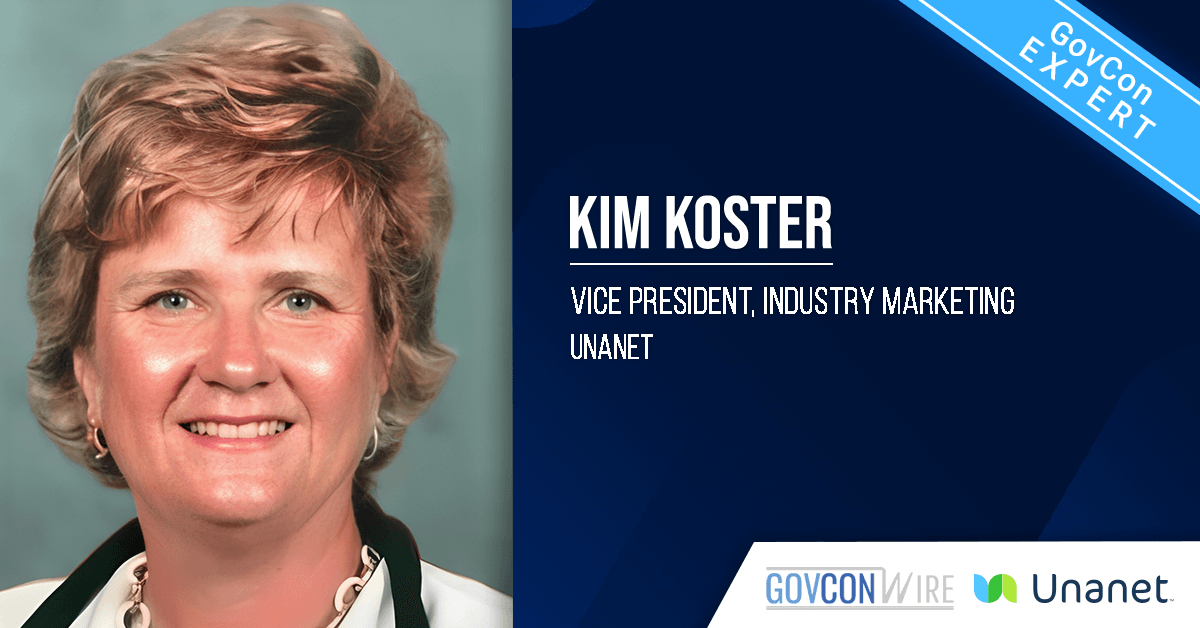

By Kim Koster, vice president of industry marketing at Unanet
For U.S. government contractors, all the current flurry of activity notwithstanding, the coming years promise a wealth of new business opportunities in areas like artificial intelligence, defense, cybersecurity and more.
Now comes the real challenge: Ensuring your firm wins its fair share — and preferably more — of that new business.
In a market where competition for government contracts is steeper than ever, positive relationships and past work with federal agencies provide an obvious edge in landing new business; up to a point. Having supported hundreds of government contracting firms over the years in their efforts to strengthen and refine their business development processes and practices, I’ve learned a few things about why certain firms excel at keeping their project pipelines full with the kinds of work they covet. Generally, they:
- Have a deeper understanding of the agencies they support — their mission and needs — than competing firms do
- Know the capabilities and past performance of their own business better than competitors know theirs
- Leverage this deeper insight about themselves and the agencies they support to pursue the most winnable and profitable opportunities
- Consistently create on-point proposals because they possess a better understanding of the relevant RFP-issuing agency, their own business, and the specific RFP for which they are submitting, without adding to headcount to their business development team
A recent influx of intelligent capabilities designed specifically for government contractors gives firms the ability to marry core business applications (including customer relationship management and enterprise resource planning solutions) to elevate their game in each of these four areas. In many cases, these tools use artificial intelligence and/or machine learning. And because these tools often can be found embedded within a client relationship management or enterprise resource planning system, they’re within reach for smaller companies as well as larger ones.
In a business development context, AI can help a firm do more with less. According to John Sisson, Unanet’s executive vice president of CRM, “To effectively use AI companies must ensure they have a single, reliable data source. It should be one that people across the company can readily tap into for information about prospects, customers, partners, pipeline, and other valuable institutional knowledge that’s relevant to a pursuit.”
For many government contractors, a CRM system serves as that hub, ensuring seamless access for business development, marketing, sales, proposal and program management teams.
Winning new business can be exceedingly difficult for firms that have to dig through multiple systems and spreadsheets (often populated with outdated or error-prone data) in search of an edge in their pursuits. Having that single source of truth in a CRM system strengthens a government contractor’s ability to win and grow. But in today’s evolving business climate, that’s not enough. Intelligent tools are critical to elevating a firm’s business development performance. Here’s where these capabilities can really make an impact:
Casting a Wider Net to Identify Promising New Business Opportunities
Ever had the gnawing feeling your firm is missing out on good project opportunities? Comprehensive market intelligence solutions — integrating GovWin, SAM, eBuy and key contracting vehicles — eliminate blind spots and allow firms to stay informed on all relevant bids and RFPs.
“These solutions provide a steady stream of opportunities that align with strategic goals, profitability targets, and key parameters,” according to Sisson. “By surfacing relevant task orders from GWACs and other contract vehicles, they help ensure firms don’t miss out on high-value pursuits that align with their capabilities. With these tools acting as their eyes and ears, companies uncover opportunities they might have otherwise overlooked – and that competitors might miss entirely.”
Filling the Pipeline With the Kinds of Work You Desire Most
Finding opportunities is one thing. But what sets a firm apart is how it evaluates opportunities once they’ve been identified. In horseracing terms, you want to put your resources behind the horse with the best chance of winning. So you need handicapping tools that can tell you which horse that is. In the world of GovCon, analytics have matured to the point where they can support decision-makers in evaluating and prioritizing specific pursuits. As a result, companies can focus their pursuit resources on the most winnable, profitable, and desirable opportunities, relying on data, not just gut feel, to prioritize the right customers and projects rather than betting on the wrong horses.
Boosting Proposal Quality and Capacity to Generate More New Business
AI is driving major qualitative and quantitative improvements on the proposal front, enabling firms to hand over certain proposal-creation tasks to intelligent, automated tools that can gather, standardize and organize content culled from various sources, and turn it into a coherent whole. Instead of proposal teams wasting time combing through massive volumes of data and documentation to identify relevant information for a RFP response, or getting bogged down trying to interpret complex contract compliance language or verifying data accuracy, intelligent AI-powered proposal tools can take on much of that heavy lifting.
Sisson notes, “These capabilities free people to focus on the parts of the proposal where a more nuanced human touch can really make a difference.”
Today’s AI tools are versatile. They can create content, predict optimal pricing strategies based on past projects, verify the accuracy and consistency of proposal data, and align the proposal tracks with its RFP requirements. Then AI can flow it all into automated templates to speed the process without having to reinvent the wheel with every proposal. The resulting efficiency gains (based on actual data from our customers) can be a huge difference maker: a 70 percent reduction in average RFP time-to-draft, slicing proposal-generation costs in half.
You can also enhance overall company proposal capacity by 15 to 20 percent — all without increasing headcount or compromising win rate. Most importantly, implementing intelligent tools like these can lead directly to increased revenue, increased profitability and greater predictability; exactly what a government contracting business must have in unpredictable times like these.