
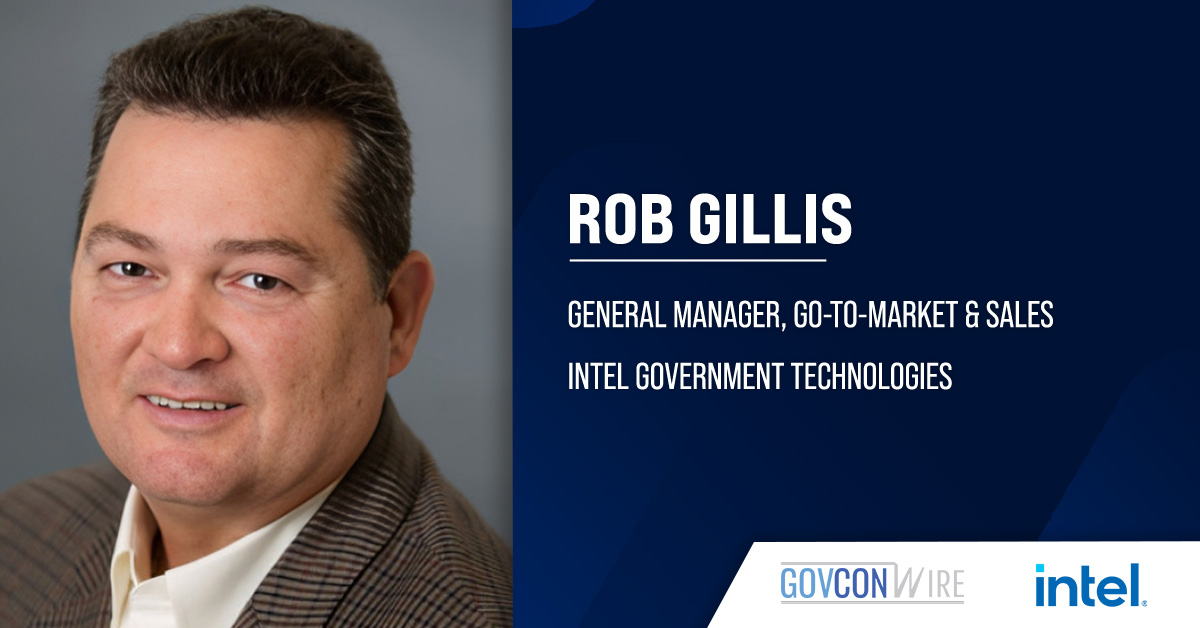

- Gillis spent four years as Intel Government Technologies’ technical sales director
- He succeeds Greg Clifton, who retired after more than 26 years of service
- Hear about supply chain visibility at the Potomac Officers Club’s 2027 Defense R&D Summit. Register now!
Intel has named Rob Gillis general manager of government go-to-market and sales for Intel Government Technologies, elevating a 12-year company veteran to run the subsidiary that serves federal customers, CRN reported Wednesday.
Gillis takes over from Greg Clifton, who spent more than 26 years at the company in various leadership roles. In a LinkedIn post, Gillis described Clifton as a “tireless advocate” for public sector and defense customers.
“I’m grateful for his partnership, his leadership, and the momentum he has created over the past year,” Gillis said.
“Our government customers and partners are working on important, complex missions. We have the privilege of listening closely, understanding their needs, and bringing Intel’s technology and engineering capabilities to help solve today’s biggest challenges,” he continued.

Hear about supply chain visibility and research security from government and industry experts at the Potomac Officers Club’s 2027 Defense R&D Summit on Feb. 4. Register now!
Who Is Rob Gillis?
Gillis spent the past four years as technical sales director for Intel Government Technologies go-to-market, leading industry technical specialists, global account managers and field applications engineers covering federal civilian, state and local government, education, the defense industrial base, federal systems integrators, and strategic original equipment and design manufacturers.
He joined Intel in 2014 as a field sales engineer, moving to strategic account manager for the company’s Internet of Things public sector business in 2017. Before Intel, he spent more than 21 years at Texas Instruments in technical sales and account management roles. He began his career as a digital design engineer at Martin Marietta, which merged with Lockheed Corp. to form Lockheed Martin. Gillis holds an engineering degree from the University of Central Florida.
How Does Gillis’ Appointment Fit Intel’s Broader Sales Changes?
The appointment represents the third executive move across Intel’s sales division in three months, CRN reported. Under the direction of CEO Lip-Bu Tan, Intel appointed former Marvell Technology executive Dean Jarnac as chief sales officer in August, succeeding 27-year veteran Greg Ernst, who held the chief revenue officer position for over a year. Shortly thereafter, former Marvell executive Sunil Kaul joined the leadership team to oversee global hyperscale and data center sales. Ernst has since transitioned to storage and memory vendor ScaleFlux as chief business officer.
Clifton had held the government role since June 2025, when Intel announced his appointment alongside Ernst’s elevation to chief revenue officer. He spent more than two decades at the company, including as general manager of federal sales, sales director and strategy lead for the Department of War and intelligence community, and general manager of its defense and national security group.
“After an incredible 26+ years at this great company I’m stepping away to begin a new and exciting chapter,” Clifton said in a LinkedIn post. “I’m proud to have represented Intel in this Government community for over two decades. It has been an honor to support our country by delivering cutting edge compute capability that has delivered amazing results to the mission and made a tangible and lasting impact across the US Government.”
Where Does Intel Stand With the US Government?
The U.S. government agreed to acquire a 9.9 percent stake in Intel in August 2025 through an $8.9 billion investment, funded by $5.7 billion in remaining CHIPS and Science Act grants and $3.2 billion awarded under the Secure Enclave program. The purchase covered 433.3 million shares at $20.47 each, bringing total government investment in the company to $11.1 billion.
The stake is passive, with no board representation or governance rights, and the government will vote with Intel’s board on matters requiring shareholder approval. The agreement includes a five-year warrant to buy an additional 5 percent at $20 per share, exercisable only if Intel ceases to own at least 51 percent of its foundry business.