
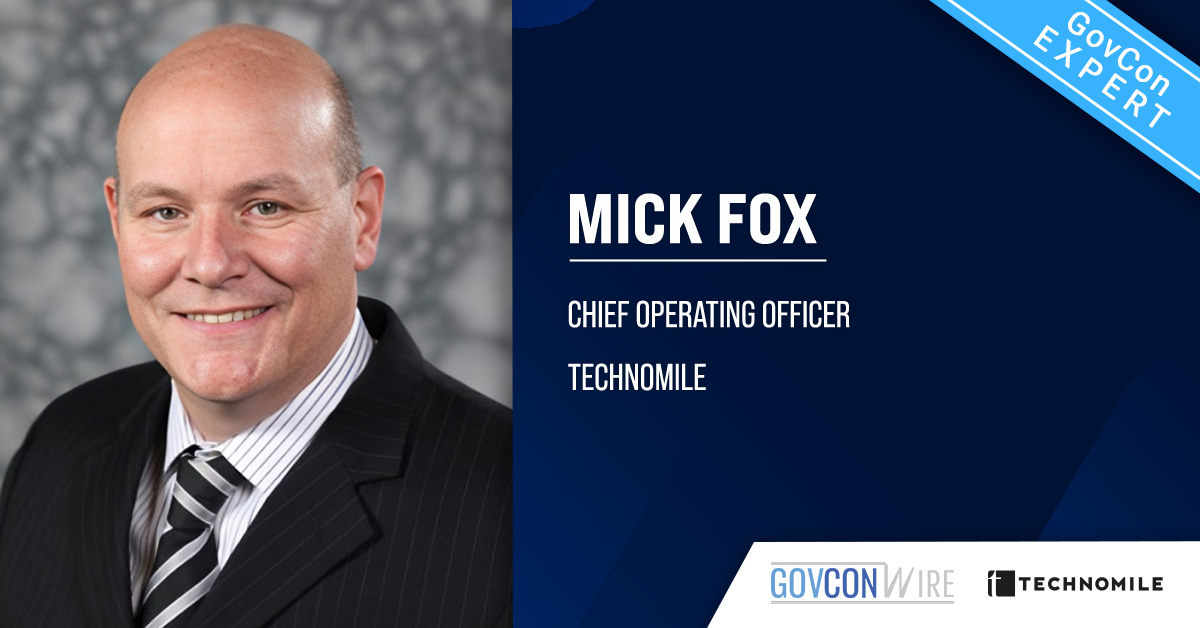

By Mick Fox, Chief Operating Officer, TechnoMile
For years, those of us operating in the federal contracting trenches have understood a simple truth: contracts don’t create value when they’re drafted – they create value when they’re managed. Forrester’s recent The Contract Lifecycle Management Platforms Landscape, Q2 2026 report highlights the CLM industry’s shift toward post-signature governance, trustworthy AI and operational integration, validating, in our opinion, the growing importance of capabilities that federal contractors have long known are critical. In other words, the CLM market is finally catching up to the realities federal contractors face every day.
But catching up isn’t the same as arriving.
The Same Play Name, Different Playbook
If you have ever watched two NFL teams run a play both called “Omaha,” you know the problem – same name, completely different execution. One is crisp and timed; the other breaks down as soon as the defense shifts.
That’s the CLM landscape today.
The terminology is identical. The underlying architecture is not.
Some platforms are still repositories dressed up as intelligence. Some automate workflows until the moment things get cross-functional. And a small handful actually treat contracts as structured, operational data that drives decisions, accountability and performance. 
The message is clear: the market knows where CLM needs to go. The question is whether your platform was built to get there, or if it’s still figuring out the route.
As AI, contract lifecycle management and operational integration reshape federal acquisition, leaders must modernize the systems that drive compliance, performance and mission success. Join the Potomac Officers Club’s 2026 FedCiv Summit on Oct. 29 to explore how government and industry are leveraging trusted AI and emerging technologies to transform federal operations. Register here.
AI Has Shifted the Center of Gravity, Just Not Where Vendors Expected
Forrester’s report highlights that AI-native drafting tools have commoditized pre-signature work: “AI-first legal tools, such as Claude for Legal, Harvey and Legora, increasingly handle drafting, redlining and playbooks directly within legal workflows, offering faster ROI with lower perceived cost and friction. As their value concentrates on presignature activity, CLM’s center of gravity shifts to postsignature intelligence…”
This confirms what many of us have been saying: the real battleground is postsignature.
Deliverables and other obligations, funding and option years, risk, portfolio-level visibility, cross-functional accountability.
This is where federal contractors win or lose margin, compliance and performance. This is also where generic CLM platforms struggle – because post-signature work isn’t a workflow problem. It’s a domain problem.
For GovCon and Aerospace & Defense organizations, this was never a surprise. The signature was always just the starting line.
Federal Contracting Isn’t Generic – and CLM Can’t Be Either
CLM buying committees today look like a table of NFL owners arguing over the “tush push” rule. Legal wants control. Contracts wants compliance without bottlenecks. Procurement wants leverage. Finance wants predictability. Operations wants stability. IT wants seamless integration.
Most CLM vendors are built to delight one of these groups. Very few can serve them all. And almost none were built with the federal environment in mind. Obligations are tied to regulatory frameworks, performance is tied to mission outcomes, and risk is tied to auditability. The data must be explainable, traceable and defensible – every time.
And this is where generic CLM platforms break down. They don’t understand the difference between obligated funding and total contract value, leaving finance teams to reconcile numbers manually. They can’t process SF30 modifications or the complex contract changes that follow, forcing contract managers back into spreadsheets and email. They fail to apply FAR and agency-specific flow downs correctly, creating compliance gaps that surface during audits. They struggle with multi-year IDIQ structures, exercised options and CDRL-linked deliverables – fundamental constructs of federal contract management.
In commercial contracting, you can negotiate your way to satisfying everyone. In federal contracting, you don’t have that luxury. The government writes the contract. You interpret it, comply with it, flow it down and manage it across the entire period of performance.
Which is why the next point matters.
Trustworthy AI Requires Domain Training – Not Just Marketing Language
Every CLM vendor has an AI slide. Most of them look the same.
Forrester highlights a widening gap between AI features and AI adoption. Vendors are pushing agentic roadmaps, while buyers are still wrestling with trust, data quality, governance and change management.
In federal contracting, trust is not optional. AI must be explainable, auditable, domain-trained and aligned with federal risk posture. That means models that understand the difference between obligated and unobligated funding. Models that can interpret FAR and DFARS clauses accurately. Models that can identify risks tied to deliverables, CDRLs and option years. Models that can trace how a contractual requirement flows from solicitation to award to performance.
This is why domain-trained AI consistently outperforms generalist models in GovCon environments. It’s not about flash. It’s about fidelity.
What This Means to GovCon and A&D Leaders
Forrester’s report validates, in our opinion, a shift that’s been underway for years. We believe the implications for GovCon and Aerospace & Defense leaders are clear:
- Post-signature is where value is created and where competitive advantage is won or lost.
- Vertical CLM tech designed for government contracting will outperform generalist platforms as complexity increases.
- Domain-trained AI will become the standard for trustworthy contract intelligence.
- CFOs and COOs will increasingly drive CLM modernization decisions, not just Contracts and Legal.
- Federal contractors who modernize now will gain measurable competitive advantage over those who wait.
CLM is no longer a legal and compliance tool. It’s no longer a workflow tool. It’s an infrastructure decision – one that shapes how organizations manage risk, performance and mission execution.
The CLM market has finally caught up to the realities of federal contracting. The question every GovCon and A&D leader needs to answer: Has your CLM platform?
To access a complimentary copy of The Contract Lifecycle Management Platforms Landscape, Q2 2026 report, please visit this link.