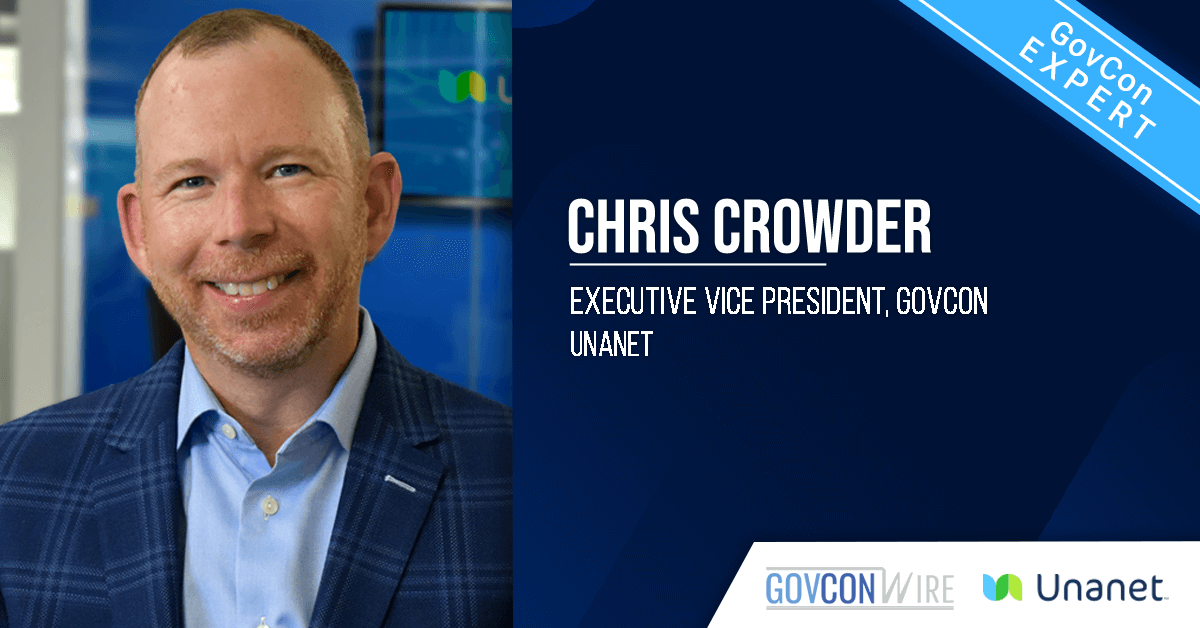

By Chris Crowder, executive vice president, GovCon, Unanet
Across government contracting, many leaders feel good about their pipelines. Opportunity volume looks strong. Backlogs are steady. Capture teams stay busy. On paper, growth appears within reach.
Yet the GovCons that consistently grow are not the ones with the biggest pipelines. They are the ones that understand, with clarity, how much of that pipeline will actually convert and when.
Revenue timing will always move in GovCon. Start dates shift. Awards slide to the right. High-performing organizations accept that reality. They focus on improving how they interpret, align around and act on pipeline signals long before the period closes.
Hear more from Chris Crowder, who will serve as a panel moderator at the Potomac Officers Club’s 2026 GovCon Executive Leadership Summit on Feb. 26. Secure your seat here.
Confidence Is Not the Issue, Interpretation Is
Your pipeline captures what is possible. Your forecast should reflect what is likely, given how your business really performs. The gap between those two views is where many teams lose confidence.
Often, pipeline confidence is well founded. You have strong customer relationships. You are the incumbent in key programs. Capture feedback is positive. Your past performance is solid. None of that should be ignored.
High-performing GovCons take those signals and sharpen them with data. They look at historical win rates by agency and contract type. They study how long work typically sits in each pipeline stage. They factor in how ready they are to deliver if they win. That mix of insight turns a confident story into a credible forecast.
As contract and program complexity grow, these organizations are careful not to let optimism quietly change win probabilities or award dates. They adjust assumptions early, revisit them often and treat forecasting as an active discipline, not a one-time exercise at quarter end.
The goal is not to be conservative. The goal is to be precise.
Why Alignment Drives Predictability
Forecasting breaks down when every team brings its own version of reality. Outcomes improve when you align early instead of reconciling late.
High-performing organizations bring business development, finance and operations into a shared view of pipeline health. They use common definitions for each stage so everyone understands what “real” means at that point in the lifecycle. Capture maturity, revenue expectations and delivery readiness are discussed together, not in separate conversations.
This alignment helps leaders spot timing risk sooner. They can pull slips into view while there is still time to react. They can adjust spending plans and hiring decisions with more confidence.
The conversation shifts from “whose numbers are right” to “what is the data telling us together.”
In practice, it is consistency, not complexity, that drives predictability.
Conversion Is a Discipline, Not a Moment
Many teams treat conversion as a single event when the award arrives. High-performing GovCons see conversion as a discipline that strengthens over time.
That shift starts with different leadership questions. Instead of asking only, “How strong is the pipeline?” leaders ask, “How reliably does this pipeline convert?” They look for patterns such as:
- How long do qualified opportunities actually stay in each stage?
- Which signs most often show up in opportunities that close on time?
- Where does timing risk usually emerge, by customer or contract type?
“Pipeline confidence is important, but it’s only meaningful when it’s grounded in how work actually converts,” said John Sisson, EVP of Growth at Unanet. “High-performing organizations connect pipeline activity to real conversion patterns, timing risk and execution readiness. That alignment is what turns forecasting into a leadership advantage instead of a quarter end surprise.”
When teams routinely compare forecasts to actuals, forecasting becomes a learning loop. Each quarter informs the next. Confidence grows, not because the story sounds good, but because it continues to match reality.
What High-Performing Organizations Sanity-Check Before Committing to the Forecast
Top-performing GovCons still use experience and judgment. They just do not rely on instinct alone when it is time to lock the forecast. They pressure-test a small set of fundamentals every time.
They review pipeline aging. Late-stage opportunities are checked against historical behavior. If an opportunity has lingered far longer than normal for that customer or vehicle, they flag it as timing risk or adjust the close date.
They ground win probabilities in real data. Win rates are viewed by agency, contract type and level of competition. A “high probability” label must match what has actually happened in similar pursuits, not just how much the team wants the work.
They validate revenue readiness early. That includes labor availability, pricing, indirect rates and any key partners. The question is not only “Can we win?” but “Are we truly ready to execute when this starts?”
They also model timing risk. Funding cycles, likely onboarding timelines and potential protests are reflected in the forecast instead of assumed away. Finance, business development and operations share these checks so the forecast feels like a shared commitment, not an optimistic guess that one team owns.
Predictability as a Leadership Advantage
The goal of better forecasting is not perfection. GovCon will always involve uncertainty. The real goal is earlier visibility and fewer surprises.
When organizations align pipeline confidence with conversion discipline, leaders start to see meaningful benefits. Investment decisions feel more grounded. Boards and lenders hear consistent, data-backed stories. Delivery teams get more lead time to prepare for new work.
Most importantly, trust improves. When forecasts consistently line up with outcomes, internal conversations shift. Leaders spend less time reacting to last-minute changes and more time planning the next phase of growth.
Pipeline strength will always matter. Yet the most resilient GovCons are defined less by how large their pipelines are and more by how well they understand them.
By pairing strong capture efforts with clear, disciplined conversion practices, you turn forecasting into a strategic advantage. You create a business that is better prepared to grow, even in a competitive market where margins are tight and execution matters. That clarity helps your teams simplify their workday, make confident decisions and focus on delivering work they are proud of.