
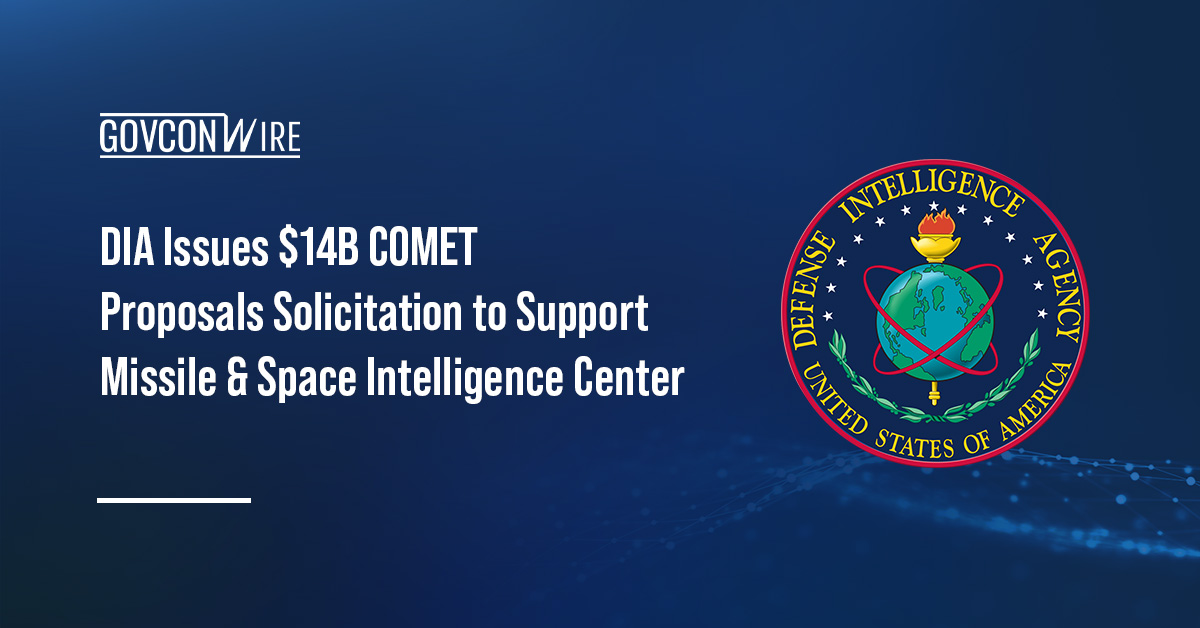

The Defense Intelligence Agency has issued a request for proposals to support the Missile and Space Intelligence Center under the Contract Operations for Missile Evaluation and Testing, or COMET, program valued at up to $14 billion.
According to the RFP posted on SAM.gov Monday, the government will award multiple indefinite-delivery/indefinite-quantity contracts with up to 10 years of performance for the required services.
DIA previously released a draft RFP for the COMET program in 2025 to gather industry feedback ahead of the final solicitation.
Proposals are due April 3.

Explore the technologies transforming intelligence operations at the 2026 Intel Summit on Sept. 24. The event will bring together senior intelligence community leaders and industry partners to discuss how intelligence organizations are transforming to meet current and future requirements. Register today.
What Are the Details of DIA’s COMET Program?
Selected contractors will provide the research, development and sustainment services for new and existing hardware, software and systems that are foundational to military intelligence. DIA said MSIC also needs analysis and analytical enabling services support for the Defense Intelligence Enterprise and its mission partners.
The COMET program spans five mission task areas: foundational and technical intelligence analysis, foreign materiel exploitation, information technology operations, modeling and simulation, and business processes.
What Is the Missile and Space Intelligence Center?
MSIC provides policymakers, homeland security and intelligence community organizations, weapons developers, and warfighters with intelligence assessments of foreign weapon systems.
MSIC analyzes technical signals intelligence, technical intelligence, signature intelligence, geospatial intelligence and open-source intelligence data on anti-tank guided missile, ground-based air defense and missile defense, short-range and close-range ballistic missile, and ground-based direct-ascent and directed-energy anti-satellite missile systems. The center also conducts modeling and simulation to deliver accurate threat representations and research and development of emerging, disruptive and breakthrough technologies.