
- SES reports $994M in Q1 2026 revenue driven by networks growth
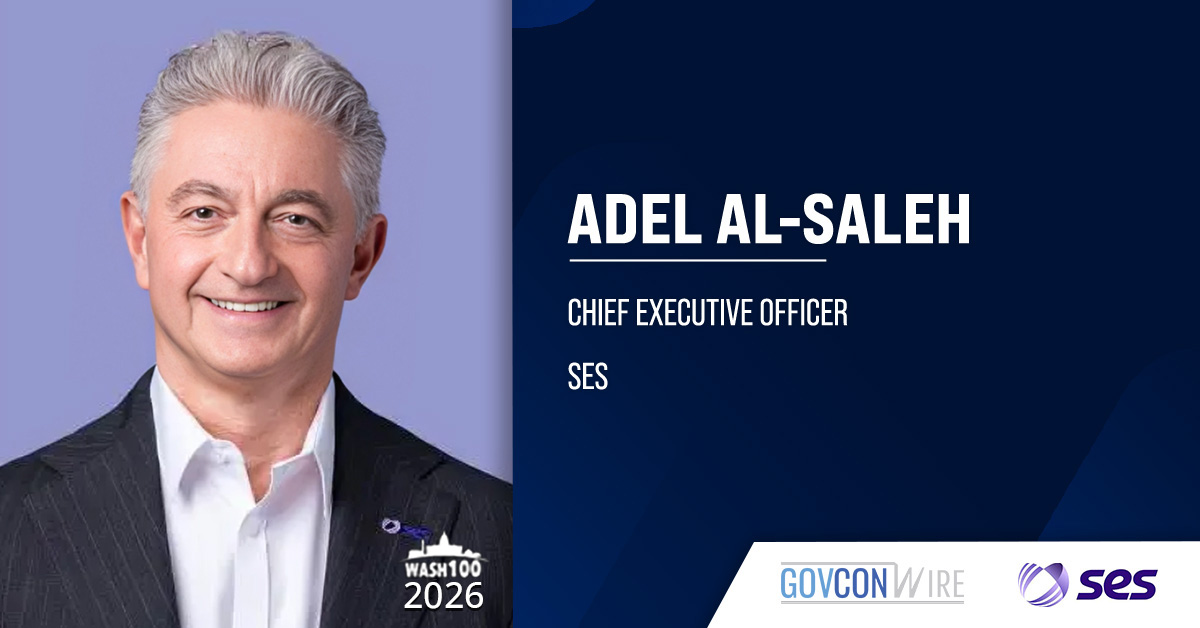
- SES CEO Adel Al-Saleh highlights meoSphere as a next-generation MEO network
- The 2026 Air and Space Summit will examine commercial space relay and other emerging space technologies
SES reported approximately $994 million in revenue during the first quarter of 2026, reflecting an 80 percent year-on-year growth driven by a 106 percent year-over-year increase in networks revenue.

As SES expands its multiorbit capabilities and advances next-generation initiatives such as meoSphere, government and industry leaders continue shaping the future of space and defense connectivity. The 2026 Air and Space Summit on July 30 will bring together executives and decision-makers to discuss commercial space relay, interoperable optical networks and more. Register now to join the conversation.
The Luxembourg-based satellite operator said Tuesday mobility revenue increased 207.8 percent year over year, while government revenue rose 50.7 percent and media revenue grew 42.9 percent.
SES also reported about $359 million in new business and contract renewals signed during the quarter.
The company said O3b mPOWER satellites 9 and 10 started serving customers in February and that satellites 11, 12 and 13 are expected to launch in the second half of 2026.
In March, SES reported $2.94 billion in revenue following the consolidation of satellite services provider Intelsat after its July 2025 acquisition.
What Did Al-Saleh Say About Government Business?
SES CEO Adel Al-Saleh said the company’s government business delivered solid performance during the quarter driven by global government activity and the company’s involvement in the IRIS2 project, which is progressing through the Rendez-vous 1 milestone.
“During the quarter, we also extended the EGNOS GEO-1 satellite service agreement with the European Union Agency for Space Programs, and it was through 2030, ensuring the continued delivery of high-precision, high reliable navigation services for aviation, maritime and other critical users across Europe,” Al-Saleh said during the quarterly earnings call Tuesday.
What Is SES’ Plan for meoSphere?
SES also announced plans to deploy meoSphere, its next-generation medium Earth orbit network targeted for operation by 2030 and is designed to significantly increase the company’s MEO network capacity.
The company said the first phase of the rollout will combine software-defined payloads with 28 K2 Space-developed high-power satellite buses.
Al-Saleh said meoSphere will feature software-defined payloads, optical and RF communications, modular multiorbit architecture, 5G-compatible infrastructure and sovereign network capabilities for government customers. He added that the system will support dynamic capacity allocation, advanced service orchestration and compact plug-and-play terminals designed for mobility and constrained environments.
What Are the 4 Strategic Pillars Guiding SES’ Growth Strategy?
During the call, Al-Saleh told analysts that SES is positioning itself as an integrated space platforms provider combining multiorbit networks, ground infrastructure, software and services supported by a partner ecosystem focused on mission-critical customer requirements.
According to Al-Saleh, the company’s strategy is built around four strategic pillars.
The first pillar, sustained financial strength, focuses on execution, disciplined capital allocation, cash generation and maintaining a resilient balance sheet to support long-term investments.
The second pillar centers on vertical customer solutions across government and defense, aviation and maritime, fixed data and media. Al-Saleh said SES intends to focus on areas where it can provide differentiated value to customers.
The third pillar emphasizes investment in innovation through modular networks, software-defined satellites, hosted payloads and sovereign network capabilities. Al-Saleh said SES is also increasing ownership of its supply chain through verticalization efforts.
The fourth pillar, smart diversification, involves selective expansion into growth areas supported by partnerships and ecosystem models. Al-Saleh cited hosted payloads and direct-to-device initiatives with Lynk Global as examples of that strategy.