
- The Air Force’s operational technology cybersecurity division is seeking a 400 percent budget boost for workforce initiatives to help it better combat advanced persistent threats
- CROCS wants a nascent training pipeline to produce skilled cyber defenders to be available to the Army, Space Force and Navy by the end of 2026
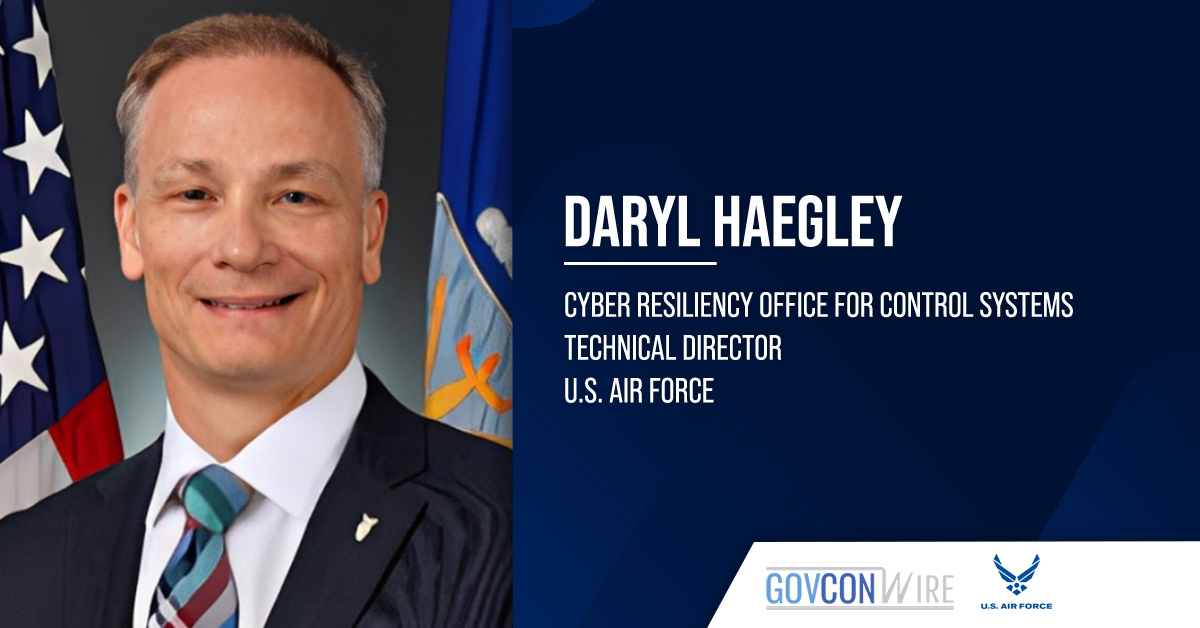
- Hear directly from Daryl Haegley, USAF CROCS technical director, during a panel at the 2026 Cyber Summit on May 21!
The Air Force’s cybersecurity division in charge of operational technology efforts is pursuing a 400 percent budget increase for FY 2027 to better fight advanced persistent threats through a variety of workforce initiatives.
A USAF spokesperson said the Cyber Resiliency Office for Control Systems, or CROCS, is seeking $100 million in FY 2027. If approved by Congress, this would be a 400 percent increase from the $20 million enacted in FY 2026.
Daryl Haegley, Air Force Cyber Resiliency Office for Control Systems, or CROCS, technical director, told GovCon Wire in an exclusive interview ahead of his appearance at the Potomac Officers Club’s 2026 Cyber Summit on May 21 that one of his top priorities in 2026 is better developing and fielding skilled cyber defenders. CROCS, he said, is creating a training pipeline to help its cyber practitioners better identify threats.
Many of these advanced persistent threat assessments, he said, are being done by contractors. But Haegley wants a core cadre of military staffers to lead, and be part, of these teams. He hopes for this pipeline to start creating advanced cyber pros by the end of the year so the USAF can open it to the Army, Space Force and Navy.
Hear directly from Haegley during his Combating Advanced Persistent Threats panel discussion at the Potomac Officers Club’s 2026 Cyber Summit on May 21! Dig into detecting and disrupting long-dwell adversaries and public-private cyber defense collaboration with other esteemed federal experts including:
- Stephanie Walker, FBI cyber national security intelligence section chief
- Dr. Jeremy Kepner, MIT Lincoln Laboratory fellow
- Davey Gibian, Pentagon deputy chief digital and artificial intelligence officer for warfighting.
What Is the Air Force’s CROCS Cyber Unit?
The Air Force’s CROCS cyber unit is a division founded in 2024 to oversee and coordinate control system, OT and critical infrastructure cybersecurity. Early initiatives for CROCS included governance, visibility and prioritization activities, workforce, and transforming OT response and defense, according to DefenseScoop.
Adversarial nation-states are performing cyber attacks on utility, water and power systems worldwide. Haegley said he wants people who can recognize a serious problem with advanced persistent threats and take action.
CROCS additionally wants to build a unique training regimen for OT to improve its monitoring and defense capabilities. Haegley said many OT systems can’t be “pinged” for information, requiring the USAF to install passive sensors and ensure the resulting information is shared with cybersecurity experts.
This is critical, he said, because much of this information resides with OT owners and operators who aren’t skilled in cybersecurity. CROCS, as part of this effort, is leading an initiative to finalize OT as a standard cyber workforce role with competencies available to the rest of the federal government.
What Is Operational Technology?
Operational technology is the software and hardware that monitor, automate and control physical processes and infrastructure in industrial settings. It supports essential infrastructure, such as power grids, industrial manufacturing facilities and transportation systems.
The systems and layers that manage industrial operations; including sensors, controllers, networks and control software that work next to valves, motors, pumps and other components; compromise OT. While IT focuses on data processing and storage, OT ensures physical devices run safely and reliably.
The Potomac Officers Club’s 2026 Cyber Summit on May 21 is the premier forum for evaluating business opportunities in the growing realm of cybersecurity. Hear about new requirements and partnership opportunities from our slate of keynotes by all-star national security cyber professionals:
- Aaron Bishop, Pentagon acting principal deputy chief information officer and chief information security officer
- Chris Butera, Cybersecurity and Infrastructure Security Agency acting executive assistant director
- Michael Duffy, Office of Management and Budget acting federal CISO
- Will Loucks, White House Office of the National Cyber Director senior director for intelligence
- Katherine Sutton, Pentagon assistant secretary for cyber policy
- Rear Adm. Jason Tama, Coast Guard Cyber Command chief
Tickets are selling fast and seating is limited for his highly-anticipated GovCon event. Secure your seat now!
The USAF is trying to figure out how to protect these OT systems when they are not connected to an enterprise network. Haegley said 70 percent of USAF OT systems are disconnected while close to 80 percent are based on legacy technologies such as Microsoft’s Windows 7 operating system, which was released in 2009. This is one reason why so many OT systems are disconnected, he said.
What Is Daryl Haegley’s Advice for GovCons?
Haegley advises GovCons to align and map solutions to zero trust, an IT security model that requires strict identity verification for every person and device trying to access resources on a private network. This is regardless of whether they are within, or outside, a network perimeter. He also expects partnerships as part of industry offerings and is encouraging industry teams to provide laboratory verification of their solutions to prove their capabilities.
If CROCS gets to a pilot on the verge of implementation, Haegley recommends contractors tell the USAF the support they need to deliver, including connections, data and format. He would like to be offered cyber as-a-service in the OT space so that a non-government team could maintain and secure equipment on, for example, an on-base utility, and respond to an identified threat vector. This is instead of having the USAF do everything in-house.