
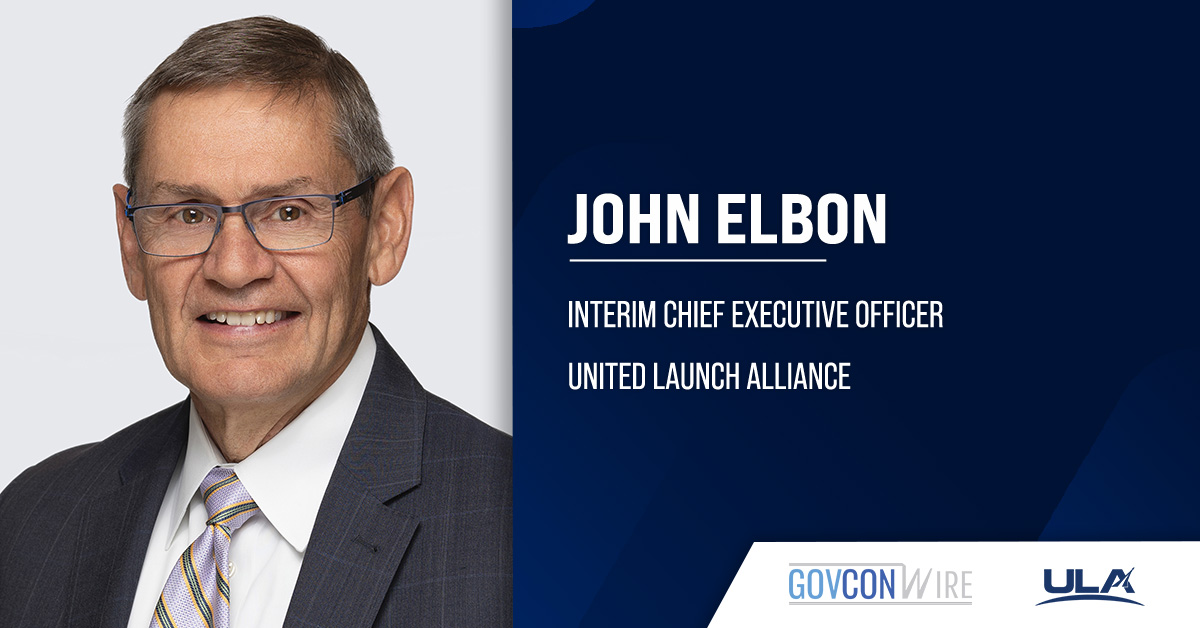

United Launch Alliance has announced a leadership transition, with longtime President and CEO Tory Bruno stepping down after nearly 12 years at the helm. The decision was confirmed in a joint statement issued Monday by ULA board chairs Robert Lightfoot and Kay Sears. All three executives are past recipients of the Wash100 Award.
Bruno is departing the company to pursue another opportunity. The board thanked him for his service, citing his role in guiding ULA through a period of significant change and positioning the company for its next phase of launch operations.
ULA is a joint venture of Boeing and Lockheed Martin.
Who Is John Elbon?
John Elbon was appointed interim CEO, effective immediately. Elbon most recently served as ULA’s chief operating officer, overseeing operations across the Atlas, Delta and Vulcan Centaur launch vehicle programs, including engineering, integration, production, quality assurance and program management.
Lightfoot and Sears said they “have the greatest confidence” in Elbon to sustain ULA’s momentum while a formal search for the company’s next permanent chief executive is underway. He will work alongside Mark Peller, who was named COO, as ULA advances toward key Vulcan milestones.
Elbon joined ULA in 2018 after a 35-year career at Boeing, where he held senior leadership roles across civil, defense and space programs. His experience includes managing Boeing’s space exploration portfolio, supporting NASA programs such as the International Space Station and the Commercial Crew Development program.
He holds a bachelor’s degree in aerospace engineering from the Georgia Institute of Technology.
The leadership transition comes as ULA continues to support the U.S. Space Force’s National Security Space Launch program. The company is a core provider of launch services to the program under a multibillion-dollar Phase 2 contract that has been expanded through contract modifications covering launches scheduled between fiscal years 2022 and 2027.
ULA is also one of three companies selected for Lane 1 of NSSL Phase 3, a 10-year, $5.6 billion multiple-award vehicle designed to ensure assured access to space through a mix of competitive launch task orders. Under that structure, ULA will compete with SpaceX and Blue Origin for future missions as the Space Force transitions toward a more flexible, dual-lane launch acquisition model.