


- The Air Force is accelerating AI deployment at the tactical edge to accelerate threat detection and response, but data and security challenges remain
- In its AI-First Strategy, DAF is prioritizing automated multi-level security to ensure that warfighters maintain access to critical information
- The 2026 Air and Space Summit on July 30 will host a dedicated panel on AI-powered multi-level security
The Department of the Air Force sees potential in artificial intelligence to secure a decision advantage on the battlefield. The service is cutting through red tape to accelerate the development and fielding of advanced AI capabilities to support missions. However, bringing AI to the tactical edge is creating complex challenges in data and security.

Air Force leaders will share insights about the service’s current and future AI initiatives and discuss other AI-related requirements during the From Data to Decision: Advancing Multi-Level Security With AI/ML for the Modern Warfighter panel at the 2026 Air and Space Summit on July 30. The panel will be a deep dive into AI-enabled threat analysis, data sharing across classification levels and delivering advanced multi-level security architectures to warfighters. Sign up today to secure your seat!
Why Is Data Classification a Challenge for DAF’s AI Efforts?
DAF’s AI push is encumbered by a long-standing problem: data silos. AI requires large pools of data, but information in federal environments is often designated classifications, restricting who can access what data and when. This creates a complex landscape for AI integration.
Ron Wilcom, director of innovation for Clarity Business Solutions, discussed the problem in an article published on Federal News Network.
He explained that most government AI use cases pair a general-purpose large language model with proprietary mission data using retrieval-augmented generation, or RAG. When the retrieval system does not strictly enforce classification levels, an AI could pull a classified document that an analyst is not cleared to access, leading to data spills.
Wilcom recommended a “semantic index with strong, attribute-based filtering” rather than creating separate data bins, which could lead to lost context or operational complexity. He also proposed keeping models and prompts inside the security enclave to ensure that sensitive information does not cross boundaries.
What Is Multi-Level Security?
The Air Force is pursuing a concept called multi-level security, or MLS. According to the National Institute of Standards and Technology, MLS allows information at different classification levels to coexist within the same system while ensuring that each user only sees what their clearance level permits.
The Air Force highlighted the importance of MLS in its AI-First Strategy. Published in April, the document calls for a cloud-to-edge infrastructure that automates security pipelines and delivers immediate access to critical intelligence to warfighters.
“The multi-level security foundation allows models built in lower classification environments to be securely elevated to higher networks, enabling scalability, interoperability and rapid capability delivery,” a service spokesperson shared in a statement to GovCIO Media & Research.
The service recently awarded General Dynamics Information Technology a $120 million task order to provide an AI-powered, data-centric cybersecurity system that can secure information at all classification levels. The system, called Everest Zero Trust Digital Accelerator, will be implemented at 187 military bases worldwide, Airforce Technology reported.
Why Does the Air Force Want AI at the Tactical Edge?
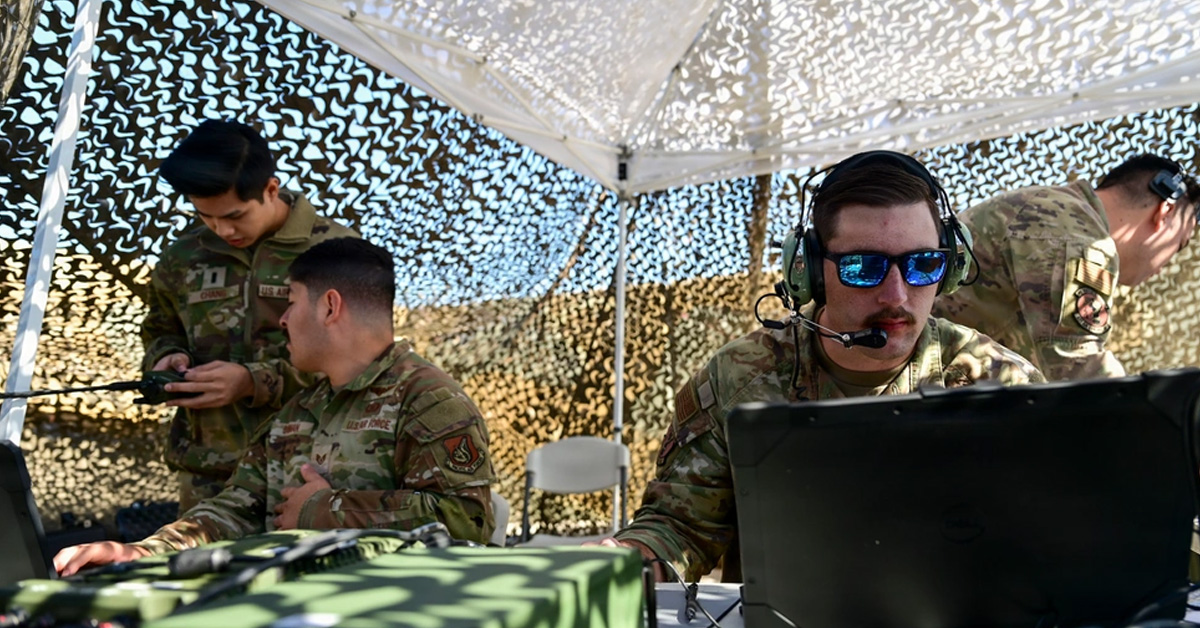
Despite the challenges, the Air Force is developing AI for a number of potential battlefield use cases. Recent experiments, such as the Decision Advantage Sprint for Human-Machine Teaming, or DASH, and the Multi-Decision Advantage Sprint for Human-Machine Teaming, or MASH, wargames have seen DAF employ AI and automation services to battle management and strengthen warfighter lethality.
One AI use case that the military is pursuing is to accelerate the process of threat analysis at the edge to protect assets and personnel.
For instance, Maj. Christopher Huynh, an AI and data officer for the U.S. Space Force, explained that AI can be deployed on a satellite for an autonomous response to adversary activities in orbit. He writes in an article published on Apogee Magazine that putting AI in space reduces the amount of time it takes to sense and counter a threat.
“Until quite recently, these complex calculations relied on first sensing the threat, computing possible response options using powerful computers on the ground, and then uploading a series of commands for the satellite to execute,” he said. “These critical minutes or hours could determine the life or death of a satellite.”
DAF is also exploring AI deployment for military drones, autonomous platforms and aircraft to support future defense missions.
The Air Force recently demonstrated the capability to run AI workloads in operational conditions using SAKURA-II, an AI accelerator from Japanese semiconductor company EdgeCortix.
During an exercise, SAKURA-II was integrated into a mission system and flown as part of a large-scale operation, Interesting Engineering reported. The technology validated its ability to deliver AI inference with minimal power consumption.
AI & Security Contract Opportunities for GovCons at DAF
Foundations of Trusted Systems
Contract value: approximately $99.9 million
DAF issued a broad agency announcement in March for research in technologies and techniques for the establishment of trusted foundations for hardware and software in support of secure and resilient command, control, communications, computers, intelligence and cyber information processing systems.
White papers will be accepted until December 2028, but the deadline for FY27 funding consideration is Sept. 2, 2026.
Next-Generation Air Operations Center Weapon System
Contract Value: not listed
The Air Operations Center Program Office of Kessel Run, the Air Force’s software factory, intends to upgrade its Air Operations Center Weapon System by providing planners and operators at combatant commands with AI-powered tools under the Next-Generation AOC Weapon System effort. According to a request for information issued in May, requirements include impact level 6 and above for cloud capabilities and secret-or-higher edge computing technologies.
While the Air Force has not issued a procurement timeline, the service has signaled that it intends to issue a bidder’s library with a draft solicitation in the future, DefenseOne reported.
Advanced Tracking Architecture Using AI
Contract value: Approximately $99 million
The Air Force Research Laboratory published an advanced research announcement, or ARA, to support research on innovative technologies for Next-Generation Target-Tracking architectures that integrate data from diverse sources and utilize AI within high-performance computing frameworks.
The ARA is open to white papers until July 12, 2029, but submissions for the next project funding are due on Nov. 30, 2026.
Where to Hear More About Multi-Level Security and AI at the Tactical Edge?
At the Potomac Officers Club’s 2026 Air and Space Summit on July 30, leaders from the Air Force will sit down with executives from the defense industry to discuss the challenges of bringing AI to the tactical edge during the From Data to Decision: Advancing Multi-Level Security With AI/ML for the Modern Warfighter panel.
Panelists include:
Col. John Ohlund
Advanced Battle Management System Cross-Functional Team Lead, U.S. Air Force
Col. John Ohlund oversees the development and delivery of digital infrastructure, architecture and software requirements of the DAF Battle Network as the director of the Advanced Battle Management System Cross-Functional Team, a role he has held since June. Prior to his current role, he served as commander of the 805th Combat Training Squadron. He also previously served as assistant director of operations for the 621st Air Control Squadron and operations officer for Cruise Missile Support Activity-Atlantic.
Steven Butow
Senior Adviser to the Director & Executive Committee Member, Defense Innovation Unit
Steven Butow joined the Defense Innovation Unit in 2015 as the West Coast military lead and helped establish agency presence in Silicon Valley, California; Boston, Massachusetts; and Austin, Texas. In 2016, he was appointed DIU’s first space portfolio director.
As adviser to DIU Director Owen West, he guides agency efforts to align with Joint Force needs.
Ilya Levtov (Moderator)
CEO, Craft
Ilya Levtov co-founded and leads Craft, a supplier intelligence platform for government and enterprise procurement. He also serves as chair of the Digital Supply Chain Institute, an organization focused on promoting digital supply chain transformations.
His career includes senior leadership positions at Crunchyroll, VenRock and Deutsche Telekom.
Randy Fields
Vice President & Chief Technology Officer, Ultra I&C
Randy Fields has extensive experience in the U.S. military and the defense industry. He currently leads technology strategy and drives innovation as vice president and chief technology officer at Ultra I&C. His industry experience also includes leadership roles at Cubic Digital Intelligence and Northrop Grumman.
He began his career in 2001 as a Navy cryptologic technician and served as a Navy Reserve cryptologic warfare officer from 2016 through 2024.
Dr. Merrick Watchorn (Pending Confirmation)
Chief Cyber, Quantum & Cognitive Information Services Architect, U.S. Air Force
Dr. Merrick Watchorn is an industry-respected technology expert who has served in leadership roles at MANTECH. He also chaired the Quantum Security Alliance, a group established to address the cryptographic threat of quantum computing. He served in the Navy earlier in his career.
Joseph Fraier
Senior Industrial Policy Analyst