
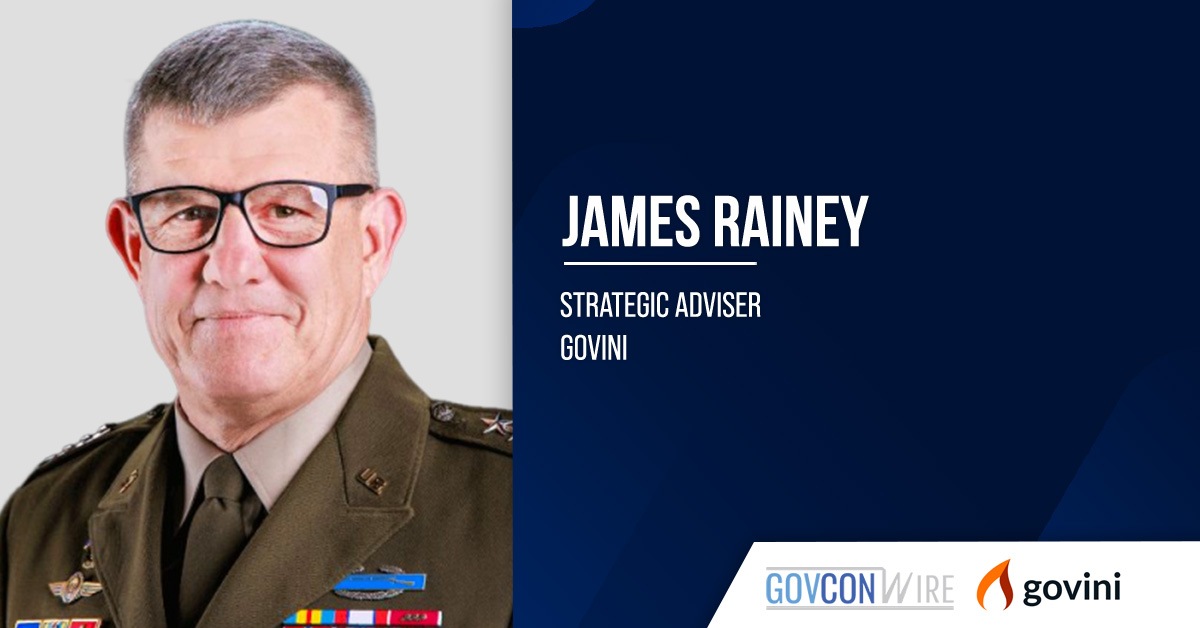

- Retired Gen. James Rainey, who led Army Futures Command until his retirement, has signed on as a strategic adviser to defense acquisition software firm Govini
- He will support the company’s executive team in matching emerging technologies to warfighter requirements
- During his Army career, Rainey championed rapid experimentation and data-driven command and control
 Retired U.S. Army Gen. James Rainey, former commanding general of Army Futures Command, has joined Govini as a strategic adviser. The defense acquisition software company announced the appointment in a LinkedIn post Wednesday.
Conversations about accelerating capability delivery and connecting emerging technology with warfighter needs will take center stage at the Potomac Officers Club’s 2026 Army Summit on June 18 in Virginia. Six months into the rollout of the Acquisition Transformation Strategy, the 11th annual gathering will bring together Army leaders — including Lt. Gen. Robert Collins, director of Army Acquisition Corps — and industry executives to explore unmanned systems development, the acceleration of commercial solutions, expanded AI usage and the push toward an interconnected battlefield. Register now to join the discussion.
In the said role, Rainey will work with Govini’s executive team to help connect emerging technology with warfighter needs, drawing on a 38-year Army career focused on modernization, data-driven operations and faster capability delivery.
Rainey said he spent his final years in uniform working to change how the service develops and fields capability, and that joining Govini lets him pursue the same challenge from the industry side. “Throughout my career, I’ve seen firsthand that modern war demands faster decisions grounded in trusted, integrated data solutions,” he noted.
Govini CEO Tara Murphy Dougherty said Rainey understands the consequences when data, technology and acquisition timelines fail to keep pace with the mission.
“His leadership on critical modernization efforts demonstrated how the Department of War can break from legacy processes, partner differently with industry, and deliver integrated capability faster,” she added.
Who Is James Rainey?
Rainey retired as a four-star general after leading Army Futures Command, the service’s modernization enterprise, where he oversaw efforts to streamline how the Army develops and delivers new technology. His tenure saw the introduction of Next Generation Command and Control, software procurement advancements and the continuation of Project Convergence, the Army’s annual experimentation exercise for testing emerging technologies alongside joint forces. He described those efforts as the Army’s most ambitious transformation since World War II.
Rainey was also the architect of the Army’s transformation in contact approach, which emphasizes rapid experimentation and putting new capabilities directly into soldiers’ hands for operational testing and feedback. Speaking at the Army Global Force Symposium in 2024, he outlined a three-horizon transformation framework — spanning 18 to 24 months, two to seven years, and seven to 15 years — designed to keep the service flexible as the warfighting environment evolves, with near-term fielding of counter-drone systems, robotics and human-machine integrated formations.
Before taking the helm of Army Futures Command, Rainey served as the Army’s deputy chief of staff for operations, plans and training, or G-3/5/7. His command assignments included the 3rd Infantry Division, the Army Combined Arms Center at Fort Leavenworth and Combined Security Transition Command-Afghanistan. He began his career as an Army infantry officer.
How Does the Move Fit Rainey’s Post-Retirement Work?
The Govini appointment expands Rainey’s advisory portfolio in the defense technology sector. In May, he joined ground autonomy company Overland AI as an adviser, where he provides strategic guidance on operational integration, force design and scaling autonomous ground systems from experimentation to adoption.
Rainey previously said that uncrewed and robotic platforms will reshape land warfare and that the service is obligated to keep soldiers out of unnecessary danger — a view that has guided his advocacy for data-driven command and control as a potentially decisive shift in how wars are fought. Those positions align with the focus of both companies he now advises.
Govini builds software aimed at modernizing defense acquisition. The company said Rainey’s addition supports its goal of turning acquisitions into a strategic advantage.