
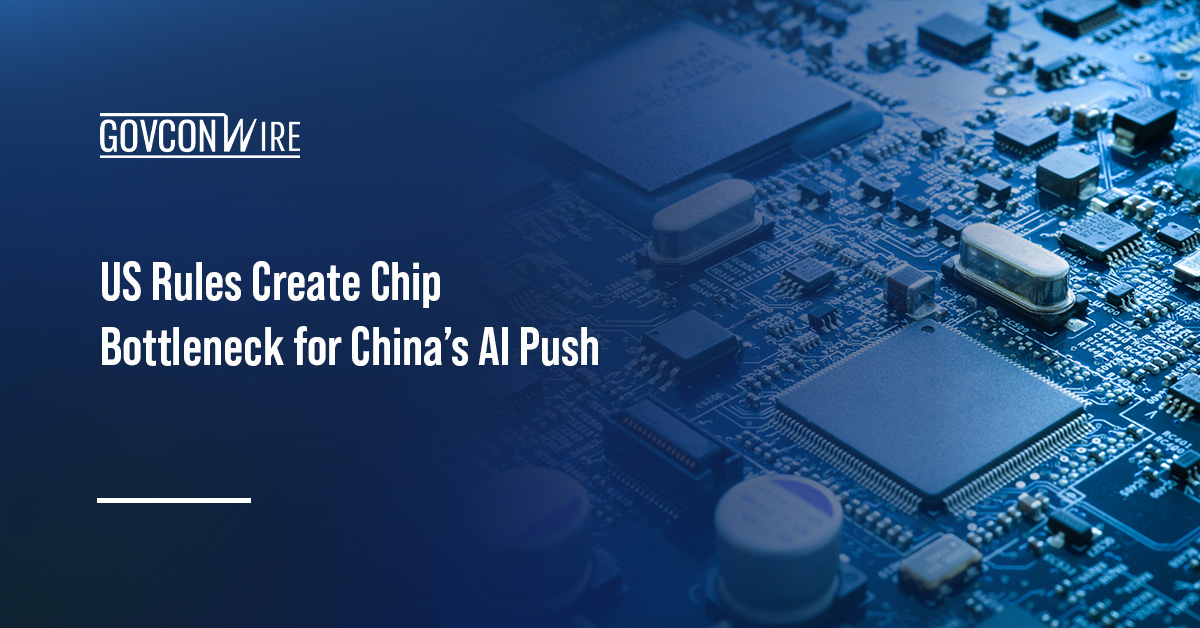

Some Chinese artificial intelligence developers said China’s efforts to catch up with the U.S. in AI are being slowed by a bottleneck in access to advanced chips, The Wall Street Journal reported Thursday.

As U.S. policy continues to shape the direction of AI at home and abroad, industry and government stakeholders are watching closely how these decisions play out. The Potomac Officers Club will host its 2026 Artificial Intelligence Summit on March 18, offering a forum for leaders across government and industry to connect on AI developments. Sign up now to join the conversation.
U.S. export controls that limit the Asian country’s access to the most advanced AI chips have discouraged many Chinese companies from pursuing cutting-edge AI, which requires massive computing power.
“The truth may be that the gap is actually widening,” said Tang Jie, founder of the Chinese AI startup Zhipu, said at a conference last weekend in Beijing. “While we’re doing well in certain areas, we must still acknowledge the challenges and the disparities we face.”
How US Export Rules Are Shaping NVIDIA’s AI Chip Sales?
In early January, NVIDIA launched its next-generation Rubin hardware. While U.S. companies are first in line for NVIDIA’s Rubin chips, Chinese firms are barred from direct purchases due to existing U.S. rules and must rely on indirect, often cumbersome arrangements overseas, according to WSJ.
What Is NVIDIA Rubin?
Rubin is NVIDIA’s next-generation AI chip platform comprising six new chips designed to deliver an AI supercomputer. It uses extreme codesign across these chips to reduce training time and inference token costs.
The platform introduces the Transformer Engine, NVIDIA Vera CPU, Confidential Computing, RAS Engine and the latest generations of NVIDIA NVLink interconnect technology designed to accelerate the development of agentic AI and mixture-of-experts model inference.
Why Efficiency Gains Are Not Enough to Close the US-China AI Gap?
Chinese firms, such as DeepSeek and Alibaba, have made progress by improving training efficiency and releasing open-source models, narrowing the performance gap with top U.S. systems. But industry executives acknowledge that domestic chips still lag far behind the most advanced American hardware.
According to people in the industry, the Trump administration’s recent approval to allow NVIDIA to sell H200 chips to China is unlikely to alter the competitive balance as U.S. companies continue to race ahead with newer, more powerful systems.
What Steps Is the US Taking to Achieve Global AI Dominance?
The U.S. government is working to maintain and expand its global leadership in AI through legislative action, executive policy and strategic export controls.
In December, a bipartisan House bill was introduced to strengthen the enforcement of U.S. export controls to prevent U.S.-made AI chips and other sensitive technologies from being smuggled into foreign adversaries. A bipartisan group of senators proposed the GAIN AI Act, a measure that would require chipmakers to give U.S. companies, startups and universities priority access to advanced AI chips before exporting them to China or other countries of concern.
In July 2025, the White House unveiled its AI Action Plan outlining over 90 federal policy actions across three pillars: accelerating AI innovation; building American AI infrastructure; and leading in international AI diplomacy and security.
In December, President Trump signed an executive order directing the attorney general to establish an AI litigation task force to challenge restrictive state AI laws that could potentially hinder innovation.