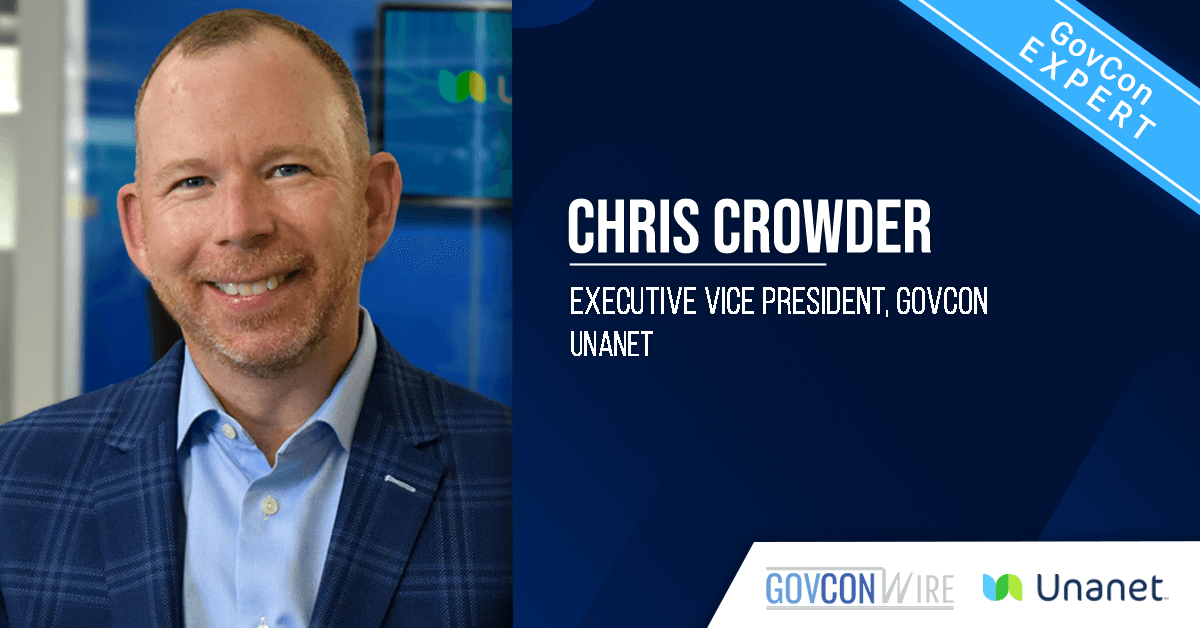

By Chris Crowder, executive vice president, GovCon, Unanet
As government contractors close out and reset for the year ahead, one reality is becoming clear: 2026 will reward discipline, not optimism. To make 2026 a defining year, organizations should convert recent lessons into more disciplined, repeatable execution.
Over the last several years, many GovCons have been operating in survival mode. Pandemic disruption, labor volatility, delayed awards and shifting agency priorities forced teams to move fast and make decisions with imperfect information. Growth strategies leaned heavily on pipeline volume, manual forecasts and the assumption that teams would figure it out during execution.
While this approach can occasionally work, it is unreliable and exposes GovCons to unnecessary risk.
Expectations Are Tightening Inside & Outside the Organization
Federal agencies are approaching purchasing decisions more deliberately, placing greater emphasis on past performance and value. Budgets are constrained, recompetes are increasingly competitive and past performance is under greater scrutiny. At the same time, GovCons are aligning growth plans more closely with operational capacity.
With labor costs elevated and compliance requirements continuing to mature, leadership teams are leaning more heavily on reliable data to support forecasts, margins and staffing decisions. Organizations that pair disciplined execution with operational transparency are well-positioned to build confidence and move forward with clarity.
Forecasting Has Become a Credibility Issue
Forecasting has always been a core discipline in GovCon, and today it carries even greater strategic importance as the tolerance for inaccuracy is shrinking. Forecasts often live in disconnected systems and spreadsheets that don’t reflect the delivery reality. While many organizations express strong confidence in their pipelines, the opportunity lies in strengthening the connection between forecasts and execution to improve predictability and outcomes.
The path forward is less about working harder and more about working together. Forecasts that are informed by integrated data—linking business development, delivery capacity, utilization trends, rate structures and program-level margins—give leadership teams a clearer, shared view of performance. When finance, operations and growth teams operate from the same assumptions, decisions become more proactive, aligned and confident.
In 2026, credibility will be a defining factor in achieving strategic goals. Organizations that can demonstrate reliable forecasts, disciplined execution and consistent performance against commitments will earn greater trust from agencies, auditors and investors alike. That trust translates into faster decision-making, stronger partnerships and increased flexibility to pursue growth opportunities with confidence.
The PMO Is Becoming a Leadership Asset
More GovCons are rethinking the role of the program management office, or PMO. What was once viewed primarily as a reporting or compliance function is increasingly becoming a strategic control point.
Organizations with mature PMOs are better positioned to connect contracts, resources, schedules and financial performance. That visibility allows teams to identify delivery risk earlier, align staffing plans with real demand and protect margins at the project level.
This isn’t about adding process. It’s about giving leadership clear and timely performance signals.
The GAUGE Report shows that companies that have a PMO are 4.5x more likely to have very mature project management practices and 2.5x more likely to have very mature resource management practices.
“Good Enough” Systems Create Hidden Risk
Many GovCons have managed complexity using a patchwork of tools—CRM for pipeline, spreadsheets for forecasting, point solutions for project tracking and ERP for accounting. In more stable environments, that approach was workable. Under today’s conditions, it isn’t.
When margins are thin, contracts are complex and conditions are dynamic, leaders need connected visibility across the full lifecycle—from opportunity to delivery to financial performance. Without it, risk surfaces too late and decisions are made with incomplete and/or inaccurate information. In 2026, disconnected systems increasingly represent hidden operational risk.
Firms with PMOs still rely on spreadsheets to forecast labor, but with a few differences. They are 40% more likely to use integrated tools and 40% less likely to perform manual calculations than those without a PMO.
Where AI Fits & Where It Doesn’t
Artificial intelligence remains part of the conversation, but expectations have matured. GovCons are moving past experimentation and focusing on practical use cases that deliver measurable value—improving proposal quality, highlighting forecasting gaps and identifying utilization risk.
At the same time, AI doesn’t fix broken processes or poor data. It amplifies what already exists. Without operational discipline, AI investments will fall short.
The GAUGE AI Supplement showed a meaningful year-over-year increase from 2024 to 2025 in the number of companies using AI. While companies are seeing early efficiency gains from AI in business development, operations and project management, accounting and finance remain underutilized areas with meaningful opportunity for future impact.
Discipline Will Define the Next Phase of Growth
The GovCon market remains active with so much optimism, but capital, contracts and confidence are flowing toward firms that demonstrate financial and operational discipline. Agencies, auditors and investors are increasingly aligned in what they reward: credible forecasts, controlled growth and the ability to consistently deliver on their commitments.
Looking ahead to 2026, the strongest GovCons will distinguish themselves by forecasting with accuracy, aligning pipeline ambition to delivery capacity and investing in integrated visibility across finance, programs and operations. These organizations will treat execution discipline as a lever for margin protection, audit readiness and scalable growth, not simply as a compliance exercise.
For CFOs and executive leadership teams, the takeaway is clear. Discipline is no longer about constraint; it’s about credibility. Firms that can demonstrate control over their numbers, resources and execution will earn greater trust, move faster when opportunities emerge and position themselves for sustained growth in an increasingly selective market.
For leadership teams, the message is straightforward: discipline is no longer a best practice—it’s a requirement.
Disciplined growth requires real-time visibility across financials, projects and pursuits. Unanet helps government contractors unify these areas with AI-first ERP and growth software. Learn more at unanet.com.