Author: Summer Myatt|| Date Published: May 4, 2022
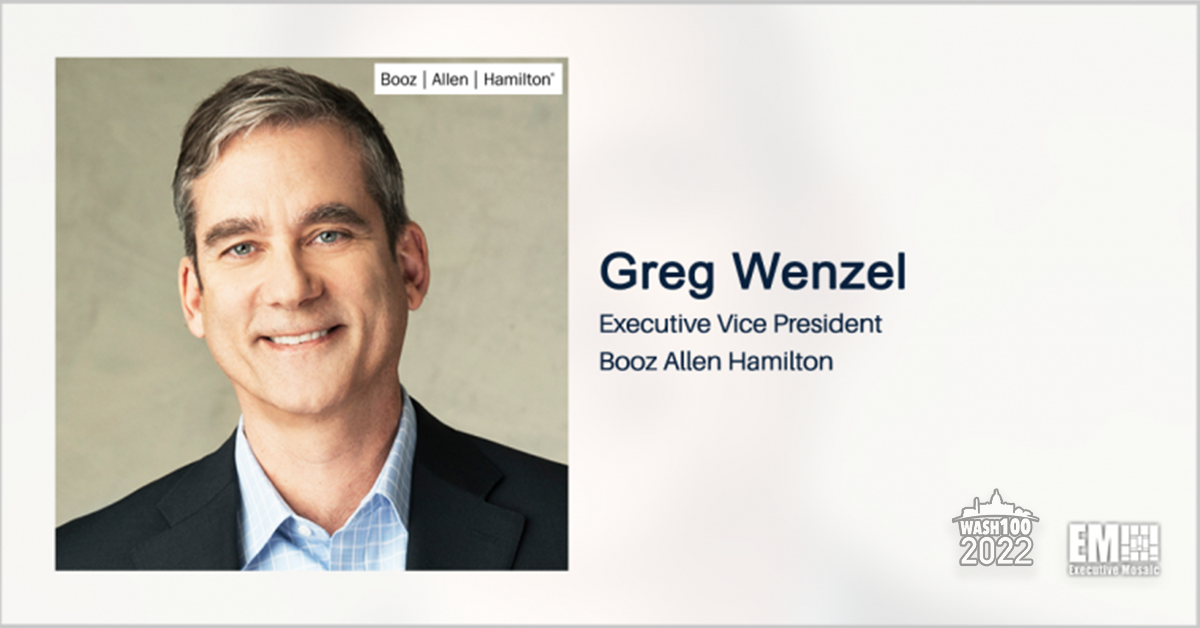
The United States’ near-peer adversaries have the same technologies that we do, but on a much larger scale. The only way to be survivable in the near-peer fight of the future is to “be able to be networked, agile and lethal,” according to Greg Wenzel, executive vice president and a leader in Booz Allen Hamilton’s global defense business unit.
Wenzel, a four-time Wash100 Award winner, said the Department of Defense needs to stitch together its array of command and control systems, data fabric initiatives and DevSecOps pipelines in order to truly achieve joint all-domain command and control.
“The one thing I would say we need to think about under JADC2 is how do we operate as a DOD enterprise?” Wenzel asked in a video interview with Executive Mosaic.
He also highlighted the importance of mission partner information sharing as a key element in winning the future fight. “We’re going up against Goliath,” Wenzel analogized, “so we have got to be networked. And it’s not just the U.S., it’s with our coalition partners. When our adversary knows that we are united and connected in a coalition environment, they’ll think again” about making certain geopolitical moves, he explained.
The Department of State has awarded spots on a multiple-award indefinite-delivery/indefinite-quantity contract with a combined potential value of $10 billion…
Brian Hobbs has been appointed CEO of Clarity Innovations, effective March 2, the company announced Tuesday. He succeeds founder and long-serving CEO Wes…
The Federal Aviation Administration has awarded a potential five-year, $437.4 million contract to ASRC Federal Advanced Research to provide second-level…