
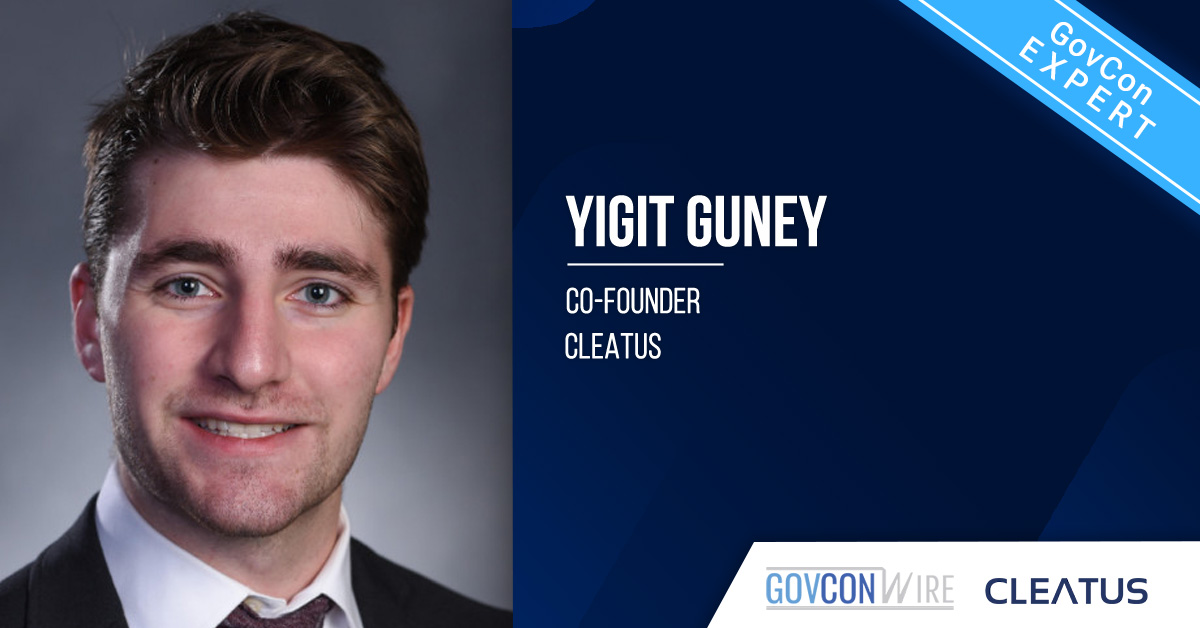

By Yigit Guney, co-founder of CLEATUS and one of Executive Mosaic’s GovCon Experts.
A procurement forecast gives a capture team an agency, a rough scope, and a date that will probably move. It does not tell the team whether the pursuit deserves money. That depends on questions the forecast cannot answer, such as which partner’s projects the agency will count when it scores experience. Change that one rule and the team changes, the evidence changes, and the pursuit may not be worth funding at all.
My standard is simple. A forecast earns its place in the pipeline when someone can state the reason to pursue it, owns the work of testing that reason, and has named the condition that would end it. Those three answers establish accountability. They have not yet established a capture plan. The plan adds the next action, its deadline, and the money and people committed to it. Artificial intelligence has a real role in that work. Collecting more forecasts is not the measure of whether it is helping. Changing those answers is.
Procurement Forecasts, Inferred Recompetes & Solicitations Carry Different Certainty
Early capture runs on three kinds of records, and they do not all deserve the same level of trust.
- An official procurement forecast is an agency’s published statement of what it expects to buy, roughly when, and sometimes through which acquisition approach. It is a basis for researching the customer, the likely scope and the timing. The General Services Administration encourages early engagement while warning that forecast opportunities may change or be canceled.
- An AI-inferred recompete is a prediction that an existing award will be competed again, built from the award record and its potential end date. CLEATUS publishes these as pre-forecasts based on USASpending award data. The end date is a reason to investigate the continuing requirement. It does not establish that the agency will buy the same work through the same vehicle. An extension, a consolidation, or a different acquisition approach could change the opportunity entirely.
- A published solicitation, such as a request for proposals, or RFP, is the document set the agency will actually evaluate against: instructions, evaluation criteria, attachments, and amendments. A forecast entry cannot settle whether a partner’s project will count toward an evaluation. That answer lives in the solicitation documents.
An official forecast can describe a recompete. The distinction is whether the agency announced the planned procurement or a model inferred it.
Put all three in one pipeline and the view is useful only while their dates, sources, and status stay visible. Lose that, and an estimate quietly becomes an assumption. That is how teams spend proposal money on a date somebody guessed.
Tie the Forecast to Its Identifier & Its Incumbent
The Department of Homeland Security’s Program Management, Administrative, Clerical, and Technical Services, or PACTS, III procurement is a historical example worth following in order. U.S. Citizenship and Immigration Services listed it in its Oct. 25, 2022, industry briefing. Page 12 identifies forecast F2022059380, and the draft solicitation notice cites the same identifier. That number connects the early planning record to the later procurement without relying on a similar title, which is how two different procurements get confused.
When a solicitation does not cite the forecast identifier, the connection must be inferred. That is why CLEATUS links a forecast to the solicitation that follows it and shows each match with a confidence score, strongest first. The link is inferred rather than declared, and a capture manager should see which. Incumbent research needs the same care. For the predecessor, PACTS II, the companies holding the vehicle and the companies performing relevant task orders answer different capture questions. A vehicle roster establishes who had access. Task-order research establishes who delivered comparable work for the buying office, which is what matters when you are sizing up a competitor or a partner. A fluent summary of the opportunity is the easy part. The connections are the work. A capture manager needs to trace a claimed incumbent relationship to the award behind it, and to see whether that link was verified or inferred.

As DHS shifts work from vehicles like PACTS III to GSA contracts such as OASIS+, the Potomac Officers Club’s 2026 Homeland Security Summit on Nov. 10 will bring DHS leaders and industry together to discuss the department’s priorities and acquisition outlook. Save your seat now!
Use the Time Before the Draft Solicitation
A forecast’s real gift is time, and a process that only waits for the agency’s next document wastes it. Before a draft appears, the capture owner tests the requirement through agency engagement and market research: industry days, a sources-sought response if the agency issues one, and comments on the draft when it arrives. GSA’s forecast guidance says as much. It tells contractors to reach out early with an expression of interest, a short capabilities statement with relevant past performance, and questions about the acquisition strategy. The plan records what remains unknown, who will resolve it, and by when. Competitor and partner research starts here too, not when the final RFP lands. The early questions are concrete. Who understands this customer? What advantage does the incumbent hold, and from which task orders? Which partner closes a specific weakness? For PACTS III, the October 2022 briefing was itself an engagement event, and the draft solicitation went through three dated versions. Use the agency’s stated comment periods and industry events to raise questions about teaming credit. The October 27 notice declined questions on that draft and took them at an Industry Day instead, and earlier drafts carried submission deadlines. An engagement plan needs a permitted channel and a date, not just a question. Use that time to validate the customer’s priorities, test your competitive position, and close gaps in the proposed team. An AI tool’s contribution here is a question list and an engagement plan with names on it.
When the Draft RFP Changes the Teaming Rules
The June 22, 2023, draft update excluded member projects from a small-business teaming arrangement. The October 27 update reversed course and permitted relevant, recent projects from partners or members. The revised criteria still mattered. Adding a partner with a long project list did not establish which of those projects the proposed team could use.
The agency issued the final solicitations on February 5, 2024. For the amended Functional Category 1 solicitation, the Government Accountability Office describes how project evidence was scored:
- Recent, relevant projects earned points based on dollar value, and unsupported claims were subject to score reductions.
- A qualifying project could not appear in another offeror’s proposal.
- Recency required at least one day of performance within two years of the RFP’s issuance.
These examples do not cover every requirement. The solicitation also imposed eight conditions for project relevance, among them at least six consecutive months of performance, a prime or first-tier subcontractor role, and a satisfactory or better performance rating. This is the check an AI tool has to run project by project and show its work on, not summarize. It also needs a third result besides pass and fail. A missing performance record does not prove a project ineligible, and public award research cannot establish every partner commitment or every restriction on a project’s use. Each project ends up verified, ineligible, or awaiting evidence, and every open item has a name on it.
The decision is then specific: retain the team, investigate another partner, or stop investing because the qualifying experience is insufficient. Three questions decide the spend. Can we perform the work? Can we compete through the expected acquisition route? Can we win enough profitable work to justify the investment? For a vehicle like PACTS III, the second and third split again. Access to the vehicle is one decision, and the task orders that follow are another, with their own competitors and their own odds. This is the level at which early research earns its cost.
What the capture plan might have looked like in October 2023, as an illustration rather than a record from any team:
- Decision: Continue limited capture research.
- Unknown: Whether the proposed partner’s projects qualify under the revised criteria.
- Next action: Obtain the project records and confirm their proposed use.
- Owner: Capture lead, supported by the proposed partner’s contracts manager.
- Deadline: 10 business days after the revised draft.
- Resource limit: Up to 16 staff hours for evidence review.
- Spending gate: Freeze further spending if project evidence remains unresolved at the deadline. Reconsider after validating the evidence or revising the team.
When the Agency Cancels the Vehicle
On June 27, 2025, the Department of Homeland Security announced the cancellation of PACTS III. Its notice named the GSA alternatives it intended to use: One Acquisition Solution for Integrated Services Plus, or OASIS+, and the Multiple Award Schedule.
That notice is where tracking from the forecast pays off, and not because anyone learned of the cancellation faster. Everyone reading SAM.gov learned it the same day. The advantage is that the customer research, the incumbent record, and the teaming assumptions already existed when the notice named OASIS+ and the Schedule. The next question could be asked immediately: did the team have a credible route to that work through those vehicles, directly or with a partner?
Access to the relevant vehicle, its scope and the proposed teaming arrangement all needed a fresh look. The notice expressed the agency’s intended buying approach. It did not establish that a particular task order would follow.
A canceled vehicle should come out of the active pursuit pipeline. The customer research survives it and can support a separate decision about pursuing the work through another vehicle, with its own owner and its own assumptions. An AI tool that keeps a canceled vehicle alive as an open recommendation is making the pipeline worse. Its job here is to close the pursuit and carry the research forward.
What the AI Has to Do With a Forecast Over Its Life
Contractors should use forecasts to prioritize research, test customer needs, investigate competitors, and decide how much capture effort to fund. Each pursuit needs an owner, a next action, a deadline, and a stopping condition. The PACTS III record, read in order, shows what an AI research tool has to do to the forecast entry at each point. It is also the list we hold CLEATUS to, so here is where each step lives.
1. When the forecast appears. Output: a decision to research further or not, with a name beside it, and the dates still marked as estimates. In CLEATUS, Forecast Recommendations scores the forecast by capability fit in your Recommended feed, and Incumbent details name who holds the work today, linked to the previous award with its value and term, or say “Not identified” rather than guess.
2. Before the draft solicitation. Output: the customer question list and an engagement plan with a permitted channel, an owner, and a deadline for each unknown, plus the first competitor and partner questions. In CLEATUS, Signals gives the forecast its own page with the next move spelled out, and market intelligence puts the contracting officers, the agency’s public meetings, and competitor award history beside it.
3. When a draft solicitation cites the forecast. Output: the draft attached to the forecast entry and every pursuit assumption tested against its proposed requirements, with the changes flagged. The forecast match does the attaching, with its confidence score in view, and an agent step does the comparison.
4. When the final RFP is issued. Output: the estimated scope and dates replaced with the current solicitation requirements and dates, and every partner project marked verified, ineligible, or awaiting evidence. Competition Analysis sharpens the bidder list started at step two: the companies that have won similar awarded contracts, ranked by how close the match is.
5. When the agency cancels. Output: the pursuit closed with the reason recorded and the customer research moved to the vehicles the notice named. Teams can configure a CLEATUS workflow to review an amendment to a tracked pursuit. If it identifies a cancellation, configured actions can archive the pursuit, record the reason, and create a research task.
At every step the tool is updating the same three answers, the reason, the owner, and the condition for stopping, with the next action and its deadline beside them. That is what turns a forecast into a capture plan. A summary of the newest notice does not.
Your Loop, Not Ours
No two teams treat a new forecast the same way. One wants every forecast that matches its capture profile assigned to a capture lead and dropped into the pipeline with a tag the day it appears. Another wants the agent to pull the predecessor award and the incumbent’s award history first and post that brief to Slack. A third wants nothing on a pre-forecast until an official forecast or the solicitation itself confirms it.
CLEATUS Automations lets teams configure what happens when a forecast or pre-forecast matches their profile. You describe, in plain English, what should happen, and a workflow is built from it. You build one for each moment that matters: one that fires when a forecast matches your profile, one when an amendment posts, one when an award is recorded, one on a schedule to recheck the estimated dates. The forecast workflow can branch on whether the record is a forecast or a pre-forecast. Agent steps do the research; filter based on what they find; and actions assign the owner, move the pursuit, log the reason or send the summary. Your process becomes the rules the system enforces, in your words, not ours. A forecast is not a pursuit. It becomes one when someone can state the reason, own the work and name what would end it. That is the job we built CLEATUS for: to make those three answers faster to reach and harder to fake.