

- CBP and the Coast Guard requested FY27 funding for UAS and C-UAS
- The Coast Guard and FEMA also received funding for UAS and C-UAS acquisitions under OBBBA
- ICE, CBP and Coast Guard leaders will speak on the drone-focused panels at the 2026 Homeland Security Summit on Nov. 10
Drone and counter-drone technologies have become fundamental to the Department of Homeland Security’s mission to protect the nation from various threats. To meet evolving security demands, the department is requesting $118.4 billion in funding for fiscal 2027, and it is dedicating a significant share of the budget for drone and counter-drone capabilities.

The Potomac Officers Club’s 2026 Homeland Security Summit on Nov. 10 will host two panels dedicated to unmanned aerial systems. The Safeguarding the Homeland: Coordination for Counter-UAS Operations panel will examine the threat of weaponized drones to national security. The Code and Drones: DHS’s Parallel Fights to Build Cyber Talent and Field Unmanned Systems panel will explore the challenges of building the workforce and the networks to enable UAS operations. Register here to join the conversation!
Why Is DHS Investing in Drones & Counter-Drone Technology?
During his appearance before the House Committee on Homeland Security in June, Homeland Security Secretary Markwayne Mullin explained that DHS’ funding request for unmanned aerial systems and C-UAS technology will address one of the department’s biggest security concerns: the proliferation of drones, GovCIO Media reported.
“We’re seeing more drone technology, so we’re adapting, and we definitely need more resources,” he shared. “Our countermeasures with drones aren’t what I would call a vulnerability, but it is one of the areas that we are struggling with every single day.”
An example he cited is the Formula One Grand Prix, held in Florida in May. DHS, he revealed, disabled eight unauthorized drones during the racing event.
During the FIFA World Cup 2026, DHS, in partnership with the FBI, the Federal Aviation Administration, and local and state law enforcement, seized more than 700 unauthorized drones operating in restricted airspace across 11 host cities.
Mullin told lawmakers that the department’s FY27 budget request will help bolster security at special events, including the upcoming 2028 Los Angeles Olympics.
DHS leaders will outline how the department is coordinating with industry to prepare for the 2028 Los Angeles Olympics during the Public-Private Collaboration on Security in Lead-Up to LA28 panel at the 2026 Homeland Security Summit on Nov. 10. Matthew Elliston, assistant director for enforcement and removals operations at the U.S. Immigration and Customs Enforcement, will sit alongside Chris Casey of T-Mobile and Johnnie Sharp of MANTECH to talk about securing venues, critical infrastructure and transit corridors during major events. Get your tickets here!
How Much Funding Did DHS Components Request for Drone Tech in FY27?
US Coast Guard
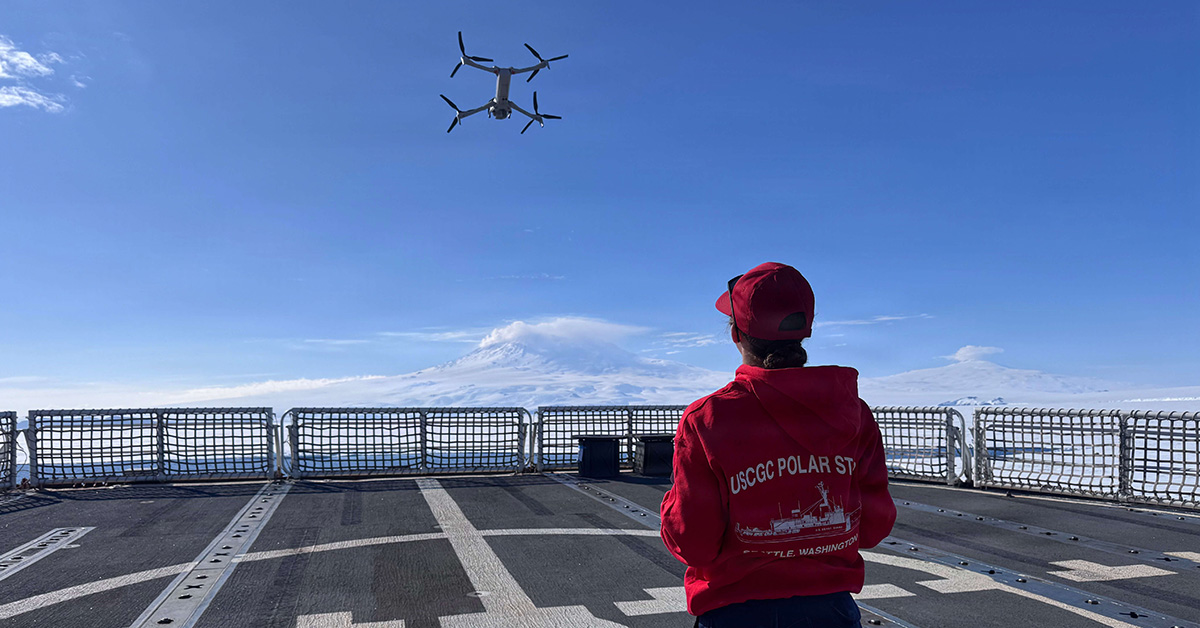
The Coast Guard is seeking $69.1 million for UAS and $22.2 million for C-UAS for FY27. The service says it requires UAS to expand its maritime domain awareness, support search and rescue missions, assess damage after disasters, and collect intelligence for drug and migrant interdictions.
Additionally, the Coast Guard is seeking funding of $130.1 million for the initial operating capability of the Program Executive Office for Robotics and Autonomous Systems, or PEO RAS, among other activities.
PEO RAS, launched in August, is intended to accelerate the development, procurement, deployment and sustainment of robotic and autonomous systems across the Coast Guard. The new office oversees the capability lifecycle, including setting requirements and contracting.
The budget will also enable the Maritime Safety and Security Teams to employ counter-drone tech.
U.S. Customs and Border Protection
The CBP has requested an $80 million budget to bolster its C-UAS capabilities in FY27. The agency has increasingly been employing counter-drone tech to support its mission. Cartels use drones to smuggle weapons and drugs, Glenn McArthur, business development manager at D-Fend Solutions and a former border patrol agent, told Inside Unmanned Systems. C-UAS technology can detect and mitigate the use of drones for illegal activities.
Although the budget request did not include funding to purchase additional MQ-9 UAS, CBP requested a $3 million increase for the UAS program to account for cost escalation and increased flight hours. The agency currently operates nine MQ-9s, including two in the Big Wing configuration that offer up to 30 hours of flight hours.
Science & Technology Directorate
DHS is requesting $754 million in funding to support research, development, test and evaluation efforts at S&T. The directorate evaluates C-UAS in laboratory and in real-world settings to aid DHS components in developing requirements, complying with congressional mandates and executing pilots.
DHS did not specify funding for the directorate’s drone and counter-drone activities, but S&T oversees a $1.5 billion contract vehicle that all components, including the U.S. Immigration and Customs Enforcement, the Transportation Security Administration and the U.S. Secret Service, use to acquire C-UAS tech.
In August, S&T awarded 12 companies spots on the indefinite-delivery/indefinite-quantity contract vehicle. It has two tracks:
- Under the first track, companies will supply hardware, software and ancillary services, including training, maintenance, installation and customization. Track 1 has a $1.01 billion ceiling. Awardees include BAE Systems, CACI, Leidos, Fortem Technologies and D-Fend Solutions AD.
- The second track covers three areas: counter-drone capability as a fully managed service, system integration, and research, development, testing and evaluation support. Anduril Industries, BAE Systems, Booz Allen Hamilton, General Dynamics Information Technology and Parsons Government Services won spots under Track 2, which has a $489 million ceiling.
Julie Brewer, executive director for the Office of Innovation and Collaboration at S&T, will share insights about how the DHS fields and deploys advanced technologies during the Mission Ready: Building Trust Through Technology Validation panel at the 2026 Homeland Security Summit on Nov. 10. Panelists also include:
- Roberto Vaquero, executive director of CBP’s Office of Field Operations
- Jay Alalasundaram, deputy assistant commissioner for software applications and services at CBP
- Capt. Chad R. Brick, inaugural chief of the Coast Guard’s Rapid Response Prototype Team RAPTOR
- Jerry Tipton, executive director at SAIC
- Kern Smith, vice president of global presales at Zimperium
How Much Drone Funding Did DHS Components Get From OBBBA?
The One Big Beautiful Bill Act, signed by President Donald Trump in July 2025, provides multi-year funding for border security, immigration enforcement, national infrastructure operations and other priorities through FY29.
Federal Emergency Management Agency
FEMA’s C-UAS Grant Program, funded with $500 million under OBBBA, is designed to arm state, local, tribal and territorial agencies with technologies to detect and monitor unauthorized drones.
The program has allocated $250 million in FY26 to strengthen security in preparation for the World Cup, with 11 host cities receiving funding. The remaining balance will be disbursed to all states and territories in FY27 to strengthen nationwide UAS detection.
Coast Guard
The U.S. Coast Guard also received $266 million in funding to purchase its own fleet of MQ-9 UAS under the reconciliation bill.
In the past, the service used CBP’s MQ-9 Alpha drones for missions in San Angelo, Texas. Lt. Commander Andrew Denning, long-range drone program manager for the Coast Guard, told Military Times that the Coast Guard will continue to work with CBP, but the service is aiming to extend its intelligence, surveillance and reconnaissance reach.
“We’re hoping to take it out of San Angelo, where we work with CBP, to West Coast and East Coast locations where we can start to use them on our own, prosecute them and push them out into our own mission set,” he shared.
The service also received another $75 million for robotic surface vessels, National Defense Magazine reported. Rear Adm. David Barata, deputy commandant for operations policy and assistant commandant for intelligence at the Coast Guard, said that PEO RAS will work with the service’s Blue Technology Center of Expertise to acquire and field robotic surface vessels.
Learn more about how DHS and its components plan to spend their FY27 budget at the 2026 Homeland Security Summit on Nov. 10. DHS Deputy Secretary Troy Edgar and Chief Procurement Officer Paul Courtney (pending approval) will keynote the event. They are expected to discuss upcoming drone and counter-drone investments, modernization and other priorities at DHS. Secure your tickets today!