
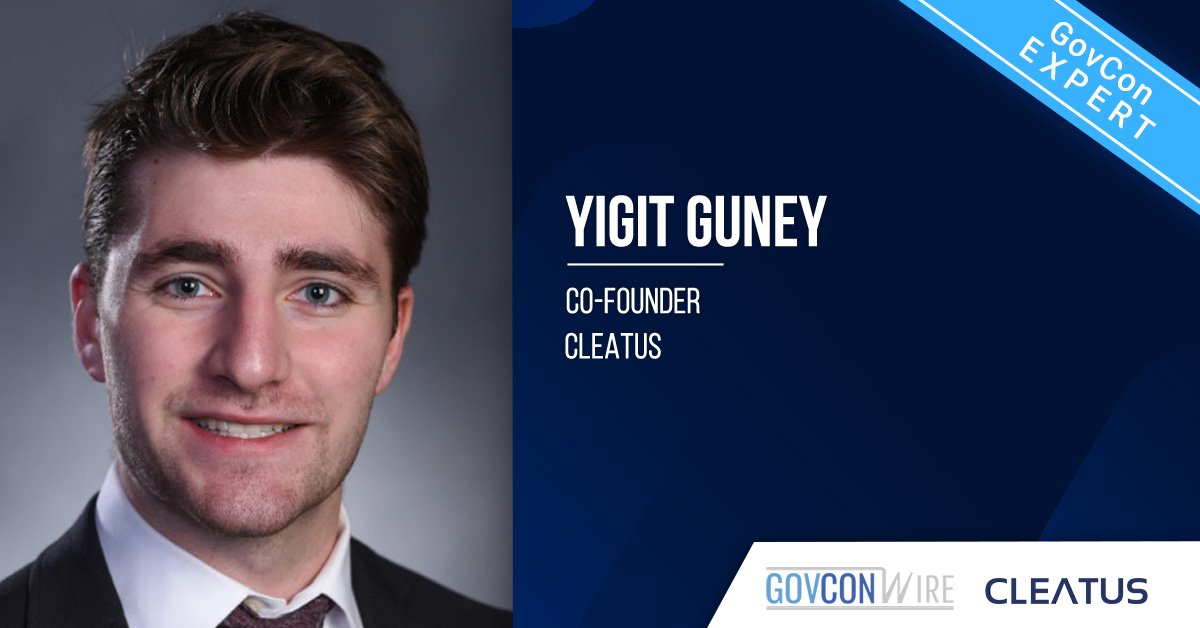

By Yigit Guney, co-founder, CLEATUS
Government contracting is not a writing problem. It is a workflow problem.
Winning is rarely decided by who can draft the fastest paragraph. It is decided by who can run the pursuit loop better: customer and mission research, fit-and-bid decisions, competitive and incumbent analysis, teaming strategy, compliance planning, iterative drafting, pricing inputs, review cycles and constant adaptation as amendments and new signals arrive.
Generative AI made teams faster at producing text and summaries. That mattered. But the next leap is not “better drafting.” It is a different capability: agentic AI systems that can plan, act, verify and iterate across real workflows, operating like digital teammates and force multipliers for high-performing teams.
That shift is especially relevant for GovCon because GovCon work is already multistep by nature. You gather facts, test assumptions, refine strategy, produce outputs, validate and repeat. The opportunity is for agentic AI to run those loops with you, not just talk about them.
What “Agentic Workflow” Actually Means
Agentic workflows are built for multistep objectives, not single responses. Instead of returning an answer and stopping, an agentic system can decide what to do next, use tools to do it, verify its outputs and keep going until the objective is complete.
This is not a word game. It is a change in how work gets done. Industry leaders increasingly describe agents as a new operating model, one that shifts organizations from isolated AI features to end-to-end execution across workflows.
In GovCon terms, agentic workflow is not “one prompt to a perfect proposal.” That is not how real pursuits work. Agentic workflow is the ability to continuously move a pursuit forward by coordinating research, analysis, strategy and artifact generation in sequence, with self-checking and iteration as the situation changes.
Two Layers: Structure at Scale, Then Autonomy
At CLEATUS, we treat agentic execution as something you earn, not something you declare. That means separating the platform into two layers.
1. The Data Foundation: Standardized GovCon Data at Industrial Scale
Government contracting data is messy, fragmented, and high-volume. If you want dependable automation, you cannot rely on “skim it live” document reading as your foundation.
So we built an industrial ingestion and standardization pipeline with Voltage Park’s AI Factory to process and structure large volumes of government contracting data. The goal is simple: turn multimodal inputs into standardized, categorized data that the platform can query reliably, compare across time and assemble into downstream work.
That scale is measurable. CLEATUS has crossed 10 billion tokens processed with OpenAI. For a reader, the simplest intuition is this: It is on the order of tens of millions of pages of text processed, roughly comparable to processing the entire English Wikipedia, and it represents a sustained, high-volume transformation of messy public procurement data into structured intelligence.
2. The Agentic Execution Layer: Multistep Pursuit Work, Done With You
The agentic layer is not “the ingestion.” It is what happens after the foundation exists.
What we mean by “agentic” isn’t an AI that chats. It’s an AI that executes.
A true agentic platform can run multistep GovCon workflows end-to-end: planning a path through an objective, taking tool-enabled actions, checking its own work and iterating until completion. That looks much closer to how real pursuit unfolds: research, analyze, strategize, follow up, validate and refine.
The practical benefit is not replacing humans. It is multiplying the output of strong teams by compressing the time between steps and reducing the manual glue work that usually slows everything down.
Tools: Generic Primitives Plus GovCon-Specific Intelligence
Execution requires tools. CLEATUS combines two tool layers.
Generic primitives, the building blocks any serious agentic AI system needs:
- Read and retrieve
- Structured search, “grep-like” lookup, semantic search
- Web verification for fresh information
- File generation for tables, spreadsheets and documents
GovCon-native tools, the capabilities workflows actually require:
- Opportunity discovery and matching across federal, state and local sources
- Contractor and competitor research
- Pricing insights and market intelligence
- Contracting officer discovery and agency context
- Agentic web research for wage determinations, market rates and competitor signals
This is why “agentic” is not just a model choice. It is a systems design choice: toolchains, verification and iterative execution layered on top of structured GovCon data.
Execution Without the ERP Straightjacket
Traditional GovCon systems often standardize work by forcing teams into rigid workflows: fixed fields, checklists and predefined stages. That structure can help with reporting, but it also forces teams to conform to the software.
Agentic workflow flips that relationship.
Instead of boxing teams into one methodology, an agent can adapt to your capture and proposal operating model: your templates, review steps, internal naming conventions, win-theme structure and approval loops. The platform augments how you already win. It does not replace your playbook with a checkbox grid.
This is one of the most important benefits of agentic execution in GovCon. Teams do not win because they follow the same process as everyone else. They win because they have a repeatable process that fits their strengths, niche and customers. Agentic workflow lets that advantage scale.
What Changes for Capture and Proposal Teams
The shift is not that AI can draft. The shift is that AI can execute sequences.
With an agentic workflow approach, teams can compress the time between steps once separated by tool sprawl and manual handoffs: gathering signals, validating assumptions, assembling structured outputs, formatting documents and iterating as new information arrives.
That is the direction we are building at CLEATUS: standardized GovCon data at industrial scale paired with an agentic AI execution layer that plans, acts, verifies and iterates.
Not chat that sounds smart. Work that gets done.