
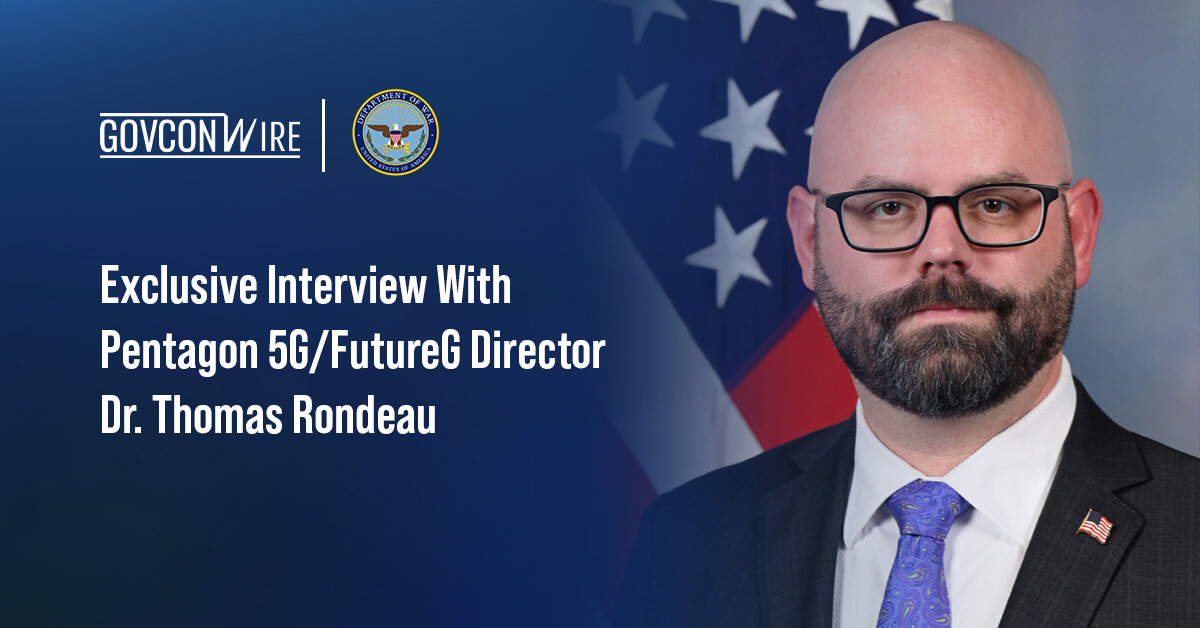

The funds allotted by President Donald Trump’s reconciliation package last summer, dubbed the One Big Beautiful Bill Act, famously poured record amounts into the Department of Homeland Security and its various sub-agencies. But an underdiscussed benefactor is the office responsible for 5G and futureG at the Department of War.
In an exclusive interview with GovCon Wire, Dr. Thomas Rondeau, principal director of futureG and 5G at DOW, told us that his office received $500 million from the OBBBA.
“That’s not appropriated money—just money in the Treasury for us to go and run with,” Rondeau said.

Dr. Rondeau will deliver a keynote speech at Potomac Officers Club’s 2026 Defense R&D Summit on Jan. 29. Attend to hear him identify the many ways he plans to partner with industry using his new influx of funding. Secure your seat now at this defense-tech-focused GovCon event before tickets sell out!
What Is Dr. Rondeau’s Office Doing With Its OBBBA Money?
The wireless communications leader, who was drawn to civil service by the “hardest signals and math problems that the U.S. government has,” said that his office is going to get started as fast as it can setting up new partnership and contract opportunities for industry.
“We’re going to be putting together a lot of solicitations and starting a lot of projects to execute that money,” Dr. Rondeau said.
OCUDU
The first major effort Dr. Rondeau told us his team would be concentrating its time and resources on is the Open Centralized Unit / Distributed Unit, or OCUDU, project, an open-source platform for 6G that began in 2025.
“The purpose of OCUDU is to get people out of the RAN [or radio access networks] and stop focusing so much on the internal code of the RAN that we’ve been doing for the past 40 years, and start focusing on how you deploy networks in various scenarios and how you use them for interesting, novel applications, specifically how you enable AI at the edge of the networks,” Dr. Rondeau said.
Alongside the Linux Foundation, the DOW will create the OCUDU Ecosystem Foundation, which they plan to unveil right before Mobile World Congress in early March. Dr. Rondeau and co. will then attend the wireless comms conference and “have a really big presence there, announcing what we’re doing with the foundation, what we’re doing with OCUDU, and really putting a lot of momentum behind that.”
Rondeau says he and the department intend to pump OCUDU with funds to enable the level of developers, applications, use cases and platforms that it needs to function in concert with.
ISAC
The other major area where Rondeau’s office will spend its OBBA funds is integrated sensing and communications, or ISAC, which he shared is “all about turning our networks into sensors.”
“We’ve been running a series of events and workshops and building an industry coalition around ISAC. Two of the key application areas we’re looking at,” Dr. Rondeau revealed, “are critical infrastructure protection and border protection.”
He said ISAC developments could help the military “detect, track and prosecute swarms of drones, both for traffic management purposes and because of the weaponization of small UAS that we’ve seen around the world.” It will also be leveraged to keep critical infrastructure safe.
Medical and health issues are another realm ISAC has potential for direct impact, with sensor networks providing a way to “increase our knowledge of injuries, casualties and recovery mission information” through the “pervasive and non-invasive tracking and sensing of medical conditions.”
Rondeau signaled that industry should stay tuned, as his office is intent on collaborating with the industrial base and the private sector to test and produce ISAC capabilities.
Join the discussion with Dr. Rondeau at the 2026 Defense R&D Summit, which will also offer three distinct panels on 5G and futureG technologies featuring experts from across the Pentagon. Register for the Jan. 29 GovCon networking conference now!
How Does ISAC Figure Into 6G?
The standards body—the 3rd Generation Partnership Project, or 3GPP—is working on rounding out a definition and parameters for 6G technologies right now. Part of these discussions is an increased access to spectrum, with more contiguous bands and wider bandwidth channels. Pair that with advancements in microelectronics and AI, and practitioners can “take all that spectrum and bandwidth and, instead of just focusing on how we immediately cut it down into bits, we can look at the signal itself for environmental and even weather condition information,” Rondeau said.
This immediately raises the question of what these new opportunities mean from a business perspective.
“5G had a lot of ideas for business cases that haven’t really panned out,” Rondeau posited, explaining that in the 5G era, paying for extra data on the users’ part became an impossibility.
“What everybody is interested in is that this is potentially very valuable data and applications that people would pay for, either for the results or for the data,” Rondeau said of ISAC and 6G.
“The problem is that it’s really hard,” he continued. “It’s a math, physics and engineering problem to detangle all of this information when you have the density of networks and the clutter of people, buildings, trees, hills and changing weather conditions. Humidity, rain and all of that affects it. It’s a really hard problem. Even though people identify that the data has value, it’s hard to understand what that value is.”
Dr. Rondeau and his team hosted a three-day industry summit in August to focus on problematizing ISAC applications, out of which came a commitment on the government’s part to get the process started and undertake some of the initial business risk. They would purchase equipment and hardware and install it and then work with the telecommunications companies to deploy it at scale.
“Then we can turn that into an open API [or application program interface] for other people to start exploring what more we can do once we actually have a dense sensor network. That buys down the risk for industry to get there,” Dr. Rondeau stated.
When Will the DOW 5G/FutureG Office’s OBBA Money Be Issued?
The 5G/FutureG office at the DOW will get access to its $500 million starting in fiscal year 2027. “This year,” Rondeau said, “is all about planning for that execution.” The money will then be spent over the course of fiscal years 2027, 2028 and a little ways into 2029.
“We want to go fast. This year, we’re doing all the due diligence. We’re talking to industry, listening to industry, and making sure we’re putting together the right set of projects to really spur on the 6G ecosystem within the United States, and a lot of work with our international allies and partners.”
Catch Dr. Rondeau’s appearance at the 2026 Defense R&D Summit on Jan. 29. Other keynotes speakers include Under Secretary of War for Research and Engineering Emil Michael and Under Secretary of War for Acquisition and Sustainment Michael Duffey. You don’t want to miss this.