
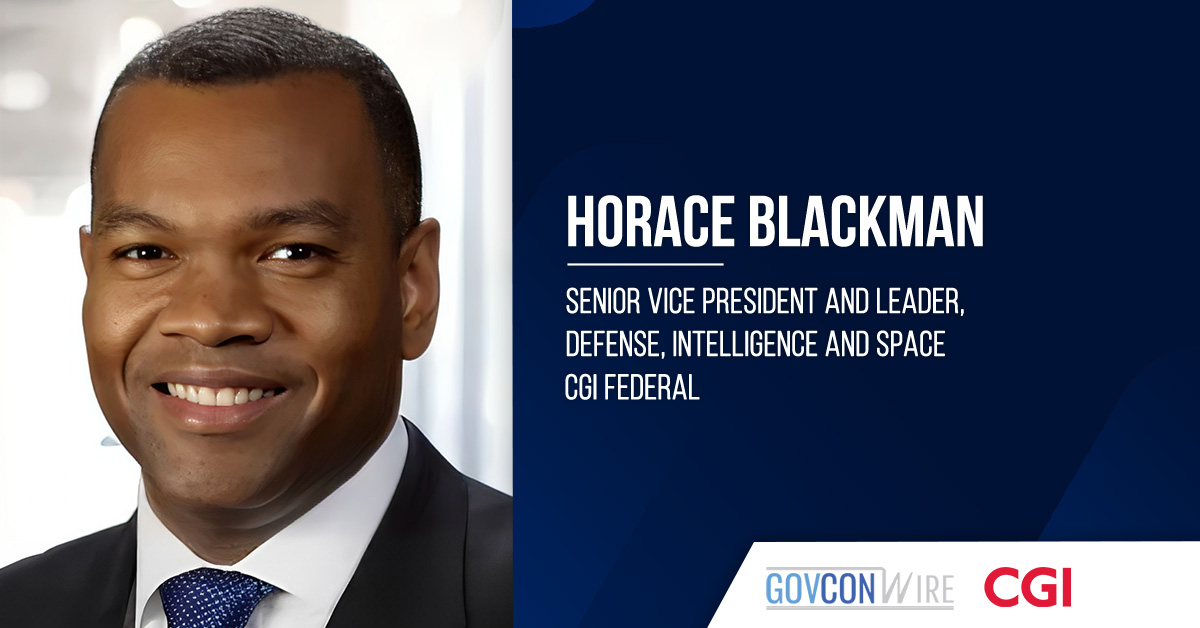

Over the last quarter century, Horace Blackman has firmly established himself in the government contracting world, performing duties on both the public and private sides of the industry to figure out how to make the biggest impact. He’s logged time at the Department of Veterans Affairs, as well as Leidos, Lockheed Martin and Booz & Company (now PwC’s &Strategy arm), and since 2020 has served as senior vice president and leader of the defense, intelligence and space business unit at CGI Federal. The exec considers ‘the mission’ as his passion.
“Having once been a client myself, I understand how critical it is to use technology in ways that truly support the mission,” Blackman told GovCon Wire in a Spotlight interview. We discussed a wide range of topics, from CGI Federal’s perspective on expansion and new mergers and acquisitions deals, to the prevalence of unclassified intelligence and geospatial intelligence.
If you’re looking to win contracts in the U.S. intelligence community, be sure to attend Potomac Officers Club’s 2025 Intel Summit on October 2. The first-class event will assemble the most prominent voices in the IC for a day of keynotes, panel sessions and productive networking. Don’t miss this essential intel GovCon conference!
GovCon Wire: Where are you seeing opportunities for expansion in CGI Federal’s portfolio? What new capabilities or markets are you eyeing?
Horace Blackman: We’re in an interesting and dynamic time right now. For us, it’s really about listening, observing and learning—taking in as much as we can. There’s a major push to improve efficiency and cost effectiveness across government spending.
I’ve seen this firsthand since my time at the VA, where we were able to reduce IT operations and infrastructure spending by roughly 40 percent. So I know there’s been real progress, but there’s still a long way to go.
Like many others, we’re embracing this shift. We’re focused on becoming more efficient and making better use of taxpayer dollars. When we look at the contracts we manage, we want to be sure we’re delivering real value—not just going through the motions.
That focus on value has been a core priority for us for a while. We’re committed to making sure our work directly supports the mission.
GCW: What can we expect to see from CGI Federal from an M&A perspective in the next year?
Blackman: Like other aspects of the market, M&A is in an interesting place. It really requires an opportunistic mindset as you assess the market. I don’t think there’s a clear road map or set of predictions I can give you—these transactions depend on timing and fit.
That said, we’ve always been an active and value-driven buyer. For the past five years, we’ve consistently looked for opportunities where we can combine our capabilities with others to expand our offerings and bring those teams into CGI Federal in a way that drives meaningful value for our customers.
There are a lot of great companies out there doing innovative work. For us, the priority is identifying game-changing capabilities—particularly around efficiency and cost effectiveness—that align with our mission. Whether it’s AI, automation or other technologies, we’re always looking for synergies that improve outcomes and support the government’s push to do more with less.
GCW: I know private equity has been playing an increasingly important role in the GovCon space. How does that factor into CGI Federal’s strategy?
Blackman: We talk to everybody. And we’re going to keep doing that.
We’ve done transactions that have involved strategic investors, private equity and other partners. Private equity is definitely part of the mix—we stay in regular contact, look for alignment and try to identify where synergies might exist.
They’ll continue to play a role, just as companies seeking strategic mergers will. Both are attractive in different ways. Ultimately, we take the market as it comes and stay open to the right opportunities when they present themselves.
GCW: We’ve seen a historic migration within the IC toward more unclassified work, which is sparking changes in the way the IC develops software. Can you elaborate more on the impact that unclassified work has had on your organization’s software development?
Blackman: It definitely has an impact on the broader market. In some cases—often for good reason—there’s been a tendency to overclassify. Certain things clearly should be classified, and others just as clearly should not. The real challenge lies in the gray area between those two extremes.
Naturally, the instinct is to err on the side of caution, to protect national security and mission-critical information. But lately, we’ve seen a shift. Clients and contracting officials are doing much more strategic analysis to determine what truly needs to be classified. That kind of rigor is welcome.
It gives us more flexibility in how we deliver services, not just software. It can lower costs, open the door to work in our onshore delivery centers across the U.S., and allow us to tap into different labor markets. That’s a win-win—it brings cost efficiency through labor arbitrage, and it helps build up regions outside the major population centers where labor is more expensive.
Ultimately, that translates into greater value for our clients and stronger support for their missions.
GCW: It seems that geospatial intelligence, or GEOINT, has only gained in importance in recent years. Can you talk about why GEOINT is so important in today’s great power competition?
Blackman: Geospatial intelligence isn’t a new topic—it’s been a focus in the community for quite some time. But what we’re seeing now is a broader and more routine application of it, especially as satellite-based capabilities evolve. What used to be considered bespoke or specialized is increasingly becoming mainstream.
There’s been a noticeable push from across the intelligence community to leverage these technologies more consistently. We’re seeing the integration of next-generation satellites, hypersonic capabilities and commercially available platforms that make geospatial data more accessible and useful.
A good comparison is everyday life—people don’t think of themselves as using geospatial intelligence, but they rely on GPS, geolocation and optimized routing all the time, from tracking Amazon packages to finding the fastest route home. A decade ago, that wasn’t the norm. Now it’s embedded in everything.
The same kind of ubiquity is starting to take hold in national security, though obviously with more complex and classified technology. But the broader trend is the same—greater accessibility, broader adoption and increasing comfort with the tools.
Ultimately, the name of the game in intelligence is speed to insight. Whoever has the best access to timely, actionable information—and can get it into the hands of decision-makers quickly—has the advantage. The more we compress that cycle between collecting, analyzing and acting on data, the stronger the impact.
Right now, we’re seeing that play out in real-world environments like eastern Europe. The threat landscape is constantly shifting, and we’re learning a lot from it. As that learning accelerates, so does the evolution of geospatial capabilities.