
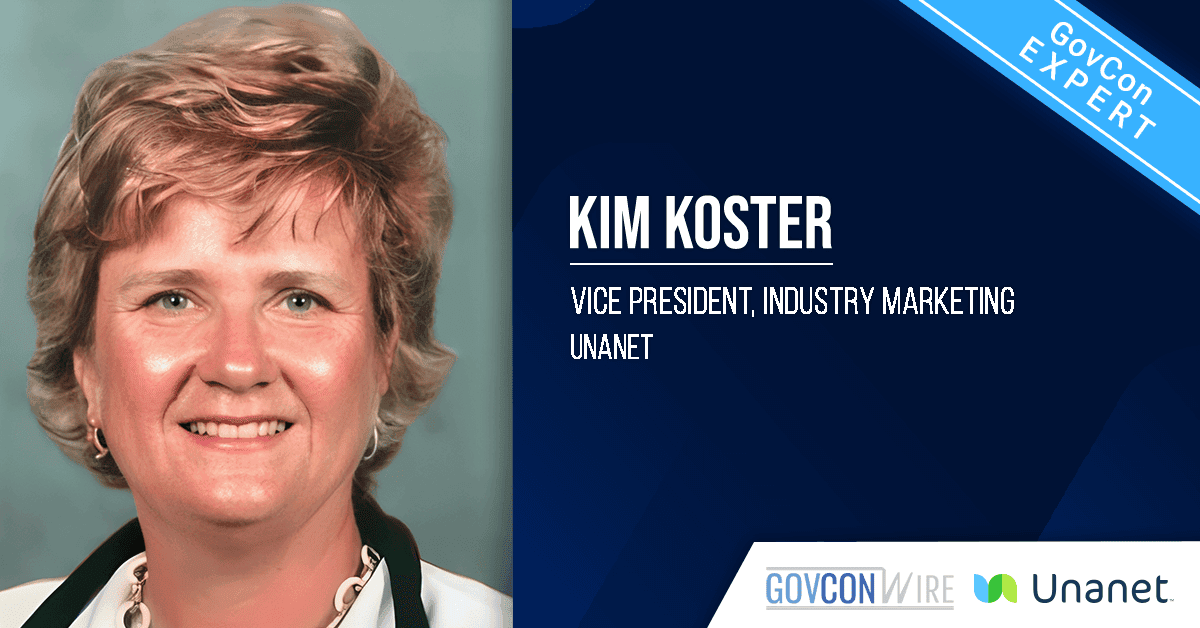

By Kim Koster, vice president of industry marketing at Unanet
As the fiscal year draws to a close, GovCons are once again sprinting to the finish line on proposals, awards and year-end execution. But amid the GFQ4 surge, a deeper issue looms.
Even if you win the work…will you be able to staff it?
Leaders across the industry are confronting a workforce crunch that is reshaping strategy as much as compliance and capture planning. The challenges are multi-dimensional, impacting everywhere from recruiting cleared professionals in a tight labor market to retaining mid-career talent in a hybrid world to experimenting with artificial intelligence as a force multiplier without eroding employee trust.
Heading into GFY26, the workforce question has become a strategic growth constraint. The contractors that solve it (or at least manage it better than peers) will be the ones that convert contract wins into successful delivery.
The GovCon Labor Shortage Reality
For years, talent with highly in-demand skill sets — cybersecurity professionals, engineers and program managers — have been in short supply. Today, demand has only intensified. Federal agencies are racing to modernize IT systems, strengthen cybersecurity defenses and expand digital services. That means they’re asking contractors to bring skills that are already scarce in the open market, with even more of a constraint when a security clearance is required.
The result is that many small and mid-sized contractors are finding themselves in a paradox. Their capture teams are securing wins, but delivery leaders are struggling to staff positions fast enough to meet customer timelines. In some cases, firms have had to walk away from opportunities because they couldn’t credibly field the required team.
For larger primes, the picture doesn’t appear much better. The ripple effect of labor shortages pushes risk down the supply chain. Primes need subs with ready-to-go cleared staff; subs need primes that allow enough ramp-up time to recruit. Across the board, staffing bottlenecks are emerging as a threat to profitability, customer satisfaction, and compliance.
The AI Augmentation Factor
Against this backdrop, GovCon leaders are turning to artificial intelligence as a potential pressure valve. AI isn’t replacing cleared engineers or program managers. But it is starting to reduce the administrative and repetitive workload that slows execution.
Proposal teams are experimenting with AI-powered writing assistants to help generate draft content, compliance matrices, and pink-team reviews. Program managers are deploying AI copilots to produce dashboards, schedule updates and routine reporting. Finance teams are looking at AI tools to reconcile project actuals faster and identify risks earlier.
The common thread is that AI can buy time back for employees. This frees technical staff to focus on higher-value tasks and gives business leaders more real-time visibility.
Still, adoption is cautious. Contractors know that trust with both customers and employees is fragile. Over-reliance on AI without human oversight raises compliance risks. Over-messaging AI internally can make employees fear replacement. The contractors gaining traction are the ones framing AI as augmentation. They’re positioning it as a tool that helps employees work smarter and build capacity without threatening their roles.
Retention & the Hybrid Work Divide
Even if you can find talent, holding onto it is another challenge.
The post-pandemic workforce is different. Many employees have grown accustomed to remote or hybrid work. The challenge is that many customer requirements often demand in-person presence on classified networks, military installations or agency sites. That tension creates frustration for employees who see private-sector peers enjoying more flexibility.
Salary increases alone are not enough to solve retention. GovCon firms are discovering that creative benefits beyond pay matter just as much:
- Career pathing: Employees want clear advancement opportunities and skill development, especially younger professionals entering the cleared space.
- Training and reskilling: Offering certifications, cyber boot camps or cross-training builds loyalty and addresses capability gaps.
- Mission alignment: Reminding employees of the national security or public service mission helps reinforce purpose, particularly when work conditions are demanding.
Company culture is emerging as a differentiator. Employees are asking: does my company value my development? Am I being supported as technology and missions evolve? Contractors that answer “yes” are reducing attrition and winning the recruitment battle through word of mouth.
The Strategic Imperative for GFY26
The workforce challenge is no longer a problem for HR to solve in isolation. It has become a strategic growth constraint that demands attention from the C-suite.
Just as contractors treat capture planning as a proactive, data-driven discipline, they must bring the same rigor to workforce planning. That means:
Proactive Talent Forecasting
- Use pipeline and CRM data to predict what roles will be needed months in advance.
- Integrate workforce planning with capture and proposal cycles to avoid last-minute scrambles.
Investment in Training & Upskilling
- Building cleared talent pipelines takes years, not weeks. Firms investing in training now will reap the benefits in GFY26 and beyond.
Smarter Use of AI and Automation
- Deploy AI strategically to relieve administrative pressure points without overpromising.
- Focus AI where compliance risk is lowest but time savings are highest.
Cultural Differentiation
- Create an environment where employees feel they are growing, not just billing hours.
- Highlight mission, mentorship and innovation in recruiting and retention.
Looking Ahead
As GFY26 approaches, GovCons face an undeniable truth: the talent gap is here to stay, at least in the near term. But the way companies respond to it will separate those who thrive from those who stagnate.
Contractors who see workforce strategy as a competitive advantage rather than a cost center can attract and retain the people they need while also delivering superior results for their federal customers. Those who ignore it risk winning contracts they cannot deliver. That’s a situation far costlier than investing in workforce readiness upfront.
The workforce crunch may feel like an obstacle, but it’s also an opportunity. Blending talent innovation, AI augmentation and smarter planning, enables GovCons to turn today’s challenges into tomorrow’s growth platform. In an industry built on trust, execution and mission success, people remain the decisive factor.