
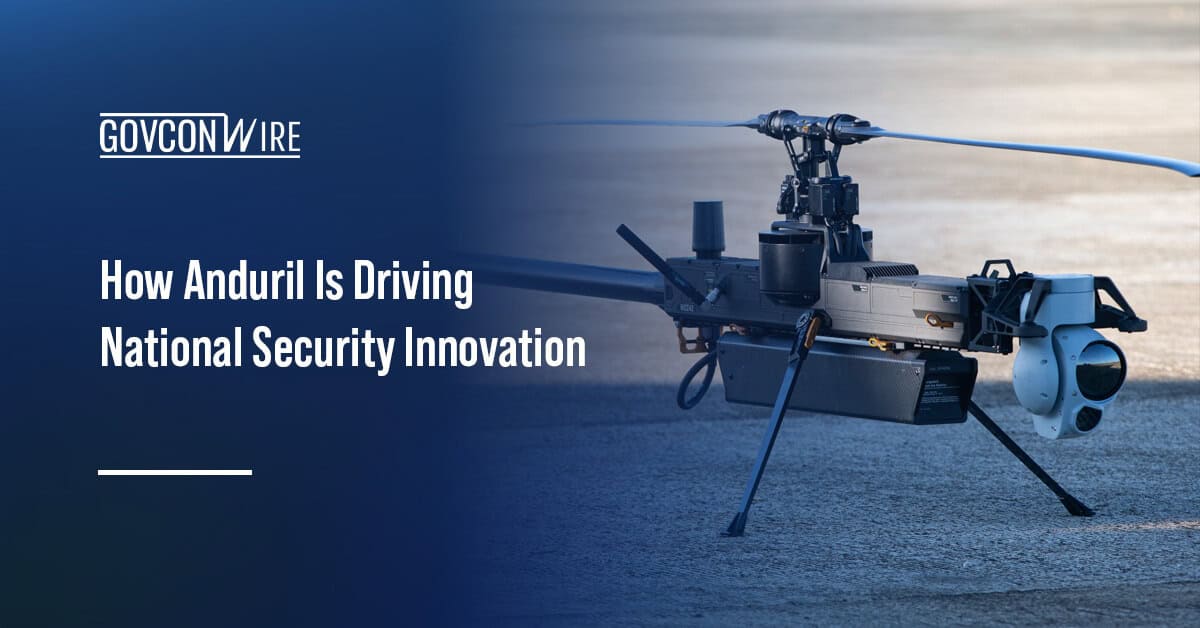

Anduril is the ultimate disruptor in national security technologies. Competing against traditional contracting giants such as Lockheed Martin and Boeing, Anduril has found its niche in GovCon by operating more like a tech startup than a legacy defense prime, pushing software-first, rapid prototyping and iteration cycles measured in months instead of years.
Anduril often bypasses traditional slow procurement cycles, offering private research and development investment upfront and delivering ready-made systems. This pressures DOD to rethink acquisition norms—and pressures contractors to consider new business models.
Let’s dive into how Anduril systems are powering national security innovation.
Dig into the latest commercial off-the-shelf technologies in national security at the Potomac Officers Club’s 2025 Homeland Security Summit on Nov. 12! Gain actionable intelligence at the “From Lab to Launch: Advanced AI Applications in National Security” panel discussion. Get your pressing questions answered by leading government and industry homeland security experts. Sign up today for this elite GovCon event and drive increased revenue in FY 2026!
Lattice Mesh Networking
The foundation of Andruil’s advanced technologies is its Lattice mesh networking system. Lattice is an open software platform designed for missions including defense, public safety and security that is network, sensor and system agnostic.
Lattice uses data from distributed and disparate sensor systems and feeds and combines them into a single layer. Lattice leverages technologies such as AI, machine learning, and sensor and data processing to filter the most important data to users. The system has additional functionality beyond just national security. Lattice can be used for power plants, wind farms, search and rescue, and maritime ports.
DOD is making a big investment in Lattice as it awarded Anduril a three-year, $100 million contract in December to broaden Lattice Mesh, according to Breaking Defense. That same week, the company issued its Lattice Software Development Kit that will permit other firms to develop their own applications to run on Lattice Mesh without having to get prior approval.
Anduril announced a preliminary list of partners, including Oracle, but the company wants any company to eventually take the kit and write software for Lattice.
Anduril Solid Rocket Motors
Anduril has broken up the old solid rocket motor duopoly by becoming a third DOD provider of solid rocket motors, Defense One reported. There were previously only two producers of solid rocket motors: L3Harris’ Aerojet Rocketdyne and Northrop Grumman.
Demand for solid rocket motors has exploded due to the Russia-Ukraine war and combat in the Middle East. In response, Anduril built a full-rate production facility in Mississippi and plans to prosecute 6,000 solid rocket motors by December 2026. The company has tested more than 700 motors since early 2024.
What makes Anduril’s solid rocket motors different? It cites a custom aluminum-lithium alloy fuel mixture that will increase its range by 40 percent. Anduril also believes a more efficient design process will slash production timelines.
The company’s work has already paid dividends. The Army earlier this year picked Anduril to deliver a new 4.75 inch solid rocket motor for the service’s long-range precision rocket artillery.
The Potomac Officers Club’s 2025 Homeland Security Summit on Nov. 12 is an exclusive opportunity for GovCon executives to hear directly from Homeland Security Secretary Kristi Noem! Be the first to hear about new DHS contracting initiatives and priorities in FY 2026 and how DHS will spend its extra money from the One Big Beautiful Bill legislation. Sign up today and get an edge on your GovCon competition!
Anduril Unmanned Jets
Anduril has quickly developed a name for itself in smaller unmanned aerial vehicles with its Ghost intelligence, surveillance and reconnaissance and force protection platform. It is now branching into larger, jet-sized unmanned aircraft, according to Flight Global.
Anduril plans to create a new unmanned jet for a Navy competition after being selected among other competitors to produce concepts for an aircraft-carrier capable Collaborative Combat Aircraft. These semi-autonomous aircraft are suggested as supporting traditional fighter platforms with extra weapons and battlefield capabilities.
The company already has its Fury autonomous air vehicle, also known as YFQ-44A. This platform is Group 5 sized, or weighs 1,320 lbs or more, and leverages autonomous technology and Lattice to perform in-demand missions such as manned-unmanned teaming. The Fury is designed for the defensive counter-air mission while helping traditional fighter jets engaged in air-to-air combat.
While Anduril’s new Navy UAV would look different from the Fury, it would have the same internal system systems and technologies. These would include autonomous flight control software, avionics hardware and fabrication and design processes.
Anduril Autonomous UUVs
Anduril has entered the maritime market by developing a new autonomous unmanned undersea vehicle. This platform, named Copperhead, will be deployed from its larger new Dive-LD and Dive-LX undersea drones, Breaking Defense reported in April.
The Copperhead, which will come in two sizes, will be able to perform a variety of missions, including strike. The baseline variant is designed for rapid response missions such as search and rescue, infrastructure inspection and environmental monitoring, according to Defense News.
The Copperhead is expected to top speeds of 30 knots while carrying different payloads such as magnetometers and passive and active sensors.
Autonomous Surveillance Towers
Autonomous technology has always been a foundation technology in Anduril’s product offerings. The company announced in late 2024 that it had deployed its 300th Autonomous Surveillance Tower to CBP to bolster border patrol agents’ situational awareness on maritime and land borders.
The ASTs use AI, machine learning and computer vision to identify border crossings. Anduril has partnered with Customs and Border Protection since 2019 when the agency tested five towers around San Diego. AST became a program of record in 2020. CBP has installed more than 200 ASTs in the last two years.
Anduril in 2024 rolled out its Extended Range Sentry Tower, or XRST, a long-range sensor that can identify and track targets autonomously from up to five miles away. The XRST can also detect targets from 7.5 miles away when used by a human.
The XRST is specifically designed for border security and force protection. It has already been deployed to the U.S.-Mexico border and is in use in Texas.
The sensor can be installed on an expeditionary tower that is 80 feet tall. The XRST system regularly trains and processes algorithms at the edge with a goal of helping crews operate more accurately and efficiently.
Anduril has similar systems with various standards and ranges. This includes a Standard Range Sentry Tower with a range of up to 2 miles and a height of 33 feet and a Long Range tower that covers a range of up to nine miles. It also has a Maritime tower with a range of up to nine miles for surface vessels.