
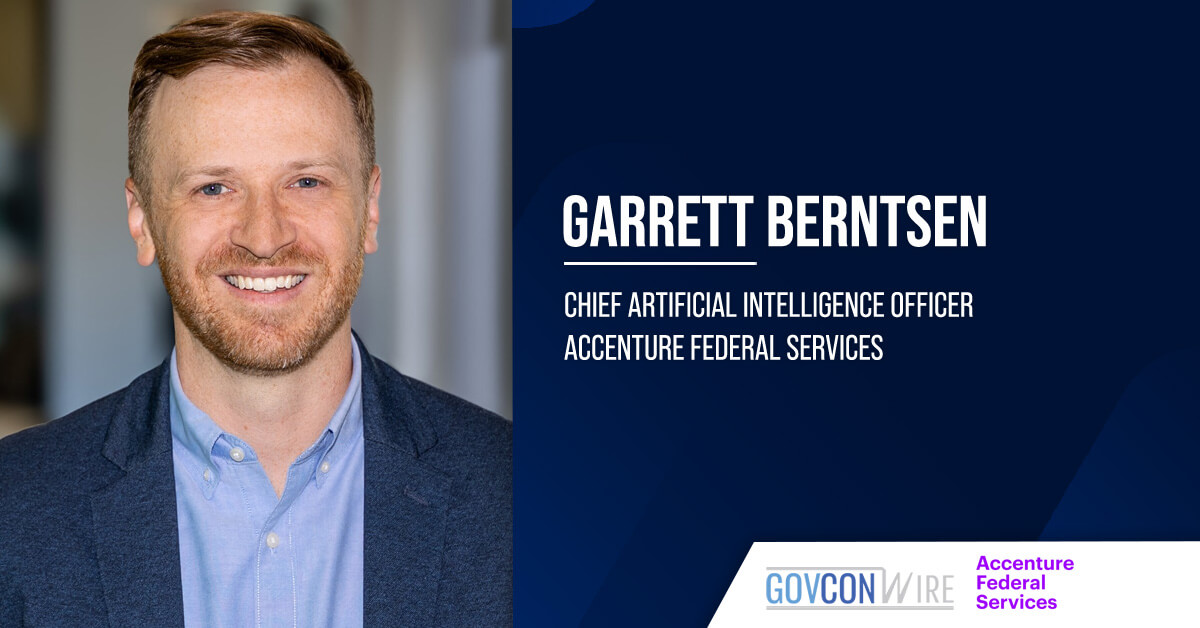

Accenture Federal Services has appointed Garrett Berntsen, a federal and industry technical leader, as chief artificial intelligence officer.

The latest appointment highlights the ongoing movement of senior AI leadership across the federal and industry landscape. That broader evolution provides useful context for gatherings such as the Potomac Officers Club’s 2026 Artificial Intelligence Summit on March 18. Sign up now to save your seat among leaders tracking the latest developments in federal AI.
In a LinkedIn post, the company said Berntsen will apply his cross-sector experience to support the advancement of national priorities by aligning mission needs with technological capabilities, talent and strategic partnerships.
“We’re not just implementing AI—we’re architecting the future of how federal agencies deliver the mission,” Berntsen said in a statement.
Who Is Garrett Berntsen?
Berntsen most recently served as managing director of Accenture Federal Services’ defense and intel data and AI practice.
Before joining Accenture in May 2025, he was deputy chief digital and AI officer at the Department of War. His other roles in the government include serving as director for technology and national security at the White House National Security Council and as deputy chief data and AI officer at the State Department.
The retired U.S. Army captain and senior logistics officer served as a senior manager at Deloitte, where he served as a data analytics and strategy consultant supporting federal customers’ digital transformation efforts.
The University of Virginia foreign affairs graduate holds a master’s degree in international economics from the Johns Hopkins School of Advanced International Studies.
What Does Accenture Federal Services Do?
Accenture Federal Services is a wholly owned subsidiary of Accenture focused on providing consulting, technology and mission support services for U.S. government clients.
The company works across defense, intelligence, civilian and public safety agencies, delivering capabilities in artificial intelligence, data analytics, cloud computing, cybersecurity and digital engineering.