

By Chris Burton, executive vice president of strategy at Sign In Solutions
Relief for overstretched, under-resourced security and compliance teams is within reach. It starts with modernizing compliance systems and processes.
As much impact as their work has on a firm’s ability to stay compliant and ultimately win more defense-related business from the federal government, few roles carry more importance within a National Industrial Security Program, or NISP-cleared government contractor than that of a facility security officer, or FSO.
In some cases, however, the systems and tools FSOs rely upon to fulfill their vital role within a firm can be a hindrance rather than a help in keeping pace with an escalating compliance workload.
Faced with a consistent stream of rule changes, schedule adjustments, moving deadlines and training requirements, the stakes are simply too high for cleared companies to stick with outdated, disconnected systems.
When it comes to staying audit-ready, mitigating risk and maintaining the strong compliance posture they must have to hold up in the Defense Counterintelligence and Security Agency, or DCSA, security reviews that rate their security posture, the status quo won’t suffice. With so much riding on compliance, what FSOs need are modern compliance tools that are sophisticated and strong enough for the demands of the role, yet simple enough for them, as well as their company’s security team and cleared employees, to use.

All the better if they can access these tools, plus critical compliance-related data, within one digital environment.
Having all this readily at hand gives cleared contractors and their FSOs an edge, enabling them to stay on top of their responsibilities and in a perpetual state of compliance readiness, even in a regulatory and reporting environment as fast-paced as today’s.
As cleared contractors face mounting compliance demands and DCSA scrutiny that can decide their eligibility for defense work, the Potomac Officers Club’s 2027 GovCon Executive Leadership Summit on Feb. 25 will bring industry leaders together to discuss protecting growth in a changing regulatory environment. Save your seat now!
Relief for Overloaded Security and Compliance Teams
By the U.S. government’s estimates, more than 12,500 contractor facilities are cleared for access to classified information under the DCSA’s security oversight program (the DCSA administers the NISP on behalf of the Department of Defense and 35 other federal agencies).
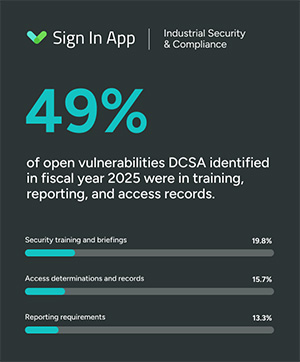
What kinds of risks are FSOs at cleared contractor firms likely to face? According to a recent GAO analysis, 49% of the open vulnerabilities identified by DCSA at cleared contractor facilities in fiscal 2025 came in three areas: security training and briefings, access determinations and records and reporting requirements.
As many cleared contractors are realizing, the success of their FSOs in managing these vulnerabilities depends on modernizing and, in particular, on moving to a single system for managing all the responsibilities that come with the role. With one central workspace, an FSO always knows where they and their organization stand with respect to compliance. What’s more, they can reclaim much of the time they would otherwise spend chasing down and verifying information, generating reports and executing other compliance-related functions.
By centralizing records, automating workflows and providing dashboard-based visibility across sites, that single platform becomes a real game-changer for FSOs in their day-to-day work, empowering them in three areas in particular:
- Simplifying self-reporting and required actions so the team is doing its part in the compliance effort. Self-service tools simplify self-reporting, allowing cleared personnel to independently log foreign travel and contacts, and to complete required training. By uniting security teams and employees within a single platform, FSOs have one reliable source of truth to see where everything stands. No longer do they have to deal with chasing down information from multiple people and across multiple systems. For organizations managing cleared and public trust personnel, these centralized workflows streamline personnel tracking and documentation and turn a stressful, fragmented process into an efficient, transparent team effort.
- Automating routine follow-up and workflows. Reminders (for reporting, training, etc.), completion tracking, along with compliance and approval workflow automation (for foreign travel, onboarding, etc.) built into the system relieve FSOs of tedious and time-consuming tasks and support ongoing compliance and audit-readiness.
- Keeping information current, provable and audit-ready. Records stay current and provable as work happens, and FSOs can produce the trail whenever they are asked, with audit-ready records aligned to NISPOM requirements under 32 CFR Part 117. All the data they need resides in one place, including clearance and personnel records. For contractors managing personnel in public trust positions, centralized records and workflows can similarly support applicable personnel vetting, documentation and reporting requirements.
By shifting away from outdated systems and manual processes to a unified, modern approach to compliance, issues like reporting and compliance drift become a lot less problematic, audits become much less daunting, readiness becomes the norm and an FSO’s job, as pressurized as it can be, becomes much more manageable.
There’s also the big picture to consider. Arming FSOs with modern capabilities like these gives firms a true advantage in landing federal contracts. FSOs are under immense pressure to protect their firm’s eligibility for defense-related contracts. With the ability to cultivate and demonstrate a strong security posture, they’re better equipped to maintain strong DCSA security ratings, protecting their standing to win and keep the contracts that are the lifeblood of a cleared contracting firm.