
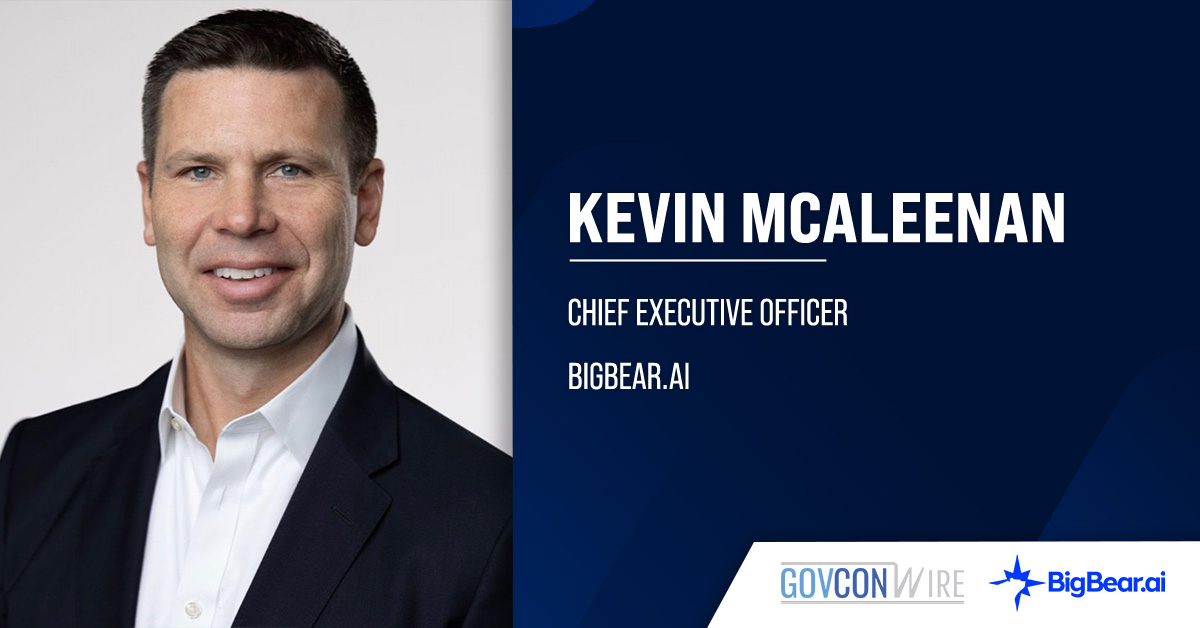

- BigBear.ai CEO Kevin McAleenan targets AI platform and application market share
- McAleenan cites the FBI, Coast Guard and NASA as new customers
- The 2026 Homeland Security Summit will explore AI, border defense and more
BigBear.ai CEO Kevin McAleenan said growing top-line revenue and searching for acquisition targets remain his two main priorities for the rest of 2026.

BigBear.ai’s AI and analytics work for U.S. Customs and Border Protection supports the agency’s efforts to assess security risks from travelers and cargo entering the country. Senior Department of Homeland Security officials and industry leaders will discuss how data and advanced technologies can help protect the nation’s borders and critical infrastructure at the Potomac Officers Club’s 2026 Homeland Security Summit on Nov. 10. Panels will cover AI for investigative intelligence, edge capabilities for border defense, federated data fabrics and counter-unmanned aircraft systems. Sign up now!
In an earnings call Tuesday, McAleenan, a three-time Wash100 awardee, told investors that the company is looking for acquisition targets that would either allow it to quickly deploy advanced capabilities or expand its market reach and size. He added that BigBear.ai plans to close the fiscal year with strong results and is well positioned for growth in 2027.
How Is BigBear.ai Positioning Its AI Offerings for Government Customers?
The CEO said the company seeks to become the preferred mission AI provider for the U.S. government, its allies and critical industries. He described the AI market as a value chain with five layers: chips and other physical hardware, compute infrastructure, foundation models, enterprise AI tools and platforms, and AI applications and mission-specific solutions.
“BigBear operates primarily across the last layers, four and five, and that is where we aim to continue to win greater market share,” McAleenan said.
According to McAleenan, BigBear.ai connects AI models to government customers’ data and workflows and builds mission-specific platforms, in addition to developing its own specialized AI and machine learning capabilities. He noted that the company’s model-agnostic platforms allow it to adopt advances in third-party AI models without relying on a single provider and that BigBear.ai does not need to fund data center construction or general-purpose foundation model development to benefit from AI growth.
McAleenan said most agencies remain in the early stages of applying AI to operational workflows. He cited the company’s security-cleared workforce, mission expertise and ability to deploy in secure environments as differentiators in supporting agency leaders, CIOs, chief technology officers, program managers and frontline operators at intelligence fusion centers, combatant commands and ports of entry.
What Contracts Has BigBear.ai Recently Won?
McAleenan said BigBear.ai has won and announced more than 25 new contracts worth over $225 million in combined contract value since the second quarter, including DHS recompetes and classified national security awards. Recent wins include:
- A subcontract under SAIC’s five-year recompete task order to provide integrated AI and analytics for systems supporting CBP in border security operations.
- A subcontract under Unissant’s five-year contract to continue software development work on CBP’s vetting workflow operations and analysis.
- New enterprise customer agreements in the third quarter with the FBI, U.S. Coast Guard, NASA, Department of Energy and Department of Veterans Affairs. McAleenan credited the company’s generative AI platform, acquired as Ask Sage in December 2025, with helping expand its customer base.
McAleenan said both CBP subcontracts extend BigBear.ai’s work with the agency’s targeting and analysis systems program directorate, which supports risk assessment and targeting operations for counterterrorism, counternarcotics, trade enforcement and other security missions.
How Did BigBear.ai Perform in the Third Quarter?
BigBear.ai reported a 31 percent year-over-year increase in revenue to $43.6 million for the third quarter of fiscal year 2026, marking its third consecutive quarter of organic growth. The company attributed much of the increase to its generative AI platform.
Gross margin rose 878 basis points to 31.2 percent from 22.4 percent in the year-ago period.
The company posted a net loss of $91.9 million, or $0.19 per share, compared with net income of $2.5 million in the third quarter of 2025, primarily due to a $76.7 million non-cash goodwill impairment charge. Adjusted earnings before interest, taxes, depreciation and amortization improved to negative $9.1 million from negative $9.4 million.
Backlog grew 22 percent from the second quarter to $330 million, about 23 percent of which was funded. BigBear.ai ended the quarter with nearly $400 million in cash and investments, and Chief Financial Officer Sean Ricker said the company expects to begin 2027 debt free after about $17 million in convertible debt matures in December.
BigBear.ai now projects full-year 2026 revenue of $150 million to $165 million, a 5 percent increase at the midpoint from its earlier guidance. McAleenan said it is the first time the company has raised its revenue guidance and that reaching the midpoint would represent 23 percent growth over 2025.