
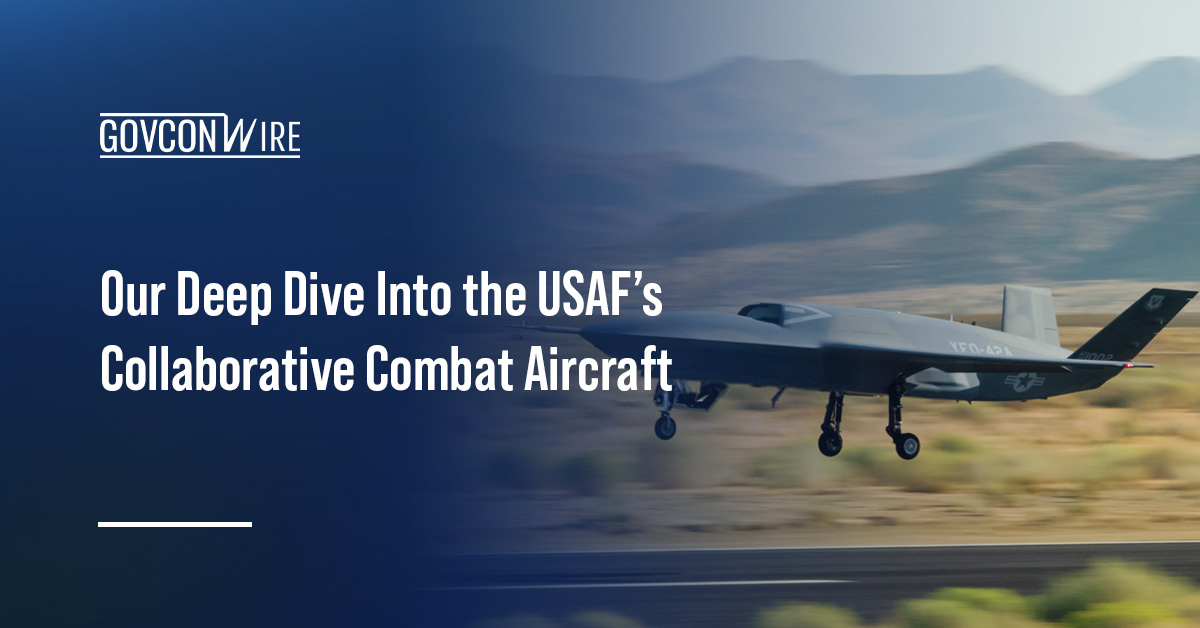

- The USAF’s Collaborative Combat Aircraft program is one of the service’s most ambitious and consequential acquisition programs in generations.
- Not only is it the USAF’s first real autonomous aircraft effort, but it leverages novel acquisition strategies and decouples the hardware and software procurement to ensure rapidly upgradable capabilities.
- Dig into CCA business opportunities with USAF Vice Chief of Staff Gen. John Lamontagne during his keynote at the 2026 Air and Space Summit on July 30!
The Air Force’s Collaborative Combat Aircraft program is one of the service’s most ambitious and consequential acquisition programs in generations. Not only is it the USAF’s first true effort at developing autonomous aircraft, but it’s also an experiment in how to get as much technological capability as possible out of hardware and software using novel acquisition strategies.
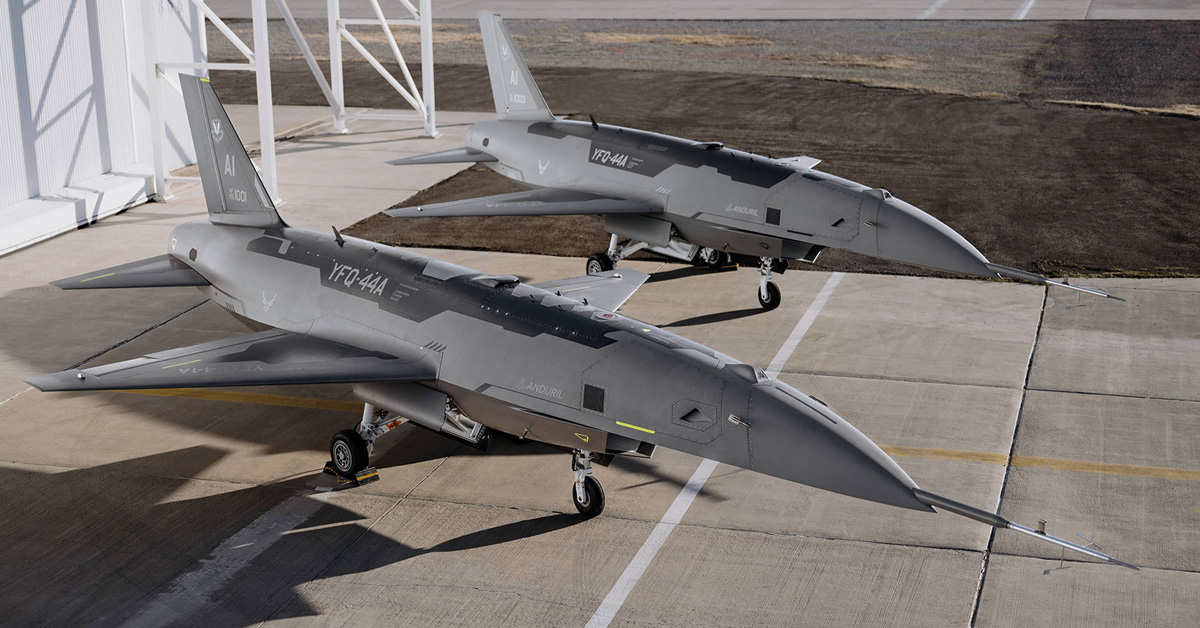
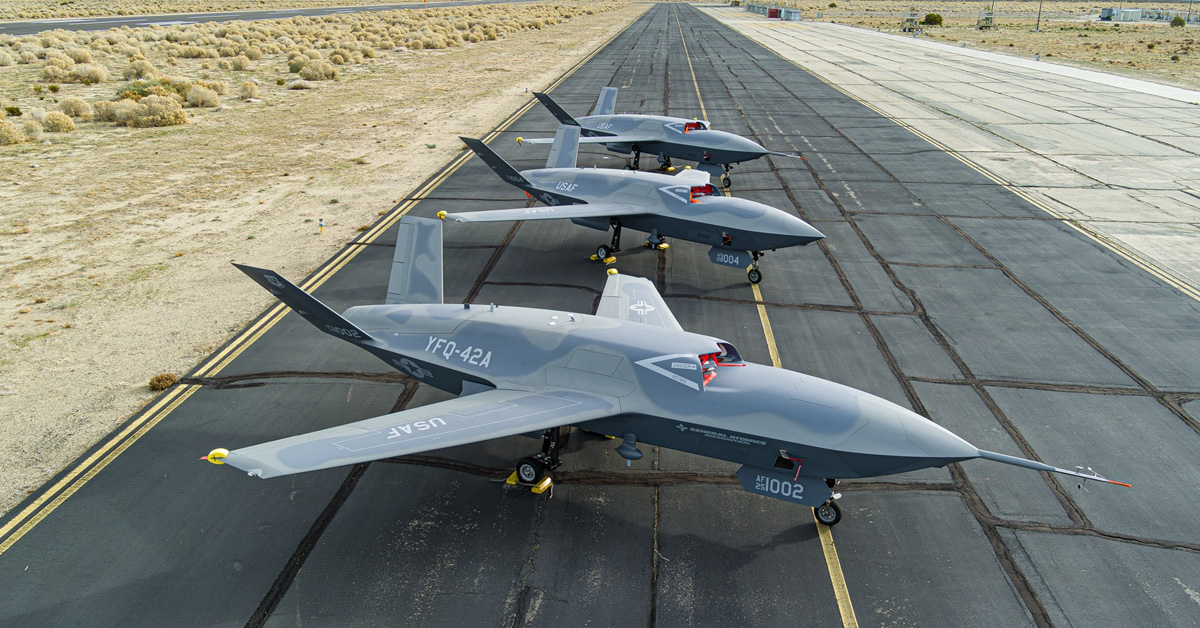
The USAF on June 17 made landmark contract awards to General Atomics and Anduril to develop air vehicles for CCA Increment 1. But the service broke procurement molds by making separate awards to a variety of companies to develop the mission autonomy software. This will ensure the USAF receives state-of-the-art platforms with agile and easily-updatable software.
What Is Collaborative Combat Aircraft?
The Collaborative Combat Aircraft program is a new type of uncrewed weapon system. The USAF plans to fly these large jet-powered platforms alongside new and existing crewed fighters.
The CCAs will potentially perform missions including air-to-air combat, electronic warfare, targeting, and intelligence, surveillance and reconnaissance, or ISR, according to the Congressional Research Service. A key component of the Next Generation Air Dominance, or NGAD, family of systems, the CCA program is an effort to help the USAF rethink the battlespace and extend reach, flexibility and lethality in combat while optimizing warfighter performance through human-machine teaming.
Let’s uncover the details of the CCA program and find out why it’s one of the USAF’s most important programs in decades.
Dive into the plethora of CCA business opportunities at the Potomac Officers Club’s 2026 Air and Space Summit on July 30! Learn what the service wants in CCA Increment 2 software offerings from USAF Vice Chief of Staff Gen. John Lamontagne during his keynote address. Secure your seat today for this highly anticipated GovCon event!
What Are Key Takeaways From the Collaborative Combat Aircraft Program?
1. Aircraft Delivery at Speed and Scale
The USAF specifically picked General Atomics and Anduril not just for the capabilities of their aircraft, but for their ability to meet demanding production rates, according to Breaking Defense. Col. Timothy Helfrich, portfolio acquisition executive for fighters and advanced aircraft, said the service wants the two contractors to deliver operational capability of more than 150 platforms by the end of the decade. The service intends to field about 1,000 combat-capable CCAs.
Following an initial six-month period, the USAF will examine the contractors’ progress and perform a second competitive award period, according to a service statement. This performance-based competition will result in the selection of a primary mission autonomy provider for CCA Increment 1, with a contract award expected for selection by the summer of 2027.
Anduril said in a statement that it has an active production line capable of delivering up to 150 aircraft per year in its current design. Everything on the production line is on wheels, meaning it can iterate on its production system in parallel with iterations on the aircraft itself, or to scale it to further meet surges in demand.
2. Massive Investment in Drones
The CCA program is part of a major Pentagon effort to rapidly develop unmanned aircraft system capabilities. Jules Hurst, the official performing the duties of comptroller and under secretary of war, said CCA is part of $21 billion requested in FY 2027 for munitions, counter-drone technologies and UAS capabilities, DefenseScoop has reported.
This is a substantial increase from the funds requested for similar programs in the previous fiscal year. DOW officials previously sought $13 billion for autonomous systems and $3 billion for counter-UAS capabilities in FY 2026.
For its part, the USAF wants $1 billion to acquire CCAs in FY 2027, according to DefenseOne.
3. Unique Software Acquisition Strategy
The USAF is leveraging a first-of-its-kind acquisition strategy for the CCA’s mission autonomy software. The service is using award fee exposure, which allows for operator feedback and combat performance to determine how much the USAF pays for mission autonomy.
Thus, the USAF will only pay the full licensing fee if a contractor delivers a combat capability that fulfills warfighter needs.
“Mission autonomy is the cornerstone of the CCA concept, and leveraging a competitive, multi-vendor environment ensures we capture the latest technology,” said USAF Secretary and Wash100 Award winner Troy Meink.
The USAF is procuring the CCA’s mission autonomy software separately to ensure it can be updated as the aircraft develops. The service, for this portion of the program, contracted with six companies as part of a baseline, six-year contract vehicle:
- Lockheed Martin
- Northrop Grumman
- Anduril
- General Atomics
- Collins Aerospace
- Shield AI
The USAF, additionally, awarded production options to Andruil, Collins Aerospace and Shield AI to speed up delivery of this essential mission autonomy software. This award is based on the contractors’ ability to meet aggressive schedule and affordability requirements compared to the baseline awards and will fund the first of two six-month competitive phases.
Boost your air and space technology revenues in FY 2027 by attending the Potomac Officers Club’s 2026 Air and Space Summit on July 30! Evaluate accelerating sensor-to-decision timelines through data-centric architectures and mission thread engineering for operational advantage at the Orchestration Across Air and Space Domains panel discussion. It features a slate of top DOW officials:
- Col. Ryan Frazier, Space Force acting portfolio acquisition executive for space-based sensing and targeting
- Col. Jason West, Space Force System Delta 85 commander
- Col. Raj Agrawal (pending confirmation), Space Force military deputy for Air Force PAE C3 and battle management
4. Open Systems Architecture Emphasis
The CCA program is using a foundational open systems architecture strategy. It makes sure mission autonomy software and algorithms from any vendor in the pool can be easily integrated, rapidly updated and ported among different physical aircraft platforms. This will give the effort never-before-seen operational flexibility to evolve to nascent threats.
This strategy is called Autonomy Government Reference Architecture, or A-GRA. It is designed to avoid vendor lock by creating a universal standard for mission autonomy. The A-GRA is being implemented by the CCA’s mission autonomy contractors, Collins Aerospace and Shield AI, which previously started semi-autonomous flight testing in tandem with General Atomics and Anduril on their respective aircraft.
The A-GRA is an example of the USAF’s new approach to acquisition, one that prioritizes innovation, speed and a software-first orientation. A 2024 report by the Center for Strategic and International Studies lauded A-GRA as attractive. This is because the interfaces and standards not only clarify to contractors how to write new software and capabilities compatible with existing systems, but they allow them to work with other developments across the DOW.
Navy leaders have hinted that their autonomous system efforts would conform to the USAF’s A-GRA, prioritizing operability between both services’ platforms and software.
5. Stringent Cost Requirements
The USAF has strict cost targets for the CCA program, as Col. Helfrich said the service wants the aircraft to be in the range of one-third of the price of an F-35 Lightning II. That would be around $30 million, as the cost of a recent F-35A was roughly $83 million, according to Breaking Defense.
CCA competitors have been measuring their costs according to weight. Robert Winkler, Kratos Defense and Security Systems vice president of corporate development and national security programs, said in 2024 that CCA prototypes had a baseline of around $1,200 per pound. Contractors, he said, were targeting less than $1,000 per pound, and even $600-800, according to Air and Space Forces Magazine.
In comparison, Winkler said that crewed fighters and intelligence, surveillance and reconnaissance aircraft were usually priced between $4,000 and $6,000 per pound.