

- Advanced wireless infrastructure is becoming as strategically important as artificial intelligence in modern defense operations
- 5G standalone enables network slicing, security and latency improvements critical for AI-enabled military use cases
- Integrated sensing and communications could offer a cost-effective way to counter drones using existing cellular networks
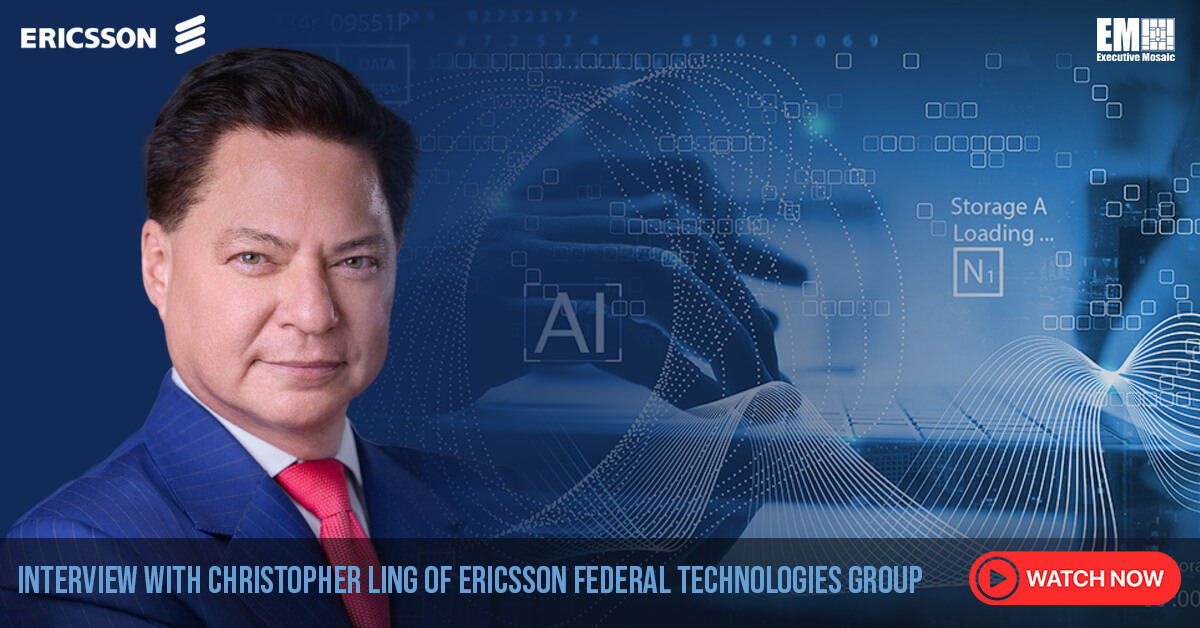
When Ericsson Federal Technologies Group officially launched in March 2024, the new subsidiary was created with a specific mandate: apply proven commercial wireless technologies to U.S. national security missions. In a recent GovCon Conversation with Executive Mosaic Senior Content Manager Charles Lyons-Burt, CEO and President Christopher Ling detailed how 5G, artificial intelligence and next-generation sensing capabilities are reshaping how the Department of War thinks about networks, data and deterrence. Watch the full interview here.

Conversations like these will be front and center at Potomac Officers Club’s 2026 Defense R&D Summit on Jan. 29, where defense and industry leaders will examine how 5G, FutureG and AI are reshaping military operations. The event will feature a keynote from Dr. Thomas Rondeau, principal director for FutureG and 5G at the Department of War. Registration is now open.
Why Was Ericsson Federal Formed in 2024?
Ling, a three-decade Booz Allen Hamilton veteran, said Ericsson Federal’s formation aligns with a broader government push to adopt commercial technology at speed rather than relying solely on bespoke systems.
“As the defense pivoted more to commercial technology, there was going to be much more reliance on wireless communication,” Ling said. “So Ericsson Federal was stood up to directly focus on the government’s mission to help them develop use cases for this dual-use technology and also to work in the classified space.”
How Does 5G Enable AI in Defense Environments?
A central theme of the interview is the often-overlooked role of network infrastructure in enabling artificial intelligence at scale. While AI applications receive significant attention, Ling emphasized that their effectiveness depends on the ability to securely move and process massive amounts of data across reliable networks.
“What people don’t realize is that artificial intelligence needs to ride on some sort of a network transport layer,” Ling said. He pointed to 5G standalone as a critical evolution, explaining that it allows operators to slice networks for specific mission needs, enabling higher security, lower latency and optimized performance for distinct use cases.
Those capabilities carry strategic weight as U.S. adversaries move faster to deploy fully standalone 5G networks tailored for military applications, Ling noted.
What Is ISAC and Why Does It Matter?
The interview also explored integrated sensing and communications, or ISAC, a capability that allows cellular infrastructure to function as a sensor for detecting drones and unmanned aerial systems. Ling described ISAC as a potential game-changer for counter-UAS missions, particularly as militaries look for alternatives to expensive interceptors.
“You can’t shoot a million-dollar missile at a $50,000 drone,” Ling said, explaining that ISAC offers a way to “bend the cost curve” by turning existing cellular networks into detection platforms. Ericsson Federal is currently demonstrating the technology in Sweden and is discussing potential applications with the War Department.
Why Are FutureG and 6G Becoming Strategic Priorities?
Looking ahead, Ling framed the transition from 5G to FutureG and 6G as foundational to maintaining operational advantage and strategic deterrence. He said next-generation networks will support massive device connectivity, ultra-low latency and virtualized environments that allow autonomous systems and AI-enabled platforms to operate seamlessly across dispersed battle spaces.
“No matter how good the AI algorithms are, the platform in which they function will be a huge competitive discriminator,” Ling said, adding that advanced wireless infrastructure will ultimately shape how quickly militaries can collect, analyze and act on data.
Many of those themes will be explored in depth at the 2026 Defense R&D Summit, which will include three panels focused on 5G and FutureG technologies and their implications for defense research, development and operational advantage. Ericsson Federal Technologies is sponsoring the Jan. 29 event, which brings together senior defense officials and industry leaders to examine where next-generation networks are headed, building on many of the challenges Ling outlined during his GovCon Conversation interview. Don’t miss out; save your spot at the summit today!
As Ericsson Federal continues to expand its federal presence, Ling positioned the company as both a technology provider and integrator, helping government customers translate commercial innovation into secure, mission-ready capabilities. In an era defined by data, speed and connectivity, the interview underscored that networks themselves are becoming decisive assets in modern defense strategy.
Watch the full interview with Christopher Ling on YouTube and subscribe to Executive Mosaic’s channel for more in-depth conversations with leading GovCon industry execs.