
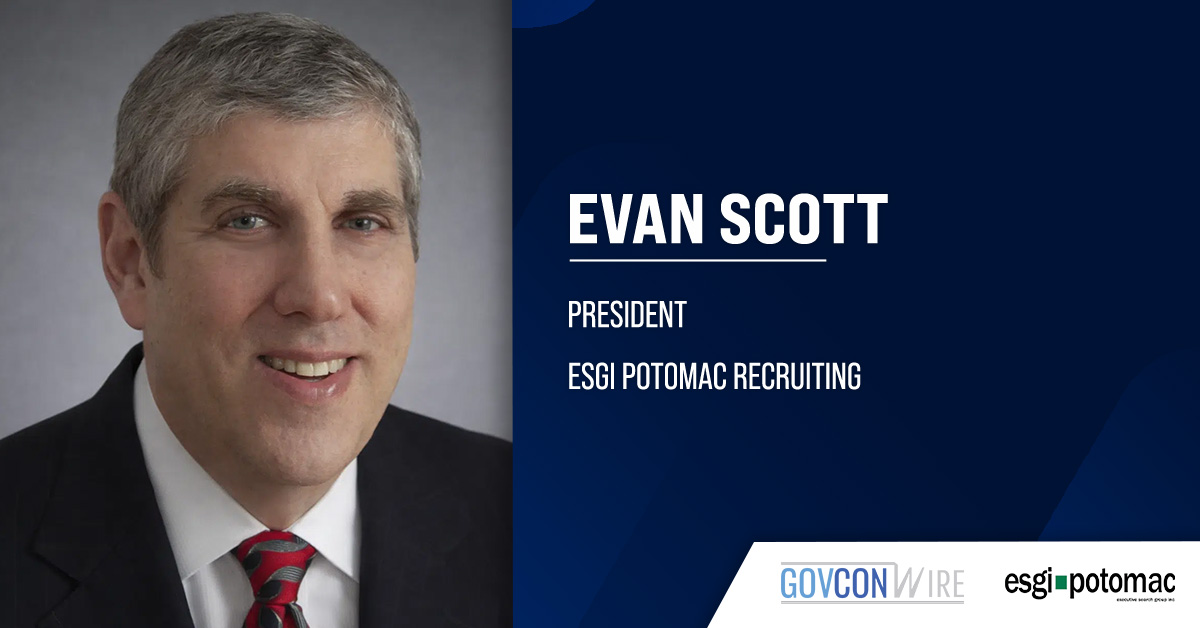

By Evan Scott, CEO, ESGI Potomac Recruiting
Everyone in government contracting talks about winning. Fewer people talk about the search that makes winning possible: finding, vetting and landing the business development executive who can move the needle.
Recruiting a genuinely accomplished federal BD executive is one of the hardest searches in professional services, harder than most CFO, COO, or even CEO searches in this sector. It’s a niche that most search firms don’t understand well, and it deserves to be treated — and priced — accordingly.
Why “Accomplished” Is Rarer Than It Looks
Let’s start with the definition problem. Plenty of executives can build a pipeline, work the conference circuit, make introductions and respond to RFPs. Far fewer can identify an opportunity two to three years before it hits the street, shape a capture strategy, influence requirements ethically and drive it to award. That gap — between activity and outcomes — is where most BD hires disappoint.
A few structural realities make this worse:
The market is a series of small, separate professions. Success at HHS doesn’t transfer to the Air Force. Someone who thrives in the intelligence community may be a poor fit at DHS. Each agency has its own culture, acquisition rhythm and relationship network, which fragments an already small talent pool into even smaller sub-pools.
Relationships take a decade or more to build. Program managers, contracting officers, SES leaders and teaming partners don’t hand over trust quickly. An executive with 15 years of credibility in a specific agency is carrying an asset that literally cannot be replicated on a shorter timeline; no amount of compensation buys that overnight.
Attribution is genuinely murky. A $200 million win usually involves BD, capture, proposal, pricing, solution architects and program leadership (often 10 to 50 people). Many candidates look like proven producers because they were present for major wins, not because they personally drove them. This is the single biggest reason companies hire the wrong person: the résumé says, “I won,” but the real story is “I was in the room.”
Demand has outpaced supply. Continued federal spending, private equity consolidation of government services firms and growth in cybersecurity, cloud and AI modernization work have all increased the number of companies chasing the same small pool of proven talent … and the best people are rarely the ones actively looking. They’re being recruited continuously, well-compensated and embedded in organizations that are already winning. Reaching them is a relationship exercise, not a job posting.
Companies often ask for five competencies in one person. BD, capture management, proposal management, strategic partnerships and account management are distinct disciplines. Searching for one executive who can open doors, run a capture, write win themes, negotiate teaming agreements and forecast revenue sets an unrealistic bar, and it’s a major reason searches stall.
The Verification Problem: Trust, But Verify
Because attribution is so murky, résumé inflation is the norm, not the exception, in this market. The fix isn’t more skepticism: it’s a disciplined process for separating real producers from people who were simply present.
Here’s the framework we at ESGI Potomac Recruiting use with clients:
Walk through the wins, in detail. For each major opportunity, ask about the agency, contract vehicle, value, competition and — critically — the candidate’s personal role. Did they identify the opportunity, shape it, own the customer relationship, lead capture, lead pricing, manage the proposal or negotiate the teaming agreement? Elite performers can walk through every stage. Weak performers get vague fast.
Check the timeline. A real capture leader usually remembers the requirement date, draft RFP date, release date, submission date and award date without hesitation. If those dates are fuzzy, so is the claim of ownership.
Ask about the losses. This is often the most revealing question in the interview: “Tell me about your three biggest losses.” Average performers blame pricing, incumbents, or politics. Elite performers say things like “we engaged six months too late” or “our win themes were weak.” The answer tells you more about accountability than any win story will.
Reference check for role, not enthusiasm. Don’t ask “Would you hire them again?” Ask which opportunities they personally led, which customer relationships were truly theirs, how much of the pipeline they originated and what their biggest weakness was. Most references will tell you the truth if you ask the right question.
Cross-reference public award data. SAM.gov, GovTribe, HigherGov, BGOV, Deltek GovWin and FPDS can confirm award value, date, prime contractor and vehicle. They can’t confirm personal contribution; that’s what the reference calls are for.
Test real-time customer knowledge. Ask who the five most important people in the target market are, and when the candidate last met with them. Relationship currency, not relationship history, is often the strongest predictor of near-term success.
Pressure-test the pipeline. “You claim a billion-dollar pipeline: how much of it was qualified, at what stage, with what PWin and how much has actually been converted to bookings?” A real producer answers instantly. A candidate who’s inflating will start hedging.
Red flags worth remembering: “The company won $2 billion while I was there,” “I supported all major pursuits,” “everybody knows me,” or an unwillingness to get specific without invoking classification. Strong candidates can be specific without disclosing anything sensitive.
What It Actually Costs to Hire a Real Producer
Compensation for proven federal BD talent has moved well beyond what most internal comp frameworks assume, and clients are frequently surprised by current market reality. Based on our active searches:
Strong VP of Business Development Base: $275K–$350K | Target Bonus: 40 percent–60 percent | Total Target Cash: $400K–$560K
Elite VP / Chief Growth Officer: Base: $325K–$450K+ | Target Bonus: 50 percent–100 percent | Total Target Compensation: $500K–$900K+
Intelligence Community Growth Leader (TS/SCI, deep CIA, NSA, NGA, DIA, NRO, or ODNI relationships) Base: $250K–$400K+ | Bonus: 50 percent–60 percent | Long-term incentives or equity participation often expected
Director, Business Development Base: ~$225K | On-Target Earnings: 30 percent–40 percent
These ranges track with broader executive market data showing incentive targets typically running 30 percent to 60 percent of base, with larger growth mandates commanding meaningfully higher total compensation. And they climb further for candidates with active clearances and standing agency relationships.
One caution for clients: watch for frequent job changes. It typically takes three to five years to win and deliver on a federal program, so we generally look for candidates who’ve stayed at least five years per employer. Career stability is one of the clearest signals of both real impact and staying power.
Compensation Gets Attention. It Doesn’t Close the Deal.
The talent pool for proven performers is small and increasingly contested, which means compensation alone rarely wins a successful hire. As mentioned, the executives worth pursuing are almost never active job seekers: they’re already being recruited, already well paid and already embedded somewhere winning. To move them, a company needs a story that goes beyond the offer letter:
- Growth trajectory — Where the company is headed, recent wins, target agencies and pipeline quality
- CEO commitment to growth — Evidence that growth is a company priority, not just a departmental mandate
- Retention and culture — Why people stay, and whether the environment is collaborative and low-drama
- Resources to win — Real capture, proposal, pricing and delivery support, not just a quota
- Decision speed — The ability to move opportunities without getting buried in bureaucracy
- Customer credibility — Past performance, contract vehicles and genuine agency relationships
- Future opportunity — A credible path to CGO, COO, president or equity participation
- Compensation upside — Base, bonus, long-term incentives and transaction participation where relevant
- Leadership access — Direct lines to the CEO and board on strategic pursuits
- Mission and reputation — Credible mission alignment and ethical leadership, which carry real weight in GovCon
Transparency matters here more than in most executive searches, because once an offer goes out in this market, it tends to get accepted or declined based on how well the story was told beforehand, not renegotiated afterward. That’s a large part of what a third-party recruiter who knows this market brings to the table: the credibility to have that conversation candidly, on both sides, before an offer is ever drafted.
The Bottom Line
Business development is a misnomer in federal contracting: it takes a team to win a program, and BD is only one piece of it. But finding the individual who can originate, shape and close opportunities — and proving that they, personally, did it before — is genuinely one of the harder searches in this industry. It deserves a rigorous process, current market data and a fee structure that reflects the difficulty. That combination is exactly what is required to drive growth at your company.