
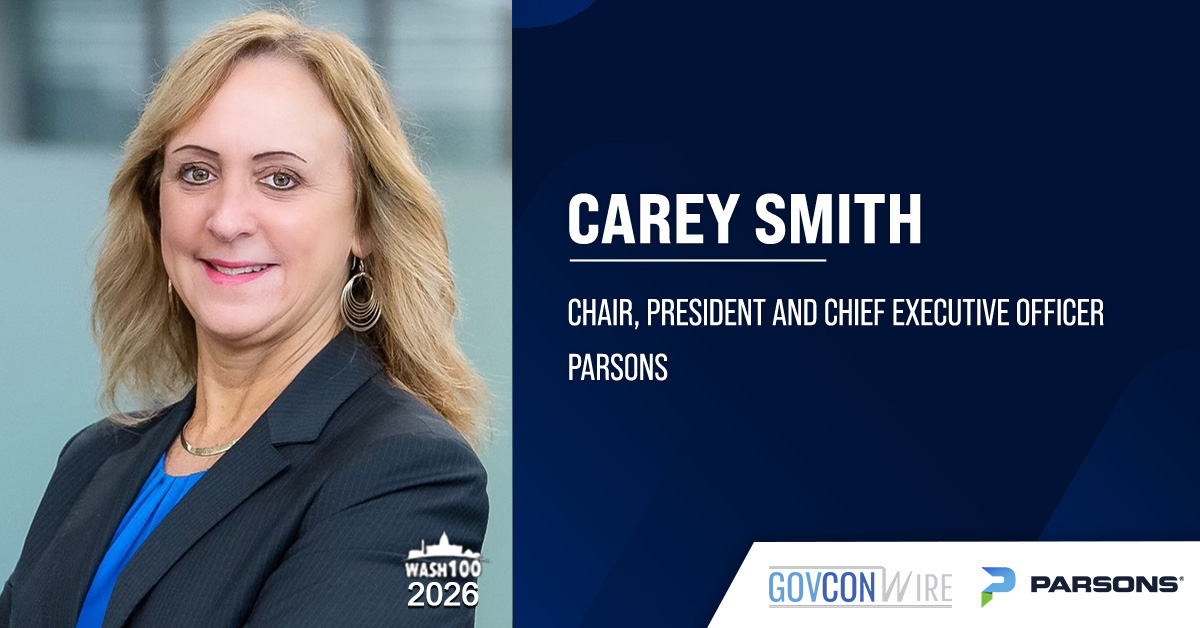

- Parsons has posted $1.6 billion in Q2 2026 revenue with a 1.2x book-to-bill ratio
- Parsons CEO Carey Smith highlighted defense contract wins and M&A strategy
- Explore AI, digital engineering and more at the 2026 Navy Summit
Parsons posted $1.6 billion in second quarter 2026 revenue, down 1 percent from the prior-year period, and ended the quarter with a total backlog of $9.3 billion and a book-to-bill ratio of 1.2x on net bookings of $1.9 billion.

As companies like Parsons continue to grow their footprint in naval intelligence and missile defense work, the Potomac Officers Club invites government and industry professionals to the 2026 Navy Summit on Aug. 27. The event will bring together leaders to discuss artificial intelligence, digital engineering, unmanned systems, network modernization and other initiatives shaping the Navy’s future priorities. Register today to save your seat and join the conversation on where naval innovation is headed next.
In an earnings release published Wednesday, the Chantilly, Virginia-based defense and infrastructure engineering company said Q2 net income swung to a loss of $15 million, compared to net income of $55 million in the same period last year, driven by charges tied to portfolio-shaping actions and a joint venture program.
Excluding those charges, Parsons posted $161 million in adjusted earnings before interest, taxes, depreciation and amortization, or EBITDA, up 8 percent year-over-year, with adjusted EBITDA margin expanding 70 basis points to 10.1 percent.
“Parsons delivered strong book-to-bill ratios in both segments, achieved profitable growth in its core business, and secured strategic contract wins for long-term success,” said Carey Smith, chair, president and CEO of Parsons. “The Middle East business performed exceptionally well despite regional conflict, posting a 1.1x book-to-bill ratio and 10% organic revenue growth, demonstrating strong alignment with regional spending priorities.”
“Looking ahead, we believe Parsons’ strong backlog, robust pipeline, high win rates, and differentiated technology capabilities—especially in advanced AI, cyber, and electronic warfare—position the company to drive profitable growth and deliver long-term shareholder value,” added Smith, an eight-time Wash100 awardee and chair of Executive Mosaic’s 4×24 Group 1 Leadership.
What Defense Contracts Did Parsons Secure?
Parsons continued to build its defense and intelligence portfolio during the quarter, booking five single-award contracts worth more than $100 million each. Key wins included:
- A two-year, $514 million contract extension under the Missile Defense Agency’s TEAMS-Next Systems Engineering contract, extending Parsons’ four-decade partnership with the agency and supporting the integrated Missile Defense System, including Golden Dome-related work
- $400 million in other transaction agreements, each spanning a three-year period of performance, reflecting demand for the company’s mission-critical defense and intelligence solutions
- A five-year, $245 million IDIQ contract from the U.S. Naval Research Laboratory to design, test, maintain and enhance mission-critical software modules and cybersecurity for space and ground systems
- A seven-year, $184 million ceiling-value IDIQ contract to support the Department of the Navy’s Intelligence Carry-On Program, representing new work for the company
- More than $160 million across two classified contracts, one focused on national security and the other on cybersecurity
- An additional $73 million contract supporting the Air Force Research Laboratory’s GARDEM mission, bringing Parsons’ total 2026 GARDEM awards to $218 million
- U.S. Cyber Command expressed intent to raise the Joint Cyber Hunt Kit, or JCHK, contract ceiling to $750 million, which Smith cited as evidence of the company’s capacity to deliver advanced hardware and software offerings at scale.
On the company’s decision to divest two Systems Engineering and Technical Assistance, or SETA, contracts, Smith said the move sharpens Parsons’ focus on higher-value development work.
“By divesting these contracts, we’ve enhanced our ability to focus on delivering critical national security space ground solutions at substantially higher margins,” she said.
How Did Parsons’ Federal Solutions & Critical Infrastructure Segments Perform in Q2 2026?
Parsons’ federal solutions segment posted $761 million in Q2 revenue, down 6 percent year-over-year. Excluding the company’s confidential contract and portfolio-shaping actions, segment revenue rose 11 percent, with 2 percent organic growth. Adjusted EBITDA for the segment came in at a loss of $14 million on a reported basis; excluding charges, adjusted EBITDA was $64 million, down 5 percent, with margin at 8.2 percent.
The critical infrastructure segment reported $815 million in Q2 revenue, up 5 percent year-over-year, driven by organic growth and the company’s Applied Sciences acquisition. Adjusted EBITDA for the segment was $56 million on a reported basis; excluding joint venture-related charges, adjusted EBITDA rose 18 percent to $97 million, with margin expanding 140 basis points to 11.9 percent.
What Did Parsons CEO Carey Smith Say About the Company’s M&A Strategy?
In an earnings call on Wednesday, Smith told analysts that Parsons’ mergers and acquisitions strategy continues to sharpen the company’s federal and defense capabilities.
“Our effective M&A strategy has enabled us to win larger and more profitable programs across both segments,” she said.
She pointed to several examples tied to recent defense wins. “JCHK brought together Parsons cyber operations experience with Sealing Tech’s advanced edge computing capabilities, including agentic AI,” Smith said, adding that Sealing Tech also contributed to the company’s $184 million Navy intelligence win this quarter.
“Similarly, the $400 million in OTA wins were led by Chesapeake Technologies,” she noted. Smith also cited Black Signal‘s role in expanding the company’s classified access. “Black Signal enhanced Parsons classified capabilities, making us an approved contractor with greater access to highly classified projects and secure networks,” she said.
She added that “the biometrics capabilities from Xator enabled the $392 million classified win we announced in the fourth quarter,” and that Parsons is “capitalizing on Altamira synergies in signals intelligence, space and missile defense and foreign military equipment analysis.”
In January, Parsons acquired Altamira Technologies for approximately $375 million as part of efforts to expand its SIGINT, missile warning, cyber and space capabilities for the Department of War and U.S. intelligence community customers.
What Are Smith’s Thoughts on Parsons’ FY 2027 Outlook?
The Parsons chief executive said the company is well-positioned to benefit from rising defense spending heading into fiscal year 2027.
“Within Federal Solutions, we are closely aligned with the administration’s priorities and equipped to deliver the speed, agility and advanced solutions the Department of War requires,” Smith said. “We’re encouraged by the ongoing bipartisan momentum to increase U.S. defense spending.”
She noted that the proposed federal budget lines up closely with the company’s core markets.
“For fiscal year 2027, the administration has proposed a $1.15 trillion base defense budget, representing more than 28% increase over 2026,” Smith said. “Importantly, the proposed FY ’27 budget is closely aligned with Parsons’ core strengths in missile defense, cyber, space, counter unmanned aircraft systems, electronic warfare, facilities modernization and joint all-domain command and control.”