

- SpaceX has secured a $4.16 billion Space Force OTA for the SB-AMTI program
- The award supports the development of a space-based airborne target tracking architecture
- USSF Col. Ryan Frazier will be one of the panelists at the 2026 Air and Space Summit on July 30
SpaceX has received a potential $4.16 billion other transaction authority agreement from the U.S. Space Force to support the development of the Space-Based Airborne Moving Target Indicator, or SB-AMTI, program.

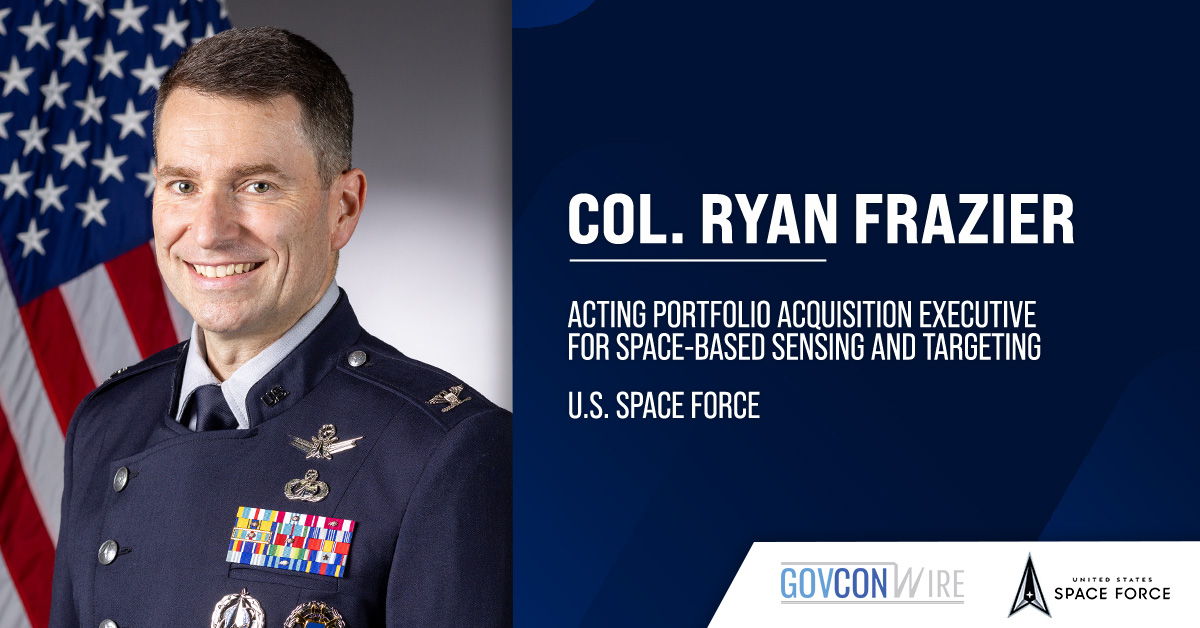
As the Space Force advances new capabilities to strengthen battlespace awareness across contested environments, defense and government leaders continue to explore how air and space systems can operate together more effectively. These topics and other emerging priorities will be part of the conversation at the 2026 Air and Space Summit on July 30, where Col. Ryan Frazier, acting Space Force portfolio acquisition executive for space-based sensing and targeting, will join fellow government and industry leaders for the panel discussion, “From Detection to Decision: Orchestration Across Air and Space Domains.” Book your spot now!
Space Systems Command said Friday the award supports efforts to establish a space-based sensing layer designed to help the Joint Force track and target airborne threats worldwide.
The latest award came days after SpaceX disclosed plans to go public and secured a $2.29 billion Space Force OTA agreement to accelerate the delivery of the Space Data Network Backbone.
What Is the Scope of the Space Force OTA?
The OTA agreement covers development and integration work on the SB-AMTI program, which will combine space-based sensors, communications links and ground processing capabilities into a system-of-systems architecture.
The Space Force is using a hybrid acquisition strategy that combines the flexibility of an OTA agreement with the ordering structure of an indefinite-delivery/indefinite-quantity acquisition model to support rapid capability delivery.
According to the announcement, multiple companies, including SpaceX, were selected for the SB-AMTI vendor pool through previously awarded competitive OTAs.
What Did Col. Ryan Frazier Say About the SB-AMTI Program?
Col. Ryan Frazier, acting Space Force portfolio acquisition executive for space-based sensing and targeting, said the program will help provide sustained battlespace awareness through space-based capabilities.
“By focusing these capabilities to the space domain, we are providing the Joint Force with sustained battlespace awareness of contested airspace,” Frazier said. “We are beginning development and integration efforts immediately to meet the program’s rapid deployment milestones and address emerging national security requirements.”
Frazier also highlighted the service’s multivendor acquisition approach.
“By utilizing this multi-vendor framework, we are capitalizing on established industry capacity and continuously evaluating and onboarding the best tech to field this essential capability at speed and scale,” he said.
According to Frazier, the Space Force will partner with a diversified pool of traditional and nontraditional contractors to support the SB-AMTI architecture and maintain a competitive industrial base for future capability development.
What Is the Goal of the Space-Based Airborne Moving Target Indicator?
The SB-AMTI program aims to provide the Joint Force with a persistent, global capability to detect and track airborne targets from space.
Space Force said the effort complements traditional airborne sensing platforms as adversaries continue to develop anti-access and area-denial capabilities. The service plans to use the space-based architecture to provide battlespace awareness in contested airspace.
The initial award is expected to deploy a constellation of satellites by 2028 to provide the Joint Force with an early operational capability to address blind spots.