

- The Army is requesting $994 million for C-sUAS technologies in its FY 2027 budget request
- The service plans to use this on capabilities including directed energy, handheld, and both kinetic and non-kinetic interceptors.
- Get the latest C-UAS and C-sUAS investment insights directly from top Army officials at the 2026 Army Summit on June 18!
The Army plans on making massive investments in counter-small unmanned aerial system, or C-sUAS, technology in FY 2027 to fight increasingly affordable, advanced and effective small drones.
These aircraft pose a significant threat to installations and deployed forces globally. Enemy forces are effectively using them for intelligence gathering, targeting, direct and indirect fires, electronic support and other missions. They penetrate fixed sites and installations and are quickly growing more capable in targeting Department of War personnel and equipment.
Not only is the $994 million the service requested for C-UAS a 195 percent increase on the $336 million provided in FY 2026, but the service anticipates requesting $1.4 billion in FY 2028, which would be a 316 percent boost from FY 2026. These investments would cover a wide variety of emerging C-UAS capabilities, including:
- C-sUAS missiles and interceptors. The Army plans further work on both kinetic and non-kinetic missiles and interceptors capable of defeating small drones.
- Fixed-site protection. The service plans on acquiring additional joint and Army counter small UAS, or C-sUAS, capabilities to guard fixed locations.
- Directed energy. The Army wants to buy as many as two 30 kW high energy weapon systems to better protect against smaller Group 1 and 2 and mid-sized Group 3 “one way attack” UAS.
Discover the latest C-UAS and C-sUAS business opportunities at the Potomac Officers Club’s 2026 Army Summit on June 18! Get exclusive investment insights from Lt. Gen. Jeth Rey, Army deputy chief of staff, G-6; and Katie Thompson, deputy executive director for Army Contracting Command-Aberdeen Proving Ground, during their insightful keynote addresses. Secure your seat today!
sUAS are defined by the Pentagon as drones in Groups 1-3. These aircraft weigh as much as 20 lbs and operate at 100 knots indicated airspeed in group 1, and weigh as much as 1,320 pounds and up to 250 KIAS in Group 3. Group 1 sUAS are similar in size and capability to the AeroVironment Puma, while Group 3 sUAS have attributes like the RQ-7B Shadow.
The Army’s FY 2027 budget request for C-sUAS capabilities would be a transformational investment for success in future warfare. Let’s examine our five biggest insights into the Army’s budget request for C-sUAS technologies.
What are the Biggest Insights Into the Army’s C-sUAS Budget Request?
1. More Money for C-sUAS Missiles and Interceptors
The Army wants to double its spending on C-sUAS capabilities like interceptors and missiles, some with explosive payloads and some without. The service requested $132 million for what it calls C-sUAS Effectors in FY 2027, up 120 percent from the $60 million enacted in FY 2026.
The Army wants to spend $111 million to buy 800 kinetic interceptor all-up rounds. These are Raytheon’s Coyote Block 2, an expendable C-UAS system that uses a kinetic warhead to defeat drones of various sizes. The Army expects to award a contract to Raytheon for the Coyote Block 2 under this budget line in April 2027.
The service also plans to invest $8 million in FY 2027 for Raytheon’s Coyote Block 3 NK non-kinetic interceptor. This is a C-UAS system that can loiter and defeat drones using a non-kinetic payload that reduces the potential for collateral damage.
AeroVironment also has a C-UAS kinetic interceptor called the Freedom Eagle. The company in late 2025 was awarded a $96 million Army contract for its Long-Range Kinetic Interceptor, or LRKI, program. The Freedom Eagle is designed to defeat Groups 2 and 3 drones.
2. Escalating Laser Development
The Army plans on furthering its development of directed energy, or lasers, to defeat adversary sUAS. The service plans on spending $66 million on directed energy under its C-sUAS line of effort in FY 2027, this would be a 32 percent boost from the $50 million enacted in FY 2026.
The service specifically wants to procure as many as two 30 kW Enduring High Energy Laser systems based on its Enduring HEL Modular Open System Approach architecture. This capability is an air defense weapon system that can acquire, track, identify and defeat sUAS.
C-sUAS capabilities can’t defeat small enemy drones without connectivity. Get the latest on the Army’s plans to power connectivity among C-sUAS and C-UAS platforms at the Potomac Officers Club’s 2026 Army Summit on June 18! Get actionable business intelligence from these top Army officials at the What’s Still Needed to Enable a Hyperconnected Battlefield panel discussion:
- Robert Monto, program manager for robotic control and integration and capability program executive for mission autonomy
- Christopher Manning, deputy assistant secretary for research and technology (pending confirmation)
- Daniel Duvak, senior science and technology manager and assistant director of network and communications
3. Expanding Portable C-sUAS Technology
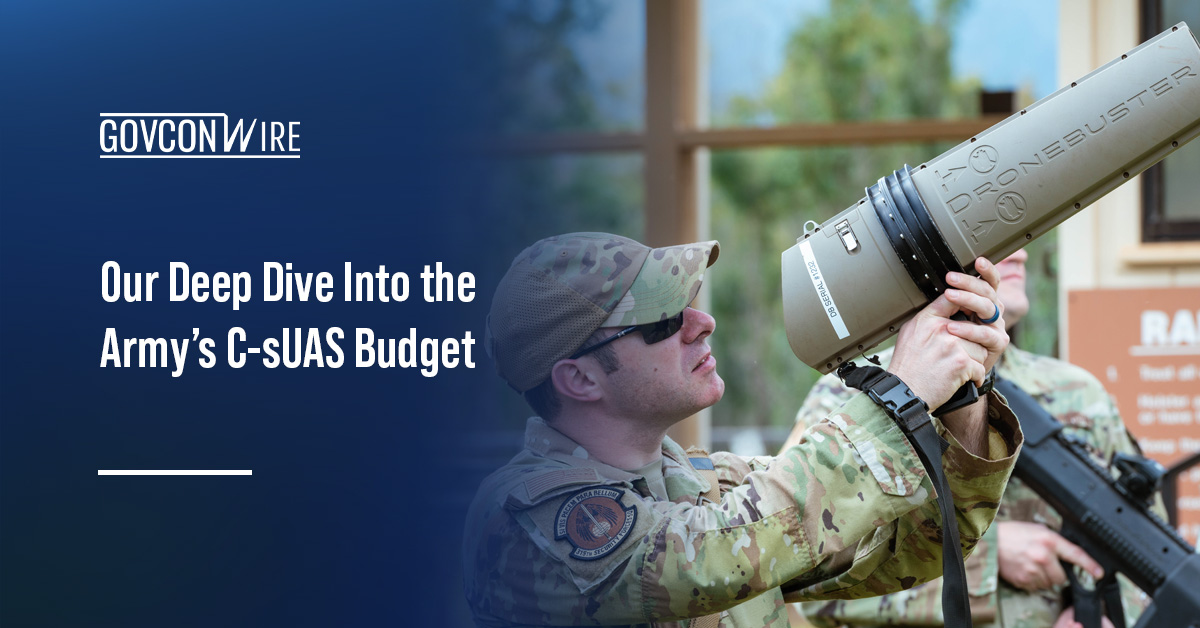
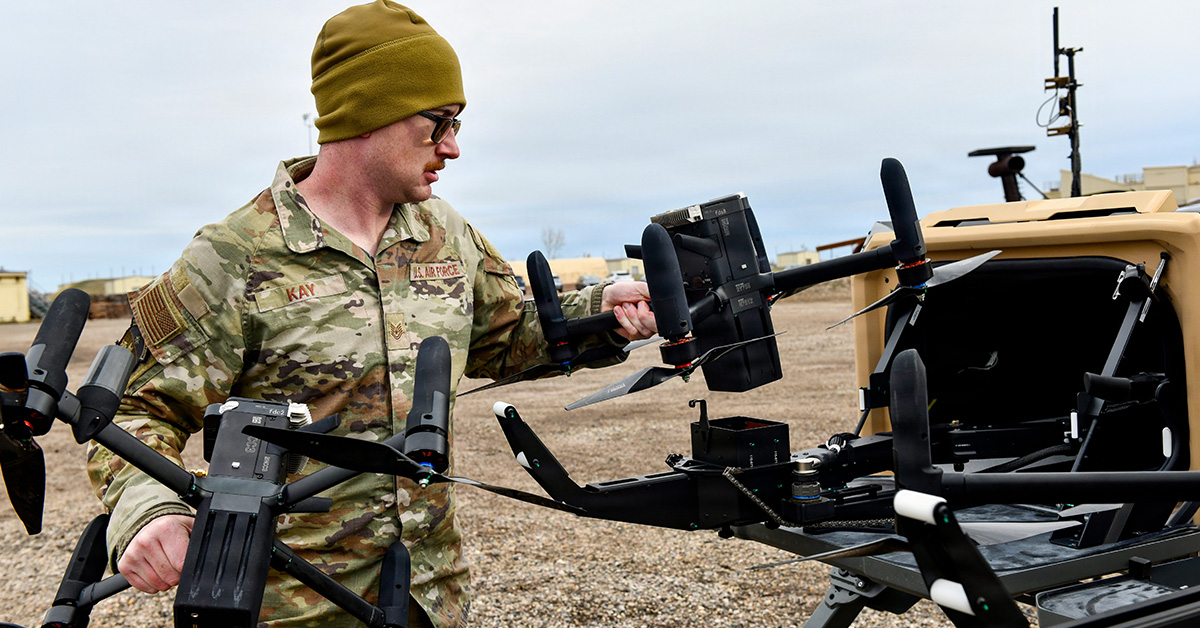
The Army wants to procure common and portable C-sUAS capabilities that almost any soldier can operate. The service plans to spend $108 million in FY 2027 for Soldier Common C-sUAS technologies for operations at the squad and individual soldier levels to provide dismounted, handheld and wearable systems for self-protection against Groups 1 and 2 threats.
These Soldier Common C-sUAS technologies can also use electronic warfare to defeat small enemy drones, the Army said in a special notice posted on sam.gov in early 2025. These systems must not require more than a single soldier to operate.
The DZYNE Dronebuster is an example of a Soldier Common C-sUAS technology. It uses radio frequency waves to detect enemy sUAS and leverages position, navigation and timing, or PNT, spoofing to disrupt the aircraft’s navigation and control.
4. Investment in Protection for Fixed Installations
The Army is maintaining its investment in what it calls C-sUAS Fixed by requesting $165 million in FY 2027. This is close to the $164 million provided in FY 2026.
The Army’s C-sUAS Fixed request would provide protection against sUAS while supporting upgrades of current Homeland and Specific Fixed Sites to a heavy configuration. It would also provide obsolescence mitigation, sustainment spares, fielding and integrated logistics support efforts.
5. Big Boost for Defending C-UAS Batteries
The Army is back to spending big money on what it calls C-sUAS Operational, or supporting the procurement, integration and fielding of capabilities for C-UAS Batteries. The service plans to spend $414 million for C-sUAS Operational in FY 2027, up 1,328 percent from $29 million in FY 2026.
The largest chunk of C-sUAS Operational investment will go toward mobile C-UAS and expeditionary sensors. Each is slated to receive $130 million. The service also wants to invest $72 million in a mobile sensor capability.