

As cybersecurity requirements continue to evolve across the federal landscape, government contractors are facing an increasingly complex web of frameworks, certifications and compliance mandates. From CMMC to NIST standards and FedRAMP, understanding how these requirements intersect is becoming essential for security and business survival alike.
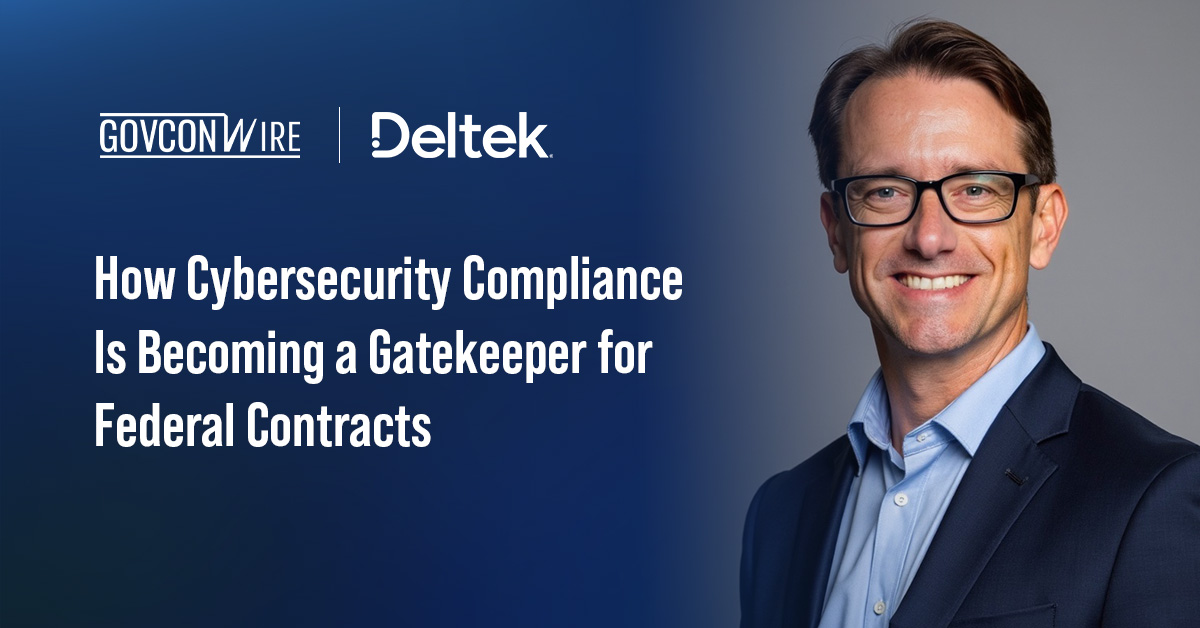
Michael Greenman, senior manager of cloud solutions at Deltek, emphasized during a recent Executive Mosaic webinar that cybersecurity compliance is no longer a secondary consideration in government contracting.
 Attendees of the 2026 Cyber Summit on May 21 will gain practical strategies to strengthen cyber readiness, meet new requirements and stay competitive in today’s market. The event will feature top government officials, like DOW Assistant Secretary for Cyber Policy Kathrine Sutton, Air Force Technical Director of Control Systems Cybersecurity Daryl Haegley, FBI Cyber Division Deputy Assistant Director Michael Machtinger, sharing insights on CMMC, zero trust and emerging cyber priorities shaping federal acquisition.
How Is Cybersecurity Compliance Becoming a Gatekeeper for Federal Contracts?
Cybersecurity compliance is now a frontline factor in whether companies can compete for and win federal business. As agencies respond to rising cyber threats and increased scrutiny around data protection, acquisition policies are evolving to prioritize security as a prerequisite rather than a differentiator.
The shift is being driven in part by broader changes in federal acquisition policy, where cybersecurity readiness is increasingly tied directly to contract eligibility.
“Cyber compliance is now a condition for award in many federal contracts,” Greenman said.
This means contractors are being evaluated on their ability to demonstrate compliance before they even reach later stages of the procurement process. In many cases, failure to meet baseline requirements results in immediate disqualification.
He added that contractors who fail to meet requirements are less competitive and may be excluded altogether.
“If you don’t meet the requirements, you’re… not even eligible to win an award,” he said.
This shift reflects a broader prioritization of security across agencies, particularly for mission-critical systems where vulnerabilities can have operational or national security consequences.
“Security is prioritized over convenience… when there’s a tradeoff, security’s gonna win every time,” Greenman noted.
For contractors, this represents a fundamental change in how they approach bids: cybersecurity is no longer a compliance box to check, but a prerequisite for entry into the federal marketplace.
What Are the Key Cybersecurity Frameworks GovCons Must Understand, Including CMMC and NIST?
Navigating the federal cybersecurity landscape requires a clear understanding of several foundational frameworks, many of which are interconnected and increasingly enforced across contracts. At the center of the compliance landscape is the Cybersecurity Maturity Model Certification, or CMMC, which Greenman described as a defining standard for defense contractors.
“CMMC… stands for the Cybersecurity Maturity Model Certification. It’s specific to defense contractors,” he said.
CMMC builds on existing standards, most notably NIST Special Publication 800-171, which has long served as the baseline for protecting controlled unclassified information across non-federal systems.
“NIST 800-171… that’s protection of controlled unclassified information,” Greenman explained.
Together, these frameworks establish the technical and procedural controls contractors must implement to safeguard sensitive data. However, the compliance environment extends well beyond these two standards.
These frameworks are not isolated. Instead, they operate as part of a broader ecosystem of compliance requirements that reinforce one another.
“All of these different programs have crossover,” Greenman said, pointing to additional standards such as ISO certifications, ITAR regulations and FedRAMP requirements.
For GovCons, success increasingly depends on understanding how these frameworks align and how to build a cohesive security posture that satisfies multiple requirements simultaneously.
Why Is Cybersecurity Maturity Now a Competitive Differentiator in GovCon?
As cybersecurity requirements become more rigorous, agencies are shifting how they evaluate contractors, moving beyond basic compliance toward a deeper assessment of overall cyber maturity.
Agencies are increasingly using compliance as a sign of organizational readiness, resilience and risk management capability.
“Cybersecurity maturity is now a competitive differentiator and not just a background compliance task,” Greenman said.
This evolution is changing the dynamics of source selection, where contracting officers are placing greater emphasis on proven capabilities rather than future intentions. This shift is evident in how contracting officers evaluate proposals, with greater emphasis on demonstrated capabilities rather than planned improvements.
“If you can’t show validated proof of compliance and readiness, you’re not gonna make it past the first evaluation gate,” he said.
In practical terms, this means contractors must move beyond policy documentation and invest in measurable, auditable security practices. Certifications, third-party assessments, continuous monitoring and documented controls are becoming essential tools for demonstrating credibility.
As a result, contractors are increasingly expected to provide tangible evidence of their security posture, from certifications to continuous monitoring data.
For many organizations, this marks a shift from reactive compliance to proactive investment in cybersecurity as a core business capability.
What Role Do Subcontractors Play in Cybersecurity Compliance?
Cybersecurity responsibility in the federal landscape no longer stops at the organizational boundary. Increasingly, agencies and prime contractors are holding the entire supply chain accountable for maintaining strong security practices.
One of the most significant developments in recent years is the extension of cybersecurity requirements across partnerships.
“Prime contractors are responsible for ensuring that security requirements flow down to every subcontractor,” Greenman said.
This requirement introduces new layers of complexity, particularly for organizations that rely on extensive networks of partners, vendors and subcontractors. Ensuring consistent compliance across this ecosystem can be difficult, especially when visibility into partner security practices is limited.
This creates new challenges for contractors, particularly as confidence in supply chain cybersecurity remains uneven.
“There’s not many government contractors… that can say definitively right now, ‘Yes, I know that my subcontractor supply chain is all 100 percent with it,'” he noted. “[So] they’re going to want proof, they’re gonna start asking for receipts, and that’s where we segue into these compliance requirements— having these cybersecurity compliance and, and this culture of security is paramount. It’s a huge differentiator.”
As agencies increase scrutiny of supply chain risk, contractors must adopt a more holistic approach to cybersecurity, one that includes vetting partners, enforcing standards and maintaining ongoing oversight.
As agencies scrutinize supply chain risk more closely, contractors must be prepared to demonstrate not only their own compliance but that of their partners.
This shift reinforces a broader trend across GovCon: cybersecurity is a shared obligation across the entire ecosystem supporting federal missions.
Staying Ahead of the Cybersecurity Compliance Landscape
Looking ahead, Greenman made clear that the compliance burden is only expected to grow as new regulations and standards emerge.
“It’s not going away… this is the new normal,” he said.
For government contractors, the takeaway is clear: navigating the expanding cybersecurity compliance landscape is no longer optional. It is a foundational requirement for competing and succeeding in today’s contracting environment.
For government contractors looking to stay ahead of evolving cybersecurity requirements, the 2026 Cyber Summit on May 21 will offer critical insights into compliance, zero trust and emerging federal priorities. The event will bring together government buyers and industry experts to discuss how organizations can strengthen cyber readiness while remaining competitive in an increasingly regulated market.