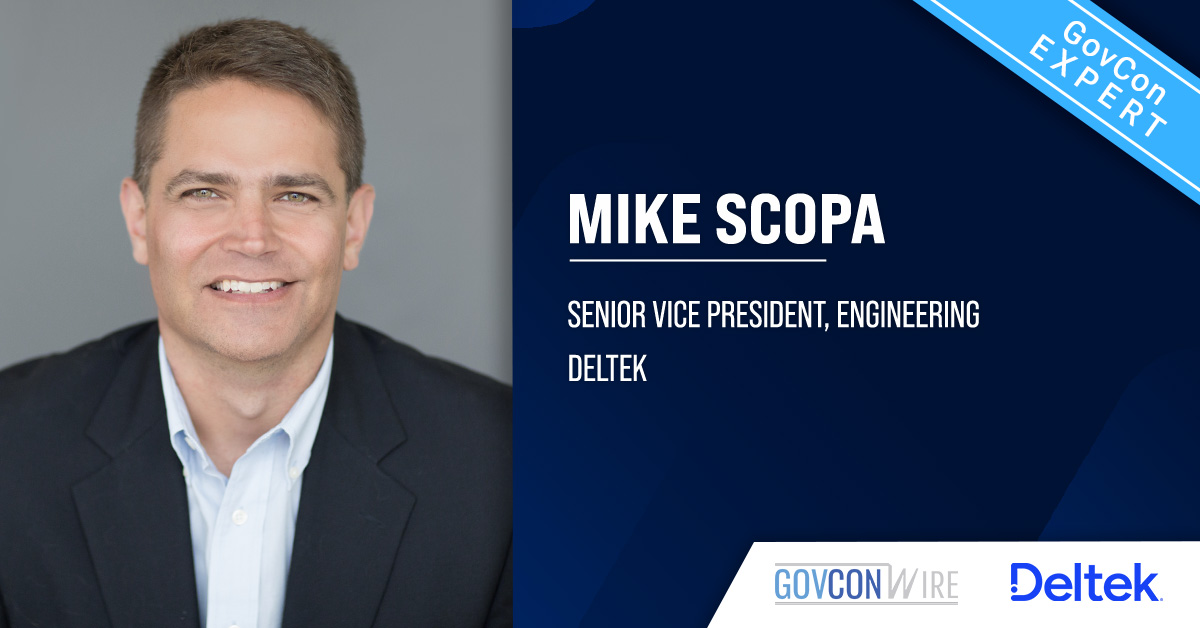

By Mike Scopa, SVP Engineering, Deltek
For government contractors, operating in the cloud is quickly becoming essential for competing in the federal market. Cloud platforms offer the scalability, agility and real-time insight that modern programs demand and most organizations recognize that the shift is inevitable.
But knowing the destination doesn’t always make the journey easier. Many GovCon teams still grapple with cost uncertainty, evolving security and compliance mandates, legacy system constraints and competing priorities. These challenges are real—and they’re common. The encouraging news is that there are practical, proven ways to navigate them while keeping mission readiness front and center.
Managing Cost Uncertainty
There’s no way around the fact that a cloud migration costs money – and for complex workloads, this can be a significant amount. When evaluating the true cost of what your cloud migration might look like, it is important for organizations, especially those operating in the government contracting space, to consider both direct and indirect expenses:
- Direct costs include cloud service provider fees, increased network bandwidth needs and the labor required to prepare, migrate and validate systems in their new environment.
- Indirect costs can emerge if unplanned disruptions occur. System outages may reduce employee productivity, while degraded online performance can negatively impact customer experience and erode trust.
Other costs can arise from the need to maintain compliance, protect sensitive government data and minimize downtime for mission-critical services. Each of these factors can introduce additional layers of cost that must be carefully planned for.
Despite these challenges, organizations can improve cost predictability by partnering with experienced migration specialists and leveraging cost estimation tools. Doing so gives teams a more realistic view of the resources required and helps ensure that cloud adoption delivers the long-term performance, scalability and security benefits that public sector customers increasingly expect.
Practical Step: Use cost estimation tools and work with experienced migration partners to build realistic, scenario-based cost models that reduce financial unknowns and prevent budget overruns.
Meeting Security & Compliance Requirements
Data protection is always a top concern when migrating or modernizing systems in cloud platforms. For government contractors, the challenge is even higher because cloud environments and cloud service providers, must meet strict, evolving regulatory requirements such as:
- GSA (January 2026): All contracts will require government contractors handling CUI to meet NIST SP 800-171 Rev. 3 security standards and validated by independent assessment. Your cloud solutions must support compliance with FedRAMP Moderate security.
- CMMC (November 2025): Nearly all new DoD contracts require CMMC certification at the time of award. This means your cloud solutions must be FedRAMP Moderate Authorized or Equivalent if in-scope.
- DFARS 252.2047012: Requires cloud solutions to be FedRAMP Moderate Authorized or Equivalent if handling CUI. Your cloud solutions must demonstrate compliance, or you risk civil penalty or contract loss.
- ExportControlled Data: Export controlled data brings additional restrictions on who can access systems and where data can reside. These rules can limit which cloud services you can use and how you configure them.
These mandates vary by agency and industry, but all contractors must ensure their cloud solutions meet rigorous security and data handling rules. This often requires partnering closely with cloud providers to validate compliance, configure environments correctly and maintain audit ready posture throughout the lifecycle of the system.
Practical Step: Establish a compliance-first architecture by selecting cloud platforms that can demonstrate FedRAMP Moderate Equivalency or Authorization (ATO) and embed security assessments and continuous monitoring into every phase of the migration plan.
Modernizing Legacy Systems
Longstanding on-premises systems, custom code and outdated architecture can’t always be lifted and shifted, turning modernization into a sometimes long-term undertaking. A major part of that challenge comes from custom or homegrown integrations—especially those built without modern APIs and instead relying on direct database connections, network calls, or bespoke code.
These integrations often sit deep in the workflow and usually require the heaviest lift to refactor or eliminate before they can operate reliably in a cloud environment. But this, too, can be mitigated by working with a trusted partner that has years of experience helping organizations untangle complex legacy environments and move them to the cloud.
As organizations modernize, AI enabled tools and workflows are increasingly assumed to be part of cloud operations and their effectiveness depends on modern architectures, accessible data and clean integration patterns. This makes addressing legacy complexity not just a technical requirement—but a foundational step for enabling future AI driven capabilities across their solutions.
Practical Step: Conduct a workload by workload readiness assessment to determine which systems can move as is, which need refactoring (especially those with non API based integrations) and which should be retired—prioritizing migrations that deliver the fastest business and cost benefits.
Driving Organizational Readiness
Teams accustomed to working with the same legacy workflows that have been used for years may resist cloud adoption due to fear of disruption, lack of cloud skills, or concerns about shifts in job responsibilities.
Change management is challenging. You’ll want to clearly communicate what is happening and at what stage, setting a clear plan with set goals and a comprehensive migration strategy that account for various factors, including overall business objectives, potential downtime mitigation and workload assessment
Practical Step: Pair migration efforts with change management initiatives that include role-based training, early stakeholder engagement and clear communication about how cloud capabilities support your business outcomes.
Conclusion
Cloud migration comes with its challenges, but none are insurmountable with the right preparation and partnership. With a secure and scalable cloud environment, the right tools can simplify collaboration, strengthen visibility and help organizations move away from the constraints of legacy systems with confidence.
By anticipating risks and planning each phase of the journey, government contractors can fully realize the advantages of operating in the cloud—from improved efficiency and stronger compliance to more predictable costs. The transition may be complex, but with a thoughtful, well-structured approach and a partner like Deltek, who is committed to supporting your long-term success, it becomes a clear and achievable path forward.