
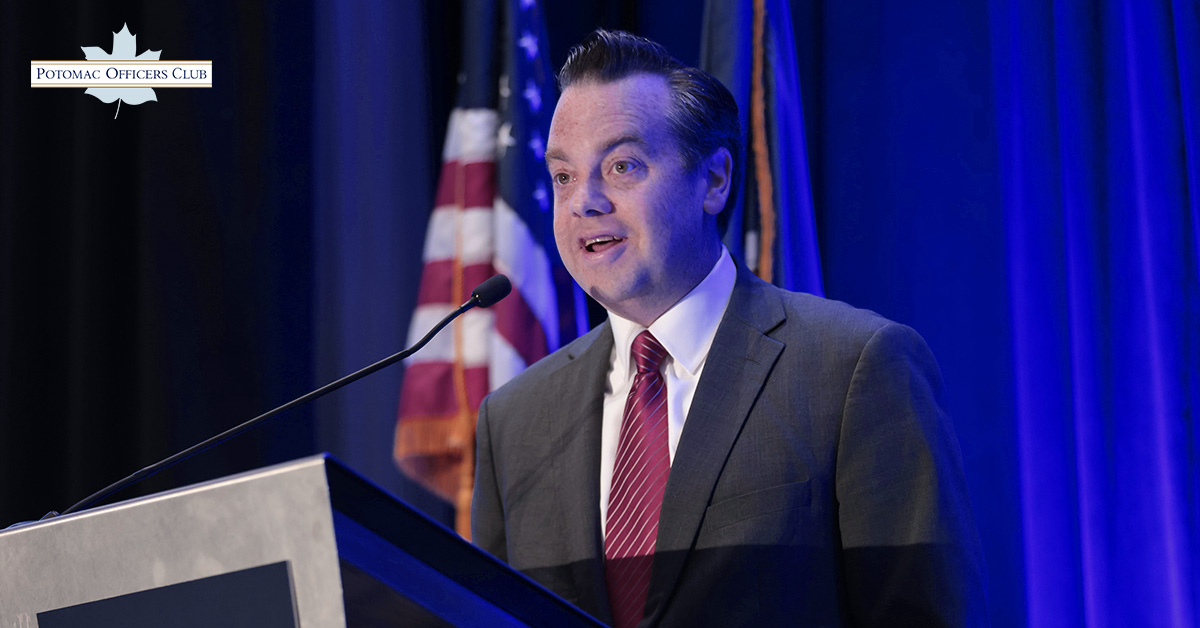

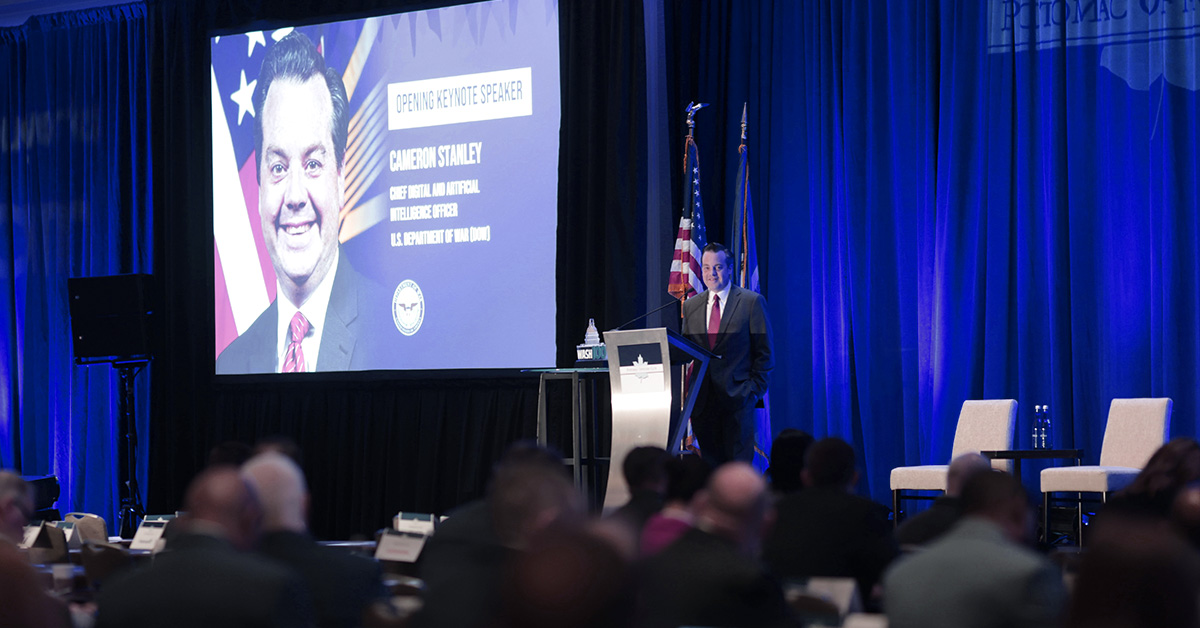
The Department of War is charting a new course with artificial intelligence: moving from a mode of strategic enablement to disciplined delivery. The Pentagon wants to put “key critical [AI] capabilities” in the hands of warfighters as fast as possible, according to Cameron Stanley, who was appointed chief digital and artificial intelligence officer for the entire U.S. warfighting enterprise in January.
Stanley, a 2026 Wash100 Award winner, told the Potomac Officers Club’s 2026 Artificial Intelligence Summit on Wednesday that the department’s prior AI approach was more “piecemeal” and siloed and that the new approach aims to provide every military and civilian component with AI for “every workload.” Where prior timelines for new AI capability delivery were sometimes two-to-three years, Stanley and his team are aiming for completion in a matter of a few months. A revised AI Strategy for the War Department was issued in January concurrent with the announcement of Stanley taking the role.

Continue the critical conversation on DOW technology modernization at Potomac Officers Club’s 2026 Digital Transformation Summit on April 22. The event will feature a keynote from Pentagon Chief Information Officer Kirsten Davies. Don’t miss this prime networking opportunity, and the chance to level-up on new business. Register now!
What Is the Pentagon’s Three-Portfolio Approach for Pace-Setting Projects?
During his AI Summit keynote, Stanley said his team has a three-pronged approach to the seven Pace-Setting Projects announced in the aforementioned AI Strategy. They are as follows:
- Deliver actual capability to actual warfighters in real time
- Identify blockers for delivery of capabilities
- Identify critical capabilities that can be scaled
Who Is Cameron Stanley?
Cameron Stanley is a longtime Pentagon technologist and public servant. A U.S. Air Force Academy graduate, he began his career in the U.S. Air Force in the 2000s as a lieutenant and later supported the USAF in a stint at Concurrent Technologies. At Booz Allen Hamilton, he collaborated closely with the Defense Advanced Research Projects Agency on emerging tech like counter IED, sensor miniaturization, data processing and microsystem materials development.
Stanley then served in positions at U.S. Southern Command and the Office of the Under Secretary of Defense for Intelligence and Security and stewarded the Project Maven initiative, “the largest AI algorithm development and deployment program,” according to his LinkedIn profile.
He briefly moved to industry to work as a national security technology lead at Amazon Web Services before reentering public service in January 2026 as the Pentagon’s CDAO. He is a winner of the 2026 Wash100 Award, the highest honor in government contracting.
How Is the New AI Strategy Similar to Project Maven?
Stanley likened his CDAO team’s methodology to his philosophy for Project Maven when he helped launch and nurture Maven in its early stages. This means not aiming for 100 percent perfection in terms of performance of AI capabilities, but rather aiming for 80 percent success, and then conducting trial and error alongside users until a system is fully optimized and synced to the desired mission outcomes.
“Put it in front of warfighters, have them give you feedback—usually very aggressive and with-prejudice feedback—on how bad it was, and then iterate again. And iterate again. Until you [get] to a solution that works. Once you have a solution that works, you’re not satisfied. You keep iterating until you get to perfection…They tell us what’s wrong with it, we fix it, we deploy. End of story,” Stanley shared.
The goal is, simply, to “create data-centric solutions that you can put into the hands of warfighters,” because in all of his recent conversations, he has “not met a single senior leader at the three- or four-star level in uniform who does not believe that the next war is going to be fought in a data-centric way with AI tools.”
How Is Advana Being Rebranded?
Advana, one of the Pentagon’s longest running AI initiatives, was a precedent for the creation of the Chief Digital and Artificial Intelligence Office in 2022. Advana is currently undergoing realignment, which includes a rebrand in nomenclature: it has now been dubbed the War Data Platform.
“What we’re trying to do with the War Data Platform is accelerate the identification of true authoritative data for warfighting systems and data-centric systems that warfighters are using and trying to mature that platform so that it becomes that robust database that we need in order to conduct warfighting activities,” Stanley said.
Advana has come to be financially focused, working in concert with the DOW comptroller, and Stanley said that aspect of the program’s focus is going to remain under the new name. But its main activities will be concentrated around driving authoritative data to warfighter tools, fast.
GovCons can learn about new ways to join forces with the Department of War and many other federal agencies at Potomac Officers Club’s 2026 Digital Transformation Summit. Discussions at the April 22 event will center on AI, mission engineering and other advanced tech. Save your spot today.
What Is Agent Builder?
As part of Stanley and Under Secretary of War for Research and Engineering Emil Michael’s mission to get the entire Pentagon using AI on a daily basis, they have introduced a new capability called Agent Builder. (Michael is also a past Potomac Officers Club guest and a fellow Wash100 winner.)
Stanley told the GovCon audience at the 2026 Artificial Intelligence Summit that the department made Agent Builder available at the beginning of March to help them construct customized AI agents for their workflows. Within 48 hours, Pentagon employees had created about 8,000 agents. Two weeks on, 20,000 agents have been programmed to operate.
The agents’ use cases reportedly range from basic tasks like memo-writing and email reviews to “integrat[ing] four different data sources at the CUI level to give me a better dashboard for what it is that we’re doing for those individual offices,” Stanley remarked.
“This democratization is actually quite fascinating to watch, because depending on who you are and what office you’re attached to, we’re putting tools in the hands of these individuals who have very little coding experience, and yet they’re doing things in identifying workflows in ways that just are blowing our minds,” he continued.
Where Should GovCons Go to Find DOW CDAO Opportunities?
Stanley encouraged the GovCon industry to closely consult the Tradewinds Solutions Marketplace, the DOW CDAO’s online repository of opportunities, notices and information regarding need areas and public-private collaboration on AI.
He said that the office is exploring and expanding their use of various contracting vehicles and contracting authorities and that he plans on “leveraging [Tradewinds] a whole lot more because it is an easy way to do the solicitation and the down-selection of vendors that we can then go to rapid contracting with.”