
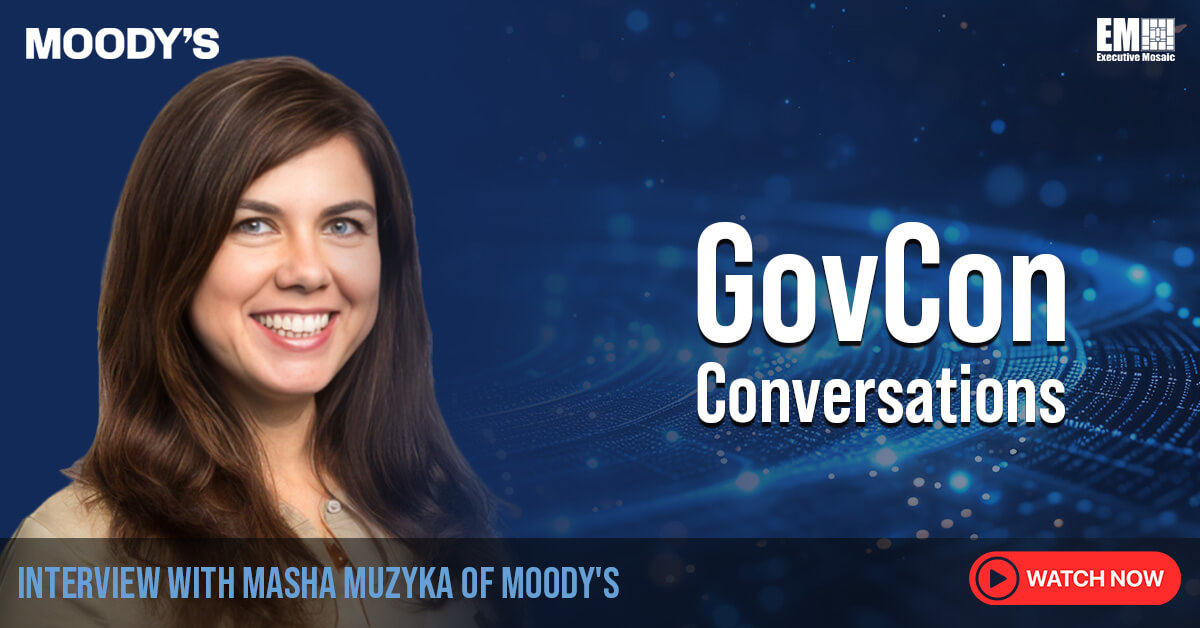

Moody’s is positioning its data, analytics and risk intelligence capabilities as mission enablers for government analysts tasked with identifying financial crime, sanctions risk and supply chain vulnerabilities, according to Masha Muzyka, head of commercial strategy, public sector at the company.
Muzyka joined Executive Mosaic Senior Content Manager Charles Lyons-Burt for a GovCon Conversations video interview to discuss how Moody’s aligns its public sector strategy with government missions, how the company approaches entity verification and ownership intelligence and which emerging risk areas are shaping its roadmap heading into 2026.
To hear from more influential leaders in the GovCon space—from established CEOs to up-and-coming entrepreneurs—be sure to attend Potomac Officers Club’s 2026 GovCon Executive Leadership Summit on February 26. Register now!
How Does Moody’s Align Its Strategy With Public Sector Missions?
Muzyka said Moody’s approaches government customers through a mission-first lens, aligning its data and analytics offerings to the challenges public sector entities are responsible for addressing.
“In my function at Moody’s, we partner with public sector across multiple missions,” she said. “We think about those major missions that government entities need to carry out, and we align our strategies and our product offerings alongside those missions.”
Those missions include public finance, regulation, economic development and security, intelligence and law enforcement, she added.
While Moody’s is widely known for its credit ratings business, Muzyka emphasized that analytics play a central role in how the company supports government users.
“Moody’s Corporation is really widely known across all customer segments for our ratings activity, but I’m really here focusing today on the analytics part of this,” she said.
What Data and Analytics Does Moody’s Provide to Government Analysts?

Muzyka described Moody’s value to intelligence and law enforcement analysts as providing a comprehensive, connected view of commercial activity that would otherwise require time-consuming manual analysis.
“We are really striving to provide our customers with the view of the world through data, and especially the view of the commercial world,” Muzyka said. “We are striving to give answers of any kind of data that we can provide around a company, people associated with that company, activity associated with the company and operations of that company. What do they do, where do they do this, how do they do that?”
She said understanding relationships is a critical part of that picture.
“And then most importantly, also the relationships of these companies to people, to markets and in the global trade,” Muzyka said. “So, ideally, you could think about almost creating that digital twin of the world. And if you understand the world through data, then you can really understand what companies do, why they do it and perhaps understand whether that activity is legitimate or if that activity is nefarious.”
Rather than directing investigations, Muzyka said Moody’s aims to give analysts the context they need to make informed decisions.
“We are not telling the analyst exactly what to do or where to investigate, but we provide that commercial footprint, business intelligence and business activity so that analysts can say, ‘Okay, my suspicions are corroborated,’ or ‘I must go in a different way and maybe consider investigating a different line,’ or then pass it to law enforcement or say, ‘This is legitimate and I need to move forward with something else,'” she said.
How Does Moody’s Approach Entity Verification and Ownership Intelligence?
Muzyka said entity verification and ultimate beneficial ownership analysis are core capabilities for government customers navigating complex corporate structures. She noted that entity identifiers alone are often insufficient without deeper context.
“For example, ‘MCO’ could be Moody’s Corporation, or ‘MCO’ could be Orlando Airport,” Muzyka said.
Understanding ownership structures can reveal risks that are not immediately visible, she added.
“A lot of times, when the ownership is obscured, you really don’t know whether the entity that you’re dealing with that looks perfectly legitimate might ultimately be owned through a hundred layers by a sanctioned entity or a criminal network,” Muzyka said.
How Do Global Conflicts and Sanctions Shape Intelligence Analysis?
Muzyka said global conflict and geopolitical tension increase the importance of timely, connected intelligence for public sector decision-makers.
“We keep up to date all the sanctions lists,” she said. “We want to provide those shell company indicators, but for the entity to decide what they want to do, that’s really up to them.”
She also highlighted the role of early warning indicators in identifying emerging vulnerabilities, particularly across supply chains.
“We call it early warning indicators,” Muzyka said. “Think about the financial strength of a company. If a company does not have enough assets to pay for its liabilities and not enough equity, then you can imagine that they are in financial distress.”
Financial strain can lead to secondary risks, she added.
“When that happens, they may focus only on their core activity and not on operational resilience. Think about cyber threats. Will you spend money on cyber protection, or will you spend money on trying to stay above water? Now you have a weakness,” Muzyka said.
That weakness can be exploited by adversaries.
“If that company is barely above water and that is understood by adversarial networks, they may try and target it as a weak link,” she said. “So when you are thinking about protection and resilience of your own supply chain, having those early indicators allows you to react faster and protect it if it is part of your critical infrastructure or critical assets.”
How Does Moody’s Work With Public Sector Customers Contractually?
Muzyka said Moody’s supports government customers through a mix of direct engagements and partner-based delivery models.
“A lot of the time we work under sole sourcing where the government specifically asks Moody’s to perform certain work,” she said.
The company also delivers capabilities through partners and existing contract vehicles.
“We are happily partnering with other players in the government space, where we are using reseller frameworks and procurement mechanisms to deliver our solutions,” Muzyka said.
Watch the full video interview now and be sure to subscribe to Executive Mosaic’s YouTube channel for more enlightening conversations with GovCon leaders.
Who Is Masha Muzyka?
Masha Muzyka is head of commercial strategy, public sector at Moody’s, where she leads innovation and growth strategies for government customers worldwide. She oversees capability development, product and data requirements and market feedback to create new use cases and partnerships.
Muzyka has spent more than nine years at Moody’s and previously served as managing director, senior director and head of the risk solutions practice. She brings more than two decades of financial services experience spanning data, analytics and risk intelligence.
What Is Moody’s?
Moody’s is a financial services company that provides credit ratings, research, data and analytics to customers worldwide. In the public sector, Moody’s supports government missions across areas such as public finance, regulation, economic development and security, intelligence and law enforcement.