

Leidos reported record third-quarter revenue of $4.47 billion for fiscal year 2025, up 7 percent from the prior-year period, and attributed the growth to increased customer demand for innovative products in support of defense and national security missions.
In an earnings release published Tuesday, the Reston, Virginia-based defense and IT services contractor said its Q3 net income was $369 million, or $2.82 per diluted share, representing year-over-year increases of 2 percent and 5 percent, respectively.
Non-GAAP diluted earnings per share were $3.05, up 4 percent from the same period last year. Adjusted EBITDA reached $616 million with a margin of 13.8 percent.
The company ended the quarter with a total backlog of $47.7 billion, of which $9.1 billion was funded. Net bookings totaled $5.9 billion, resulting in a book-to-bill ratio of 1.3.
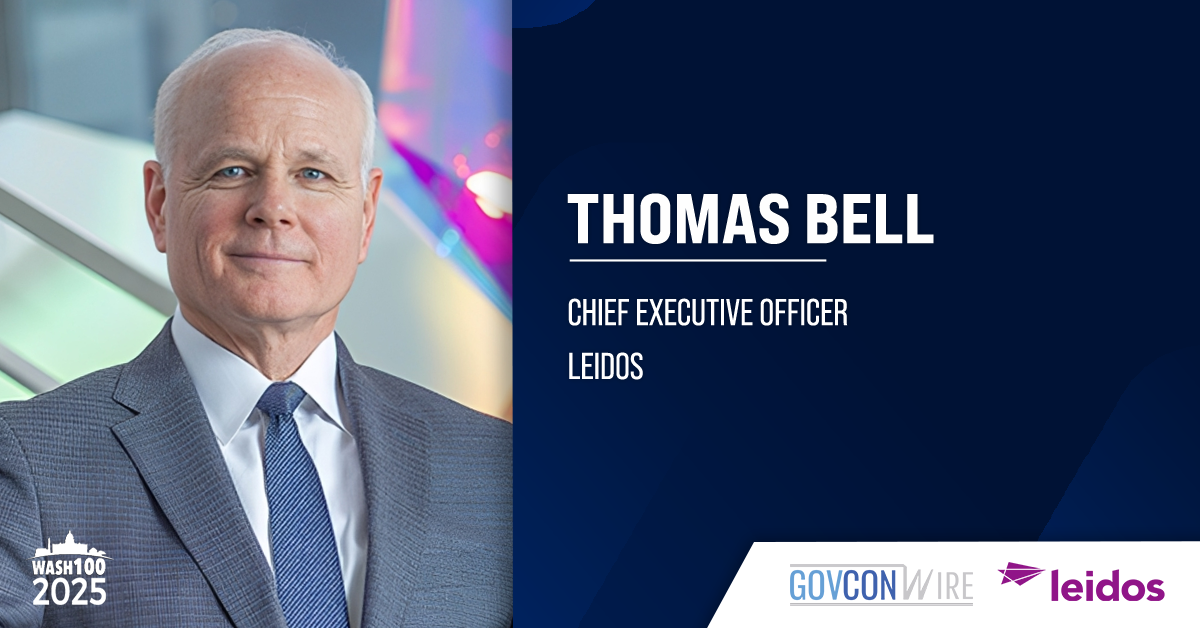
Leidos CEO Thomas Bell said the company continues to deliver strong results driven by its portfolio of mission-critical programs and the innovation, agility and discipline of its workforce.
“Despite the government shutdown, we are raising our 2025 earnings and margin guidance and holding firm on our 2025 revenue and cash guidance. Moreover, we are optimistic about our future given our alignment with the priorities of the administration and confidence that our customers will move out aggressively in search of smarter and more efficient outcomes for the nation,” added Bell, a two-time Wash100 awardee.
The company reaffirmed its full-year revenue guidance of $17 billion to $17.25 billion, raised its adjusted EBITDA margin guidance from the mid-13 percent range to the high-13 percent range and increased its non-GAAP diluted EPS guidance by $0.30 at the midpoint to a new range of $11.45 to $11.75. Leidos also reaffirmed its operating cash flow guidance of approximately $1.65 billion.
Thomas Bell on Defense Systems Business & Golden Dome
During the quarterly earnings call Tuesday, Bell also highlighted the strong performance and outlook for Leidos’ defense systems segment, which delivered 11 percent revenue growth in the third quarter.
“We’re tracking about 10 different franchise programs that we expect to deliver about $15 billion in potential value over the next 5 years. These are programs like air and base defense systems, counter-UAS systems, hypersonic missiles, our black arrow small cruise missile that you may have read about in the press or heard about and nonkinetic effects for counter-UAS areas,” he told analysts.
The CEO also referenced Leidos’ involvement in the Golden Dome next-generation missile defense shield initiative. He said the Pentagon is finalizing the program’s reference architecture and assessing proposals for the $150 billion SHIELD IDIQ procurement.
“We’re very much in the mix here, and we expect vigorous government reengagement on this subject later this month. In the meantime, we’re having healthy customer conversations about unique Leidos capabilities that could have a critical role in Golden Dome such as interceptor modernization and advanced radar surveillance systems,” he noted.
CEO on M&A Strategy
When asked about the company’s approach to mergers and acquisitions, Bell said Leidos remains committed to a “shareholder-friendly” philosophy toward capital deployment. He noted that while the company has historically prioritized organic growth and share repurchases, the development of its NorthStar 2030 strategy has refined its focus areas for potential acquisitions.
The company’s NorthStar 2030 strategy comprises five growth pillars: space and maritime; energy infrastructure; digital modernization and cyber; highly customized critical mission software; and managed health services.
“As exemplified by the Kudu acquisition that we announced last quarter, now that we have a very defined growth strategy, NorthStar 2030, with specific growth areas where we know markets are growing, we can be profitable, and we see very good opportunities for us to grow Leidos top line and bottom line. We are now focusing on that a little bit more. That’s not to say that it’s a swing to all inorganic, it’s just that now inorganic will be more a part of the playbook now that we’ve got a defined set of areas where we’re willing to play,” Bell told analysts.
The chief executive added that Leidos will remain “judicious and prudent” in pursuing M&A, maintaining strict hurdle rates and prioritizing shareholder value when it comes to capital deployment.
“So whether that’s internal, external or share buybacks or dividend increases, we’re going to have the same type of a lens,” he said.
Q3 FY 2025 Results of 4 Leidos Business Segments
Leidos’ national security and digital business recorded $2.02 billion in third-quarter revenue, up 8 percent from the year-ago quarter, driven by new contract awards and expanded defense IT and intelligence community mission support, as well as $26 million from the Kudu Dynamics acquisition.
The defense systems business saw Q3 revenues climb 11 percent to $582 million, primarily due to growth in integrated air defense and radar surveillance programs.
The health and civil segment’s Q3 revenues rose 6 percent to $1.30 billion, fueled by strong volumes and favorable timing of incentive awards in managed health services. Operating income margin improved to 25.2 percent.
The company’s commercial and international segment reported $571 million in Q3 revenue, down 1 percent from the prior-year period, reflecting a product mix shift within its security products business, partially offset by continued demand for energy infrastructure engineering services.