

What’s one way you can tell when an organization enters an elevated stage of maturity? For Josh Wilson, incoming CEO at LMI, a clear sign that a company understands who it is, what its values are, how it impacts customers and how it operates day to day is if it consistently makes senior leadership appointments via promotions.
LMI has now reached that stage. Wilson is the first chief exec in the company’s nearly 70-year history to come from an internal hire.
“That milestone coincides with a period of tremendous growth and progress,” Wilson told GovCon Wire in an exclusive interview conducted on the occasion of the announcement. “It’s something we’re all incredibly proud of.”

Josh Wilson will introduce in-person keynote speaker Sec. Kristi Noem at Potomac Officers Club’s 2025 Homeland Security Summit on Nov. 12. This all-day GovCon conference is tailormade for tech professionals who want to work (or expand existing partnerships) with DHS. Don’t miss out; register now!
What Is Josh Wilson’s Vision for LMI?
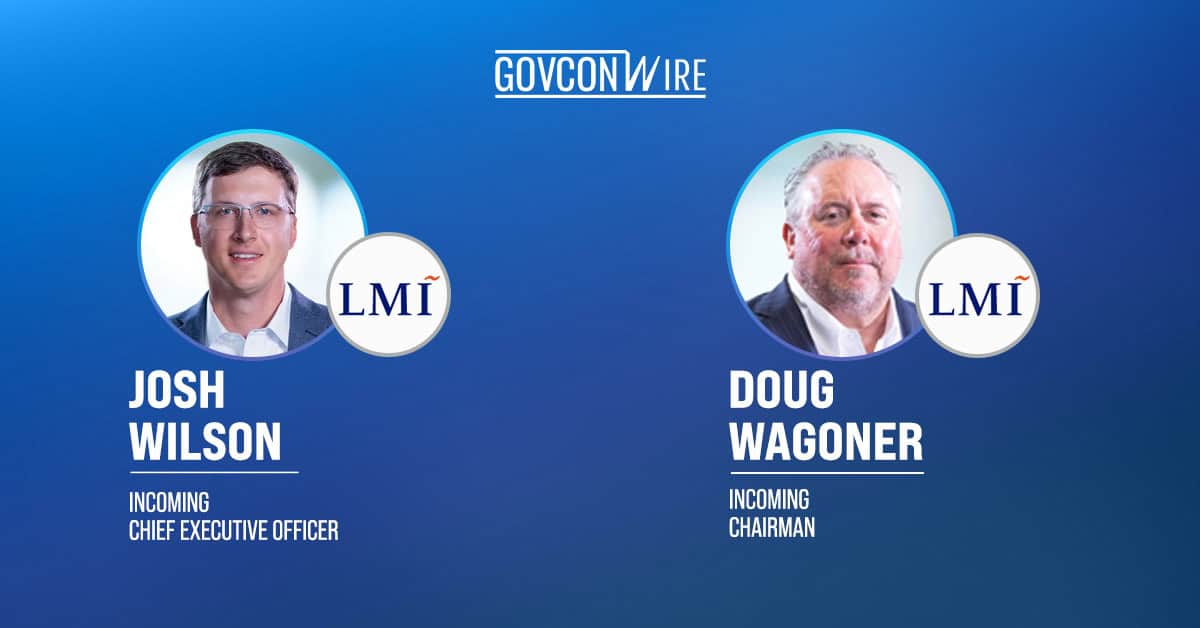
Wilson, who was most recently LMI’s president of markets, growth and technology, is succeeding six-time Wash100 Award winner Doug Wagoner, who has led the company for the last five years during an eventful period that included taking LMI for profit and almost doubling its revenue.
Because Wilson is picking up the mantle during a trajectory of growth, he says he is set on “keeping the train on the tracks.”
“There’s no big pivot or major shift coming in strategy. The path we’re on has been working, and it’s having a tremendous impact on both our customers and our people,” Wilson shared. “So this transition isn’t about changing direction—it’s about doubling down on what’s already driving our success: where we focus, why we focus and how we go to market.”
Equal Focus on Software & Hardware
Wilson said LMI believes the “next generation of technology partners for government…sit at the nexus of software and hardware to drive mission impact at the edge.” They’re already seeing this play out, he said, in some of their partnerships with the Pentagon, including delivery of the Navy JADACS solution, which is designed to enable real-time visibility into material movement and condition across logistics environments.
In his first year as CEO, Wilson wants to “double down on the movement to edge.”
“The future will be defined by technology partners who sit at the intersection of hardware and software. As we move into this next era, the talent equation expands beyond software and data science to include mechanical, electrical and systems engineers — the builders who make autonomy and edge intelligence real,” he said.
Breaking the Relationship Between Headcount & Revenue
Wilson communicated to GovCon Wire that the company’s transition from a traditional services model to a solutions-focused model can be seen in its revenue to headcount ratio. Whereas in past eras of the company, revenue and team-size grew steadily alongside one another, the last two years have seen “double-digit top-line revenue” growth, with “relatively flat” headcount over the last year.
What Makes LMI Stand Out?
Unlike traditional contractors, LMI’s research and development investments outpaced business development spend over the last 24 months—not out of legacy, but out of necessity.
“Our government partners are moving faster than ever,” Wilson said. “They’re not looking for concept papers or ideas that they have to fund from scratch. They want day-one-ready capabilities. That’s why we put more into IRAD than into BD conversations or RFP responses—we’re investing ahead of the requirement, not reacting to it.”
The company is “obsessed with speed,” according to Wilson, and they deliver on that promise — there have been several instances where the company has completed the cycle of a conversation to a customer to a contract, to a technology in the hands of 500 users in under 45 days.
“Not many companies in our space can operate at that pace, and that combination of culture, infrastructure, and mindset is something we’re really proud of,” Wilson said.
Public Sector Focus
LMI operates primarily in the public sector, and Wilson doesn’t see that focus shifting anytime soon. While the company occasionally engages with commercial, state or local organizations, those efforts are pursued selectively—when they align with LMI’s mission and expertise.
“For example,” Wilson explained, “some of our inventory optimization tools proved invaluable during COVID, when commercial partners approached us for help addressing supply chain disruptions. More recently, we’ve engaged with state and local authorities exploring investments in space infrastructure. When there’s a clear alignment and opportunity to apply our solutions, we absolutely engage.”
He continued, “Our solutions often have broad commercial relevance, but our core focus remains serving the public sector. That’s where our mission, experience, and impact are strongest.”
Fifty percent of LMI’s business is with the Department of Defense and roughly 80 percent is “national-security-centric.”
To learn how the Department of Homeland Security, a major collaborator of LMI, is accomplishing its missions with advanced technologies and how you can get involved, register to attend the 2025 Homeland Security Summit, the year’s most essential DHS GovCon conference!
What Is Doug Wagoner’s Legacy?
When Wagoner joined LMI in 2020, he had been retired for a few years after a decade-long stint at SAIC, where he led the execution of the expertly planned split into SAIC and Leidos; he also led its $900 million homeland and civilian solutions business unit. Post split, Doug became President of Services and Solutions for the new SAIC.
He made a commitment to LMI’s board to stay for five years.
“It’s been the quickest five years of my life. It’s been an absolutely great journey,” Wagoner informed us.
“About a year and a half ago, as we approached that five-year mark,” Wagoner added, “I started talking with the board about everything we’d accomplished — the transition from nonprofit to private equity-owned for-profit, the shift from services to commercial-ready solutions, and our growing focus on the pointy end of the spear for national security. Josh was instrumental, if not central, to all of that work and to making those transitions happen.”
For the last 18 months, he and the board have been architecting the transition to promote Wilson as CEO and for Wagoner to move into the board chairman seat. Come January 1, the process will be complete.
Wagoner said that he and Wilson work closely and will continue to do so, “gradually swap[ping] roles” over the next 90 days.
The accomplishment he’s most proud of at LMI is transitioning the organization to a for-profit entity after 65 years of being a national security nonprofit. Working with the private equity partners opened up innumerable doors, which included new acquisitions and increased R&D to develop new technology offerings while bolstering employee retention.
What’s Next for Wagoner?
Going forward, as chairman of the board, Wagoner says his principal focus will remain on LMI.
“It’s not that Josh or the leadership team need much help—they’re a superb leadership team—but I remain passionate about LMI and want to assist in guiding the future,” Wagoner remarked. He will have his sights set on helping Wilson and the leadership team make LMI the best it can be.