


- The Army is now issuing contracts through its new UAS Marketplace, an effort to procure innovative Group 1-3 drones faster
- The UAS Marketplace uses a digital, “Amazon-like” storefront that allows users to compare system attributes, provide feedback and easily place orders.
- Learn how the Army will expand UAS Marketplace principles to other acquisition efforts from Lt. Gen. Robert Collins during his keynote at the 2026 Army Summit!
It’s here. The Army is contracting through its new UAS Marketplace, the service’s revolutionary effort to streamline, improve and accelerate soldier access to the most cutting-edge Group 1-3 unmanned aerial systems on the market through a standard web commerce interface.
Unveiled in March, the UAS Marketplace is a digital storefront developed with Amazon Web Services and the Army Enterprise Cloud Management Agency that allows users to easily compare system functionalities, provide feedback and place orders. The goal is to help Army units, government partners and allies easily acquire vetted UAS solutions.
How Does the UAS Marketplace Work?
The UAS Marketplace acts as a one-stop shop for trusted capabilities including the air vehicle, payloads, software and autonomy algorithms, according to Defense Daily. Soldiers are able to filter systems by range, speed, group size, cost and manufacturing capability. Users can also compare systems by price, right-to-repair ability and technical specifications in an easily-accessible side-by-side format.
Win more UAS contracts in 2026 by attending the Potomac Officers Club’s 2026 Army Summit this Thursday—June 18. Learn from Lt. Gen. Robert Collins, military deputy/director, Army Acquisition Corps, Office of the Assistant Secretary of the Army for Acquisition, Technology and Logistics, how the Army is expanding innovative acquisition authorities and interfaces to issue contracts and field emerging technologies faster. Few tickets remain–get yours today!
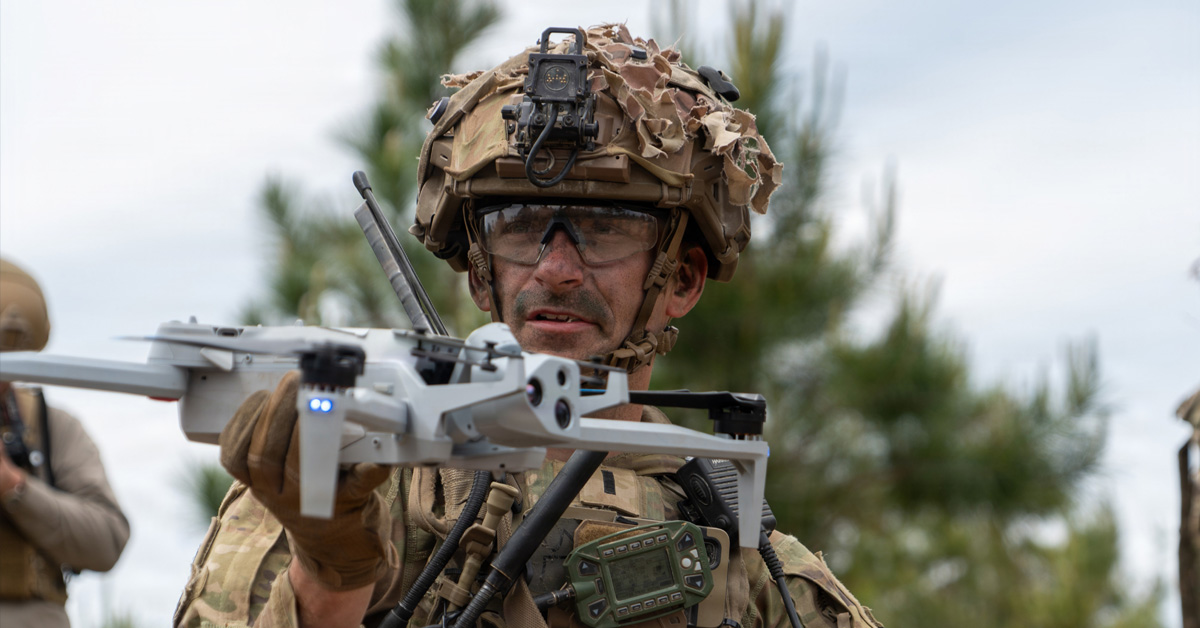
The UAS Marketplace currently consists of Group 1 and 2 drones, such as Aerovironment’s RQ-11 Raven, that weigh less than 55 lbs mass gross takeoff weight. But the Army wants to add Group 3 drones, which weigh between 55 lbs and 1,320 lbs, by this summer, depending upon available funding, Breaking Defense reported.
There’s a lot at stake with the UAS Marketplace. The Army wants faster and seamless acquisition to the smaller first-person drones that have shifted the Russia-Ukraine war in Ukraine’s favor. These UAS, sometimes modified commercial platforms, significantly improve battlefield effectiveness and can act as precision-guided munitions or reconnaissance systems, enabling complex engagements against mobile or partially hidden targets, according to Army Recognition.
Let’s dive into the five biggest ways the UAS Marketplace will transform the acquisition of paradigm-shifting UAS capabilities.
How Is the Army’s UAS Marketplace Transforming Drone Acquisition?
1. Outreach to Allied Nations and Foreign Military Sales
A top objective of the UAS Marketplace is supporting foreign military sales and providing allies with faster access to approved U.S. drone technologies. Top Army officials have described the platform as a mechanism for strengthening international partnerships and boosting exports of UAS and counter-UAS, or C-UAS, technologies.
Improving FMS sales has been a top priority of the Pentagon in President Trump’s second term. The Department of War in February reorganized both the Defense Security Cooperation Agency and the Defense Technology Security Administration to fall under the Office of the Undersecretary of War for Acquisition and Sustainment, led by Wash100 Award-winner Michael Duffey.
The DSCA largely facilitates weapon sales to partners and allies while the DTSA is tasked with identifying and mitigating risks associated with technology transfers to partner nations. The DOW wants to expand UAS Marketplace access to 25 partner militaries by the end of September.
2. Expansion Beyond Existing Program of Record Systems
Army officials want to broaden the UAS Marketplace to include systems being tested in innovative acquisition programs. The service plans to add winning drones from the Gauntlet competitions, part of the Pentagon’s Drone Dominance program, as well as systems from the Defense Contract Management Agency’s Blue List, Breaking Defense reported. These are systems approved for use by the DOW and other federal agencies.
This will help soldiers tap innovative and paradigm-pushing UAS capabilities being developed by new and up-and-coming drone startups. Drone Dominance is sending a clear demand signal to industry, with $1.1 billion provided over four phases, and is placing warfighters at the center of evaluation with iterative cycles measured in months, not years.
3. Broad Variety of Innovative Capabilities
The UAS Marketplace isn’t limited to just surveillance drones. According to DefenseScoop, the Army is also interested in using it to procure critical UAS capabilities including, but not limited to:
- Electronic warfare and sensors
- Supply chain and logistics
- Additive manufacturing
- Autonomous vehicles
- Software
- Intelligence
Members of industry are encouraged to submit white papers for these areas of interest as part of a commercial solutions opening, which will remain open indefinitely. The service expects the CSO will be updated on a regular basis to keep up with new threats, innovations and needs. The DOW is also encouraging whitepapers about iterative prototyping in the UAS Marketplace.
Dig into how the Army is moving commercial technology from pilot to fielded capability at the Potomac Officers Club’s 2026 Army Summit this Thursday—June 18. Examine how the Army is scaling solutions for operational impact across the force and strengthening industry-government collaboration for rapid delivery at the From Pilot to Production: Accelerating Commercial Capabilities at Scale panel discussion. It features a pair of esteemed Army officials:
- Dennis Teefy, program manager for C2 apps, Capability Program Executive Command and Control Information Network, or CPE C2IN
- Brig. Gen. Anthony Gibbs, CPE for mission autonomy.
4. Priming the Defense Industrial Base
The Army is already laying groundwork to expand the UAS Marketplace. Army Secretary Dan Driscoll, another Wash100 Award winner, will sign a joint statement of intent to expand the program during the Eurosatory trade show in Paris on June 16.
This joint statement of intent will mark the biggest expansion of the marketplace since its creation.
5. Rapidly-Awarded Contracts
The Army wasted no time issuing contracts through the UAS Marketplace. The service in March awarded a production contract to Survice Engineering for Joint Autonomous Aerial Resupply Systems, or JTAARS, using the UAS Marketplace basic ordering agreement, which slashes lead times and provides capabilities to soldiers faster than previously possible.
JTAARS is an autonomous aerial cargo delivery system designed to provide maneuver commanders fast and adaptable sustainment solutions. It will boost the speed, range, endurance and precision of sustainment operations by reducing reliance on typical ground-based communication lines and manned resupply missions.
JTAARS will provide soldiers with a unique opportunity to experiment with innovative operational formations and examine the system’s potential to contribute to operational capabilities within Multi-Domain Operations.