

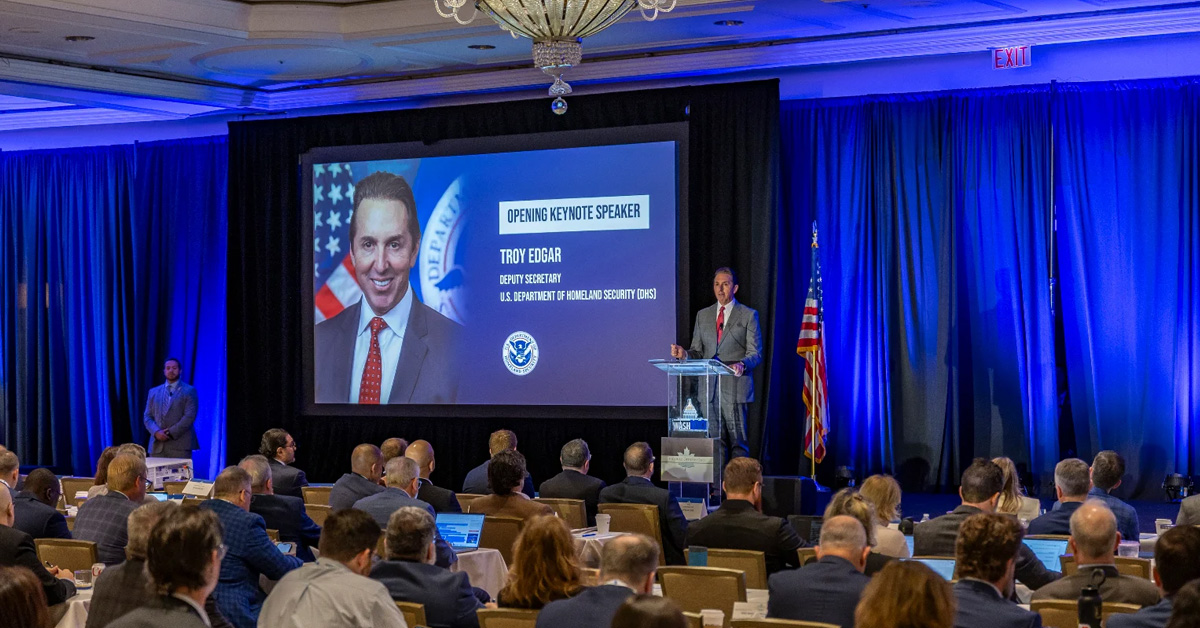
“This was our once-in-a-lifetime opportunity to reshape how federal government works,” Deputy Homeland Security Secretary Troy Edgar said of the second Trump administration’s efforts to cut through traditional political bureaucracy and run the government more like a corporation.
It’s also a historic time for the agency in terms of funding: a $118 billion budget, plus $190 billion in appropriations from the One Big Beautiful Bill and another reconciliation bill for $70 billion. Altogether, as Edgar emphasized, close to $400 billion, “the largest recapitalization of national security in history.”
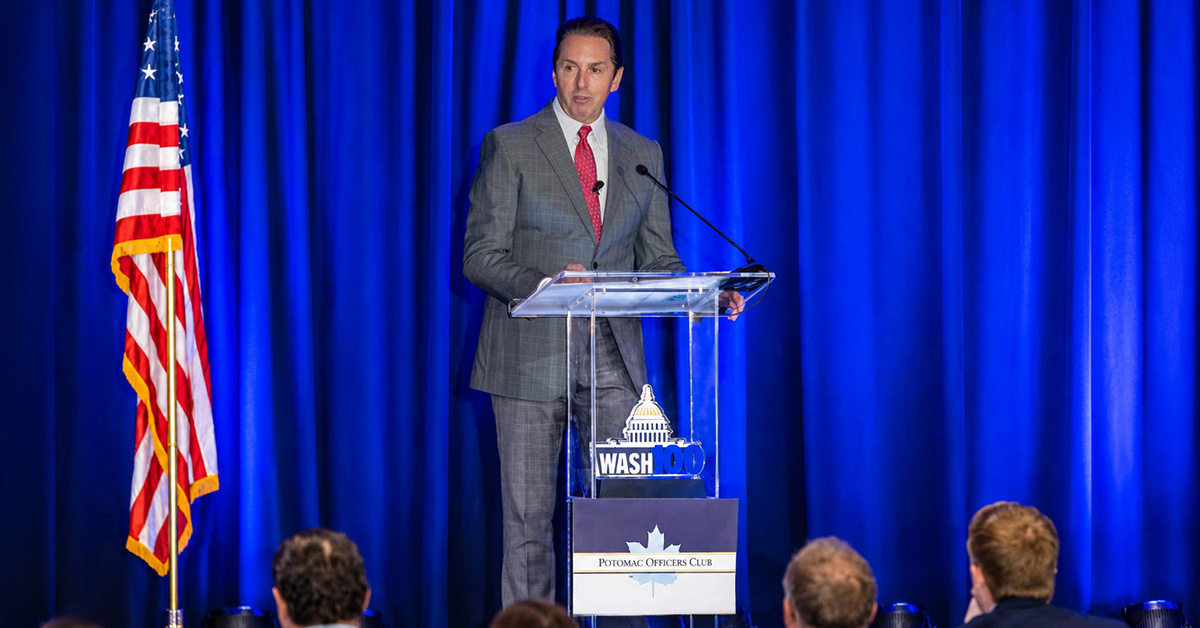
Speaking at Potomac Officers Club’s 2026 Homeland Security Summit on Nov. 10, the DHS second-in-command, who also serves as its chief operating officer, gave updates on the latest mission priorities of the organization as well as some specific advice for the contracting audience.
Don’t miss Potomac Officers Club’s next two events: its year-closing 2026 Healthcare Summit on Dec. 3, a forum to hear about cutting-edge health technology priorities from top federal leaders, and the curtain-raising 2027 Defense R&D Summit on Feb. 4, an assembly of influential defense technology decision-makers (last year’s edition featured Under Secretaries of War Emil Michael and Michael Duffey). These are great opportunities for GovCon networking, partnerships and gaining exclusive insights on forthcoming government needs.
What Are Edgar & DHS’ Current Goals?
As the former chief financial officer for DHS during President Trump’s first term, Edgar says he’s particularly concerned with not wasting the largest recapitalization the agency has received.
As for the more broadly applicable mission goals, he said that DHS continues to focus on the administration’s deportation commitments, which he says constitute a “supply chain issue…if you believe the numbers or not, 10 to 15 million people came in the United States and we have to find a way to, through the supply chain, get them out.”
Relatedly, he said securing the U.S.-Mexico border was a top concern.
What Were Edgar’s Messages to GovCons?
During his keynote, Edgar indicated that the industrial base supporting the department should operate via a collaborative ‘One DHS’ model.
Integration
A crucial aspect of achieving ‘One DHS,’ Edgar said, is creating non-stovepiped products that can work across various use cases and agencies.
“When you buy a system or capability or a component, we want to make sure that that same system and capability is something that can be potentially used and shared across other components,” he remarked.
Data Flow
Similarly, the outpouring of data generated, collected and processed by artificial intelligence systems needs to be handled in a way that benefits the entirety of the department and U.S. government, or “the enterprise.” It should not just serve the needs of an individual or office, Edgar said.
Speed
Government needs to keep pace with the national security threats it has identified and current —and especially former—acquisition processes don’t enable that kind of swift action, Edgar said.
“At IBM [where Edgar worked between his first stint at DHS and now], one of the leaders that was there used to always joke that’s like, why do we always bid programs that we could do in nine months on a five-year plan?
“Today with all the different technologies of AI,” he continued, “we aren’t going to be able to afford a 12-month requirements-gathering process, solicitation process, awarding process, implementation for a year, four-year options. The threats already moved past us.”
Edgar implored the contractor-heavy audience at the Homeland Security Summit to “break that cycle” while acknowledging that “we caused this as much as you guys are supporting it.”
Other New Developments at DHS

DHS is reportedly aligning itself more closely with the intelligence community and Department of Justice. Edgar said DHS is collaborating with the White House to put in motion cross-departmental initiatives with these other agencies and sectors.
“Now we’re multidimensional,” Edgar stated.
Additionally, Edgar shared that the organization has “recast” its “middle layer”—i.e., reducing mid-level Senior Executive Service personnel. This was a “tough decision” but the GovCon industry ultimately benefits, he argued, as there were a surplus of officials operating “on the edge of policy and execution.”
“We did it for the taxpayers, but we also did it for industry, so the industry would be able to understand how to interact,” Edgar said.
Acknowledging the changing tides brought by the recent election, Edgar ended with a call to arms for contractors to make the most of the administration’s last two years: “This is your opportunity to now recreate government, recreate your business, recreate industry, reevaluate your R&D spend, work with [the Science & Technology Directorate], figure out where the requirements are within DHS, making sure that you align…your research and development.”