
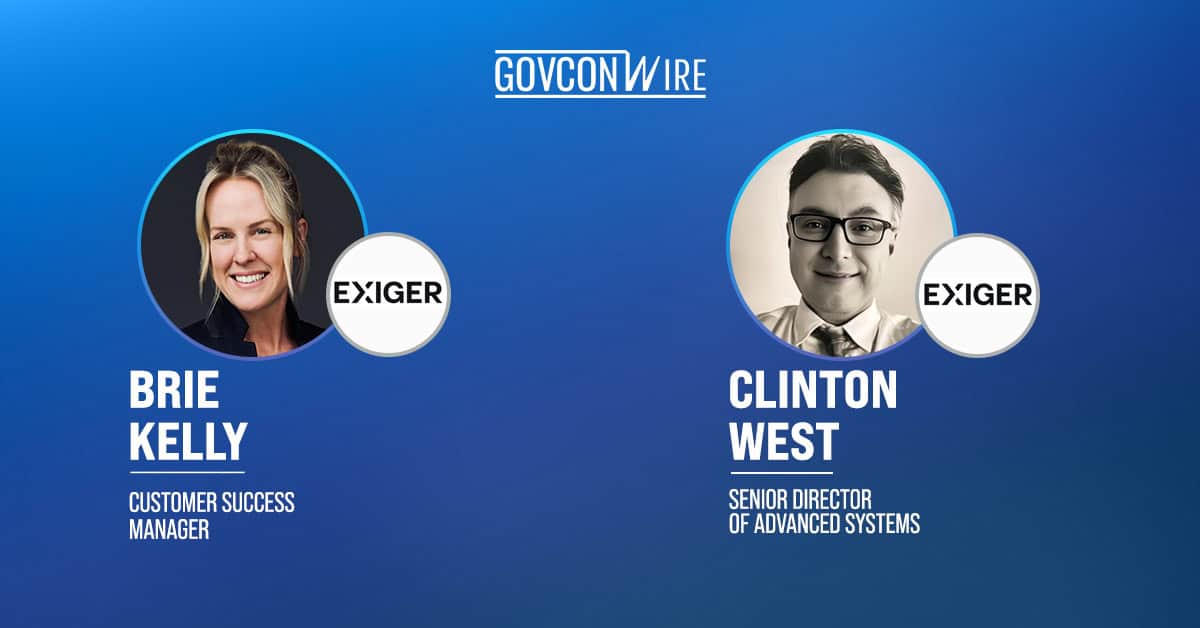

As modern conflicts reshape the battlespace, logistics has emerged as both the backbone of mission success and a frontline vulnerability. In a recent GovCon Wire webinar, Exiger Senior Director of Advanced Systems Clinton West — former chief of supply chain risk at the CIA — and Exiger Customer Success Manager Brie Kelly — a former CIA logistics officer and Senate staffer — shared hard-earned lessons from Ukraine and beyond.
This discussion set the stage for the 2025 Homeland Security Summit on Nov. 12, where West will moderate the panel Contested Logistics on the Homefront: Securing Supply Chains for Homeland Resilience. That session will dive explore how to turn military contested logistics strategies into actionable, AI-driven frameworks for DHS, ensuring the security and continuity of critical U.S. supply chains against adversarial and catastrophic domestic threats.. Register for this government-industry networking event now!
Here are five takeaways from the Exiger webinar.
1. Logistics is no longer a back office function
West emphasized that logistics has moved from a support role to the center of mission survival. In Ukraine, the ability to sustain operations under fire revealed that every assumption is tested and every moment contested. As Kelly put it, “being uncomfortable is where I do my best work” — underscoring that logistics professionals are now on the front lines of resilience.
2. The battlefield has changed — and so must supply chains
In past conflicts, logisticians faced asymmetric threats and infrastructure gaps in permissive environments like Iraq and Afghanistan. Today’s near-peer conflicts involve cyberattacks, precision strikes and the deliberate targeting of supply lines. This means supply chains must be faster, more adaptive and deeply integrated across military and civilian domains. The panel warned against overreliance on simple fixes like commercial tracking tags, which adversaries can exploit.
3. Speed vs. safety requires constant recalibration
Kelly described the “constant calculus” of balancing delivery speed against the safety of teams in Ukraine. She explained that Exiger’s layered risk management framework helped prioritize essential material while avoiding unnecessary exposure. Sometimes, missions were greenlit despite risks because the cost of delay was higher; other times, deliveries were halted to protect lives.
4. Human resilience and local relationships are critical
Both speakers highlighted how informal networks often sustained operations. West described the “I know a guy” phenomenon, where local contacts provided crucial access, while Kelly recalled a warehouse manager whose cousin’s knowledge of unmarked routes kept supplies moving when official channels collapsed. Their takeaway: logistics systems must be designed with human resilience and flexibility baked in, not only rigid contracts.
5. Future conflicts demand disruptive, tech-enabled systems
Looking ahead, both experts stressed that logistics must be built for disruption, not efficiency alone. Kelly urged investment in redundancy, survivability and decision-making speed, calling speed of decision “a warfighting function.” West noted the need for stronger vendor vetting and more authority for field logisticians to act without waiting on distant approvals. Both agreed that private-sector tools — like Exiger’s real-time risk intelligence and supply chain visibility platforms — can give logisticians the shared situational awareness needed to win the next fight.
The Bottom Line
Ukraine demonstrated that contested logistics is not a theoretical challenge — it is the defining feature of modern conflict. By integrating adaptability, partnerships and advanced tools into logistics planning, government and industry can better anticipate and mitigate risks in the contested environments of tomorrow.
These issues will be front and center at the 2026 Homeland Security Summit on Nov. 12, where West and fellow leaders will explore how DHS can protect domestic supply chains from adversarial threats, using lessons learned abroad in contested logistics scenarios. Save your spot before it’s too late!