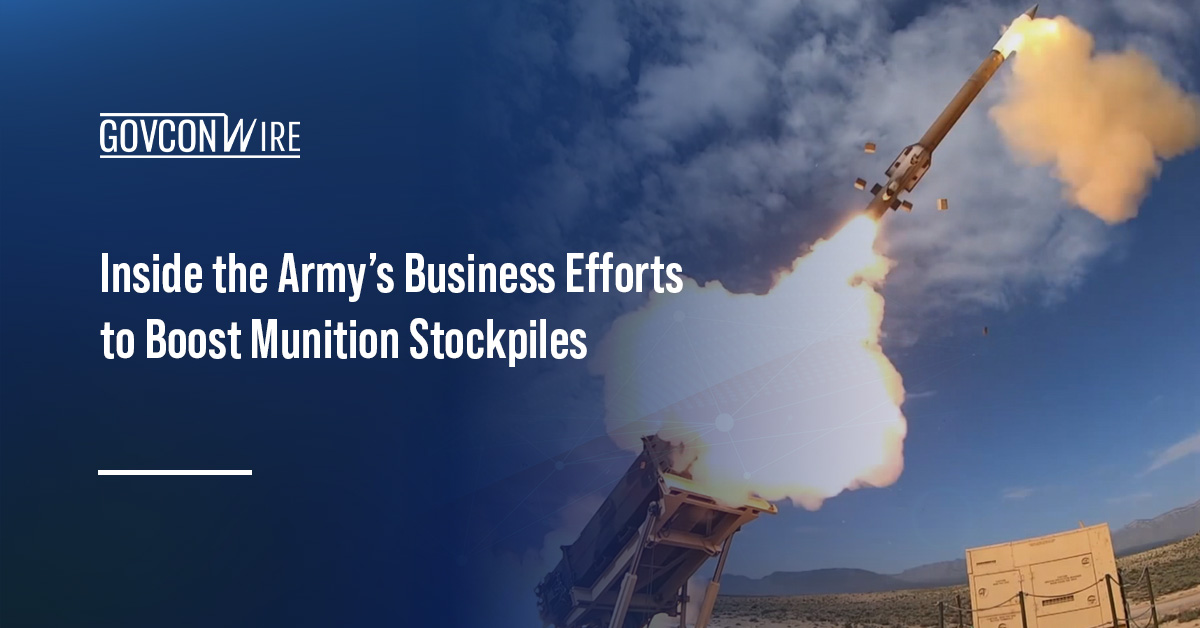

- Army Contracting Command, in a new effort, will soon start negotiating munition deals directly with subcontractors, a key official tells GovCon Wire.
- Subcontractors often account for 50 to 60 percent of a missile’s cost.
- Learn more about reconfigurable air defense and cost-effective fires at the 2026 Army Summit on June 18!
Army Contracting Command, in a new effort, will soon start negotiating munition deals directly with subcontractors to reduce the costs of these weapon systems, according to a key official.
Daniel Gallagher, ACC deputy to the commanding general, told GovCon Wire in an exclusive interview ahead of the Potomac Officers Club’s 2026 Army Summit that subcontractors often account for 50 to 60 percent of the costs of these weapon systems. He said negotiating directly with subcontractors is an initiative from the Office of the Secretary of War’s Munitions Acceleration Council Deal Team.
Negotiating directly with subcontractors is part of sweeping business initiatives by the Pentagon to rebuild its stockpiles of solid rocket motor propelled munitions like the Lockheed Martin Patriot Advanced Capability-3, or PAC-3. Gallagher said that these business initiatives are three pronged: long-term production contracts, profit sharing from industry to the Army and increased contractor spending on facility upgrades that improve productivity and capacity.
Win more Army munitions contracts in 2026 by attending the Potomac Officers Club’s 2026 Army Summit on June 18! Explore driving cost-per-kill efficiency in modern engagements and countering low-cost threats with scalable defense solutions at our Emerging Technologies at Scale: Reconfigurable Air Defense and Cost-Effective Fires panel discussion. It features Rodney Davis, Army capability program executive for aviation, and other top Army officials to be announced. Secure your seat today!
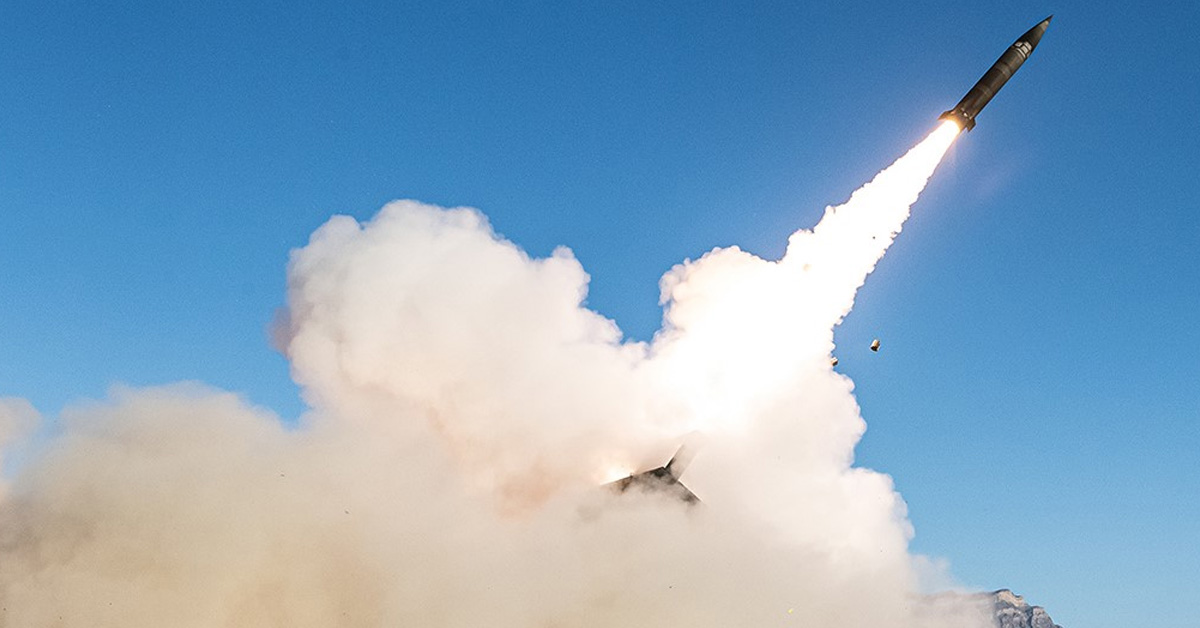
Gallagher said ACC is negotiating multi-year deals of up to seven years and guaranteeing a certain level of production quantity. Under one of these agreements, Lockheed Martin will increase annual production of the PAC-3 Missile Segment Enhancement, aka MSE, interceptor from roughly 600 to 2,000, according to a Pentagon statement.
Raytheon has entered into five agreements with the Pentagon to increase production capacity and speed deliveries of land attack and maritime strike variants of the Tomahawk, Advanced Medium-Range Air-to-Air Missile, or AMRAAM; Standard Missile-3 Block IB, SM-3 Block IIA and SM-6 interceptors, the company said in a statement.
Raytheon will increase annual Tomahawk production to more than 1,000, AMRAAMs to at least 1,900 and SM-6 to more than 500. Many of these munitions will grow 2-to-4 times their existing production rates.
What Does the Army Want in Exchange for Long-Term Munitions Contracts?
In exchange for long-term contracts, Gallagher said the Army is asking contractors to increase their share of facilitization costs, which have traditionally been provided by the service. These include digitizing a facility or installing robotics.
The Army now wants the contractors to pay for these upgrades, instead of waiting for the service to provide money. The Army also wants prime contractors to pay for subcontractors’ facilitization costs as most prime contractors only perform final assembly, Gallagher said. The Pentagon will work with key PAC-3 MSE suppliers to deliver seven-year subcontracts to ensure facilitization and production capacity.
Are you a GovCon technology executive? Then you can’t afford to miss the Potomac Officers Club’s 2026 Army Summit on June 18. Bolster your expertise on the future hyperconnected battlefield by attending an illuminating keynote by Lt. Gen. Jeth Ray, Army deputy chief of staff, G-6.
Get exclusive insights on Army budget and financial management initiatives directly from Marc Andersen, assistant secretary for financial management and comptroller. Hear directly from Katie Thompson, deputy executive director for Army Contracting Command-Aberdeen Proving Ground. Tickets are selling fast, get yours now!
Why Did the Pentagon Create the Munitions Acceleration Council?
The Pentagon created the Munitions Acceleration Council because it wants to replenish its missile stockpiles in case of a pivot to the Indo-Pacific region as China has quite an inventory. Military leaders have been concerned about the defense industrial base’s ability to increase munitions production since Russia’s invasion of Ukraine in 2022. New missile orders have not kept pace with increasing use of missiles like the PAC-3, according to the Wall Street Journal.
The Army also wants contractors to provide additional profits in excess of a previously negotiated rate back to the service in exchange for long term deals. Typical contracts are subject to annual congressional appropriations that may change, or be eliminated, in the future.
Gallagher said, for example, if the Army negotiates a profit margin of 15 percent for a capability, it wants a percentage of the company’s excess profits. He said ACC is currently negotiating what that exact profit margin might be.
What Weapons Does the Army’s Munition Business Initiatives Include?
These new business initiatives include both offensive munitions like the Lockheed Martin Precision Strike Missile, or PrSM, and defensive munitions like the PAC-3 MSE. Gallagher said he has about 10 separate deals he’s working on.
ACC is also improving how it does business with non-traditional firms. Gallagher said the Army has been approached by smaller companies that can develop missiles that perhaps don’t have the same range as legacy capabilities, but they can deliver more mass down range at lower cost. ACC is asking non-traditional companies to develop prototypes and new production facilities leveraging advanced technologies like AI and robotics.
ACC is also leveraging commercial solutions openings to increase business with non-traditional companies. Gallagher said the Army is inviting companies to provide white papers before potentially a detailed proposal and prototype. He said this has already been implemented at a couple locations, including Red River Army Depot, Texas.
How Is Lockheed Martin Increasing Munitions Production?
Lockheed Martin said it is increasing munitions production by investing $8 billion to $9 billion through 2030. It will scale munitions production by upgrading or building more than 20 facilities across the U.S. The company will also invest in its existing supply chain by developing new second sources for key parts needed to achieve munition acceleration rates.