Author: Jane Edwards|| Date Published: June 3, 2021
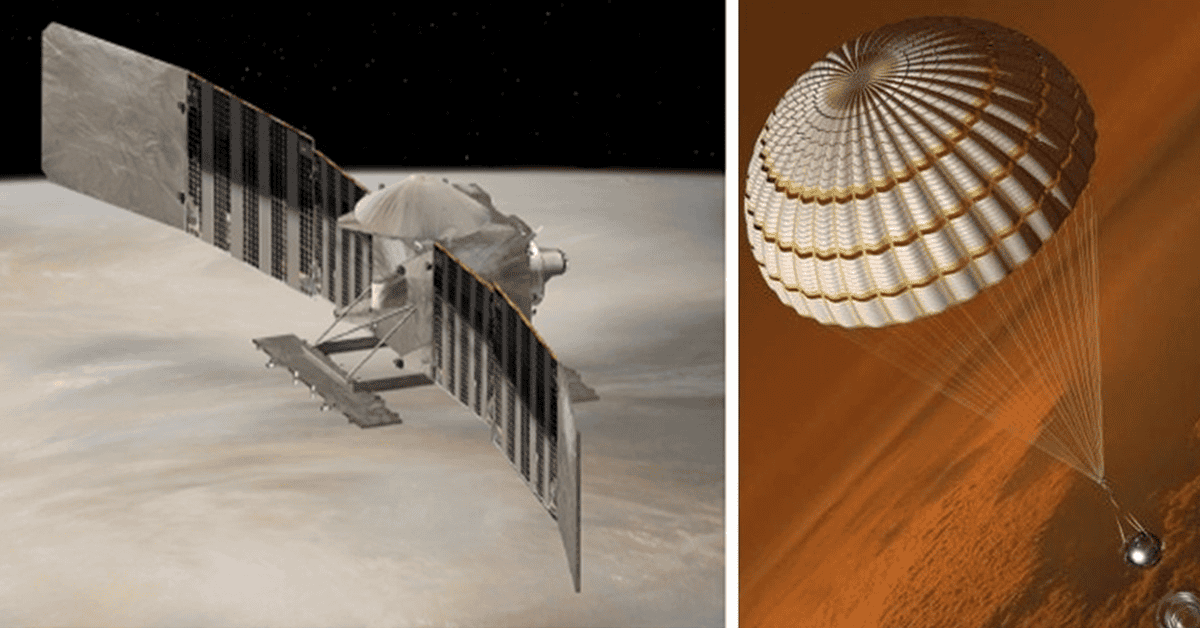
Lockheed Martin (NYSE: LMT) will design, develop and operate the spacecraft for two missions NASA selected to explore Venus as part of the agency’s Discovery Program.
The space agency expects the two missions – Deep Atmosphere Venus Investigation of Noble Gases, Chemistry and Imaging Plus or DAVINCI+ and Venus Emissivity, Radio Science, InSAR, Topography & Spectroscopy or VERITAS – to launch between 2028 and 2030, Lockheed said Wednesday.
NASA’s Goddard Space Flight Center in Greenbelt, Maryland, will manage the operations and scientific activities associated with DAVINCI+, while the agency’s Jet Propulsion Laboratory in California will oversee VERITAS.
The agency said DAVINCI+ will study the composition of the planet’s atmosphere and host the Goddard-built Compact Ultraviolet to Visible Imaging Spectrometer, also known as CUVIS.
VERITAS will explore Venus’ geologic history and rock type by mapping the planet’s surface and infrared emissions. This mission will host the JPL-developed Deep Space Atomic Clock-2 to help improve radio science observations and enable the spacecraft to perform autonomous maneuvers.
The Planetary Missions Program Office at NASA’s Marshall Space Flight Center in Huntsville, Alabama, will manage the selected missions as part of the Discovery Program.
The Department of Veterans Affairs has issued a presolicitation for the Veterans Health Administration’s Biomedical Engineering Technical Professional Support Services, or…
Trident Solutions has acquired space electronics developer Ibeos, expanding its capabilities in on-orbit computing and power systems used in government…