
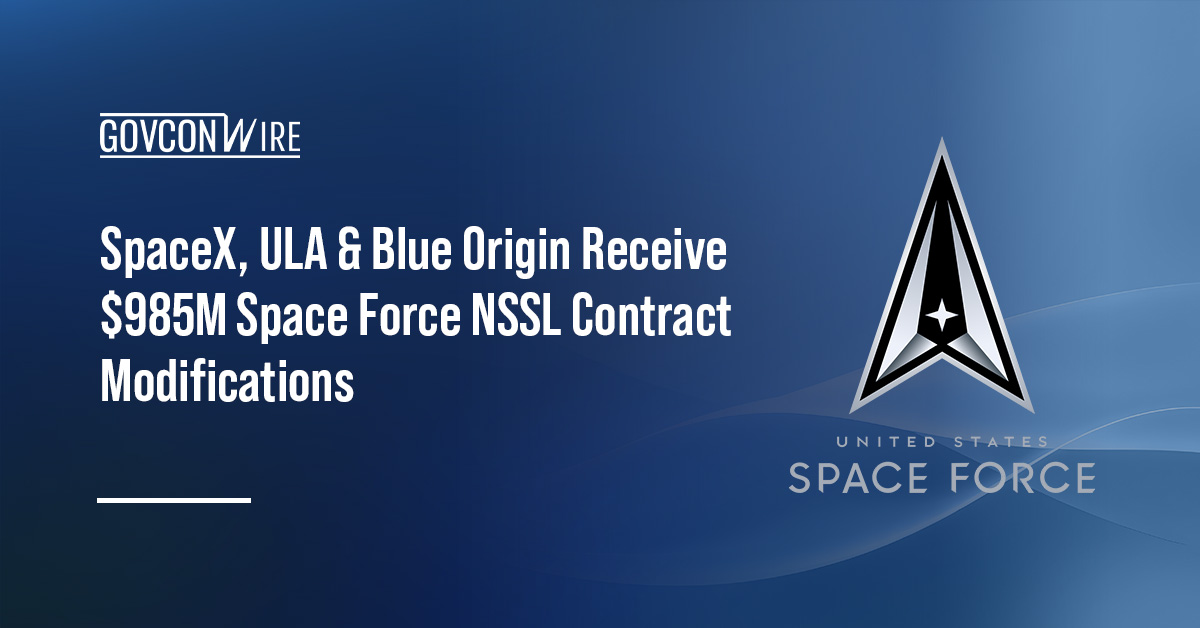

- The modifications carry a combined maximum ceiling of $985 million
- Work is scheduled to continue through April 2033
- The 2027 Defense R&D Summit will tackle advanced space technologies and other defense priorities
The U.S. Air Force has awarded contract modifications to SpaceX, United Launch Alliance and Blue Origin under the National Security Space Launch, or NSSL, Phase 3 Lane 2 program.
The Department of War said Monday the modifications are worth up to $985 million.

Reliable access to space remains essential to national security missions, making launch capacity and mission assurance key defense priorities. The Potomac Officers Club’s 2027 Defense R&D Summit on Feb. 4 will bring government and industry leaders together to discuss technologies and strategies shaping future military capabilities, including advanced space systems, AI, autonomy and unmanned platforms. Register today to join the discussion.
What Is the Scope of the NSSL Contract Modifications?
The companies will provide launch services under the modifications, with work taking place at their respective facilities, Cape Canaveral Space Force Station and Kennedy Space Center in Florida, and Vandenberg Space Force Base in California. The work is expected to conclude by April 2033.
Space Systems Command’s Space Access office at Los Angeles Air Force Base in California issued the modifications. No funds were obligated at award.
How Does the NSSL Phase 3 Lane 2 Program Work?
The NSSL Phase 3 acquisition strategy divides launch missions into two lanes based on the level of risk the government can accept. Lane 2 covers missions with the highest reliability requirements and supports launches carrying critical national security payloads.
SSC awarded the three companies Lane 2 contracts in April 2025, with a combined anticipated value of $13.68 billion. The awards included $5.92 billion for SpaceX, $5.37 billion for United Launch Alliance and $2.39 billion for Blue Origin.
Under the original mission assignments, SpaceX was designated the Requirement 1 provider for 28 missions, while ULA was selected as the Requirement 2 provider for 19 missions. Blue Origin was named the Requirement 3 provider and was projected to receive seven missions beginning in Order Year 2.
The contracts cover additional mission-related services, including rapid response, anomaly mitigation, launch service support, fleet monitoring and mission assessments.
In October 2025, SSC assigned seven Lane 2 missions under the fiscal year 2026 order year. SpaceX received $714 million for five missions, while ULA received $428 million for two missions, including USSF-88, which will carry the fourth GPS III Follow-on satellite.
Lane 1, by contrast, handles more risk-tolerant missions through expedited awards and streamlined integration. In July, the Space Force raised the Lane 1 contract ceiling from $5.6 billion to $17 billion through modifications to seven companies, including SpaceX, ULA and Blue Origin.
In May, Blue Origin secured a Lane 1 task order for one National Reconnaissance Office launch from Cape Canaveral, scheduled between the fourth quarter of 2027 and the first quarter of 2028. The award came on the same day as a New Glenn anomaly during an integrated vehicle hot fire test on May 28.
What Launch Requirements Is the Space Force Prioritizing?
In April, SSC sought industry input on potential providers for as many as 25 high-priority NSSL Phase 3 missions planned for fiscal years 2027 through 2029. The schedule included six missions in FY2027, nine in FY2028 and 10 in FY2029.
The missions are expected to require providers capable of sending heavy payloads directly into geosynchronous and medium Earth orbits, conducting launches carrying multiple payloads and meeting stringent mission assurance requirements.
The Space Force said it intended to procure the missions through existing Phase 3 Lane 2 contracts. It also invited other companies to submit information demonstrating whether they could meet the program’s certification, technical and launch readiness requirements by Oct. 1 of the applicable procurement fiscal year.