

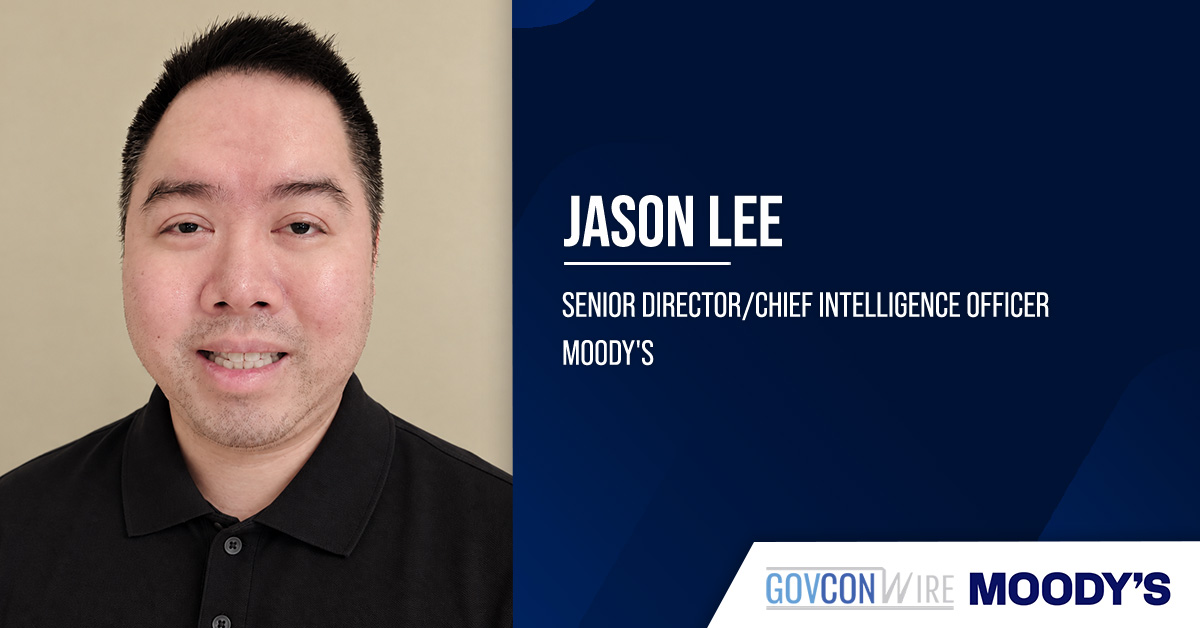

- Large amounts of social media data challenge intel agents trying to create plausible cover stories
- Moody’s Jason Lee says these cover stories, called backstopping, were easier before the internet
- Dive into OSINT in protecting RDT&E at the 2026 Intel Summit on Sept. 24!
Open source intelligence has become one of the most powerful tools for thwarting counterespionage threats. This is because the sheer volume of data on digital platforms like social media makes it significantly harder for intelligence agencies to “backstop” — or build plausible cover stories for — undercover operatives, according to an industry expert.
Jason Lee, Moody’s senior director and chief intelligence officer, gave GovCon Wire an exclusive interview ahead of his appearance on the The Power of OSINT in Counterespionage of Intellectual Property Secrets panel discussion at the 2026 Intel Summit on Sept. 24. Lee said backstopping was easier before the rise of the internet since verification was so hard to do in an analog world.
Backstopping then became more difficult, he said, but plausible disability still protected an intelligence agent’s ability to create a credible backstory, even with social media. Now, with people born into an internet world, their entire history, all the way into childhood, is often available on the web.
“For a 30- or 40-year-old to fake an entire background all the way back to kindergarten is almost now impossible, without introducing some kind of contradiction or error that would blow that cover—both for the good guys and bad guys,” Lee said.
Go beyond the headlines with Lee and top IC officials on using OSINT to unravel proxy cover for foreign nations during a panel discussion at the Potomac Officers Club’s 2026 Intel Summit, this coming Thursday, Sept. 24. At Open Secrets: The Power of OSINT in Counterespionage of Intellectual Property Secrets, examine protecting the U.S. technology development enterprise with James Cangialosi, National Counterintelligence and Security Center deputy director, and Stephen Pierce, Naval Intelligence Activity N3 director. Few tickets remain for this essential GovCon forum — get yours now!
What Is OSINT?
OSINT is intelligence derived exclusively from publicly or commercially available information that addresses specific intelligence priorities, requirements or gaps, the State Department said in 2024. The department expects the demand for OSINT products and services to grow in the future as commercial technologies generate more open source data and as the U.S. seeks to share more information with traditional and non-traditional partners.
What Has Fueled the Expansion of Online Data?
Over the past decade, the rise of social media and camera-equipped smartphones has accelerated the expansion of online data, the European Journal of International Security said in a 2025 report. Photos and videos from Russia’s war in Ukraine have flooded social media with vast amounts of data and created what some experts view as a new era of intelligence: the targeting, collection, analysis and dissemination of information to reduce decision-makers’ uncertainty.
How Are Intel Agencies Responding to More Difficult Backstopping?
Lee said intelligence agencies are taking measures to ensure backstopping against foreign adversaries. These include exhaustive “red teaming,” in which U.S. intelligence officials run automated adversarial tests on their own cover identities to determine whether anomalies they look for in cover stories used by foreign spies or bad actors would actually alert on their own undercover agents.
Fake documents like birth certificates or driver’s licenses are also not enough in 2026. Lee said an undercover agent’s life activity must be faked, including generating realistic utility bills, tax filings, active e-commerce purchase histories and holding email threads that match the persona’s supposed life milestones.
IC agencies, he said, are starting to rely on AI agents to manage hundreds of routine “developmental” digital conversations simultaneously, with fake footprints replicated to go back decades, if necessary. Lee said AI is also being used to automate present-day activity for fake personas — generating realistic social media posts and routine online behavior to create the illusion of a continuous, living identity.
Why Is Espionage Through OSINT a Huge Problem in RDT&E?
Espionage through OSINT is a major problem in the U.S. research, development, test and evaluation, or RDT&E, sector. Lee said while government intent in R&D is held close, science is open. When the government tasks scientists with figuring out how to develop something new, they leave footprints in public records that can be weaponized as they progress through research and toward determining what is possible on the road to building it.
Additionally, Lee said OSINT can be used to forecast emergence, or how far along adversary scientists are in the RDT&E process. This includes whether they are early in the discovery phase or at the end of the process.
“This allows U.S. watchers to time the emergence of operational use of any emerging technology being developed,” Lee said.
Get insights ahead of your competitors on where IC investment is headed by attending the 2026 Intel Summit this coming Thursday, Sept. 24. This is a rare opportunity to hear directly from the top officers in the IC shaping budget priorities for fiscal year 2028 and beyond. Check out our all-star lineup:
- Matthew Fodor, FBI operations director for national security
- Carrie Thompson, Drug Enforcement Administration deputy assistant administrator for intelligence
- Dustin Gard-Weiss, CIA executive director
- Tim Kosiba, National Security Agency deputy director
- Matthew Kozma, Department of Homeland Security undersecretary for intelligence and analysis
- Ryan Lewis, National Reconnaissance Office chief architect for signals intelligence
- Maj. Gen. Brian Sidari, Space Force deputy chief of space operations for intelligence
How Is OSINT Being Used in Counterespionage?
OSINT is being used in counterespionage in a variety of innovative ways. Lee said one way is through the pattern of life; not just locality data, but at a very micro level. Analysts use commercially available location data from ordinary mobile phone applications, such as those used for weather, dating or gaming, to map anonymous movements.
By running software to see which two anonymous phone identifications are constantly co-located, or show up at the same obscure park bench or coffee shop at the same time, Lee said analysts can uncover hidden spy-to-handler meetings without ever decoding physical surveillance.