

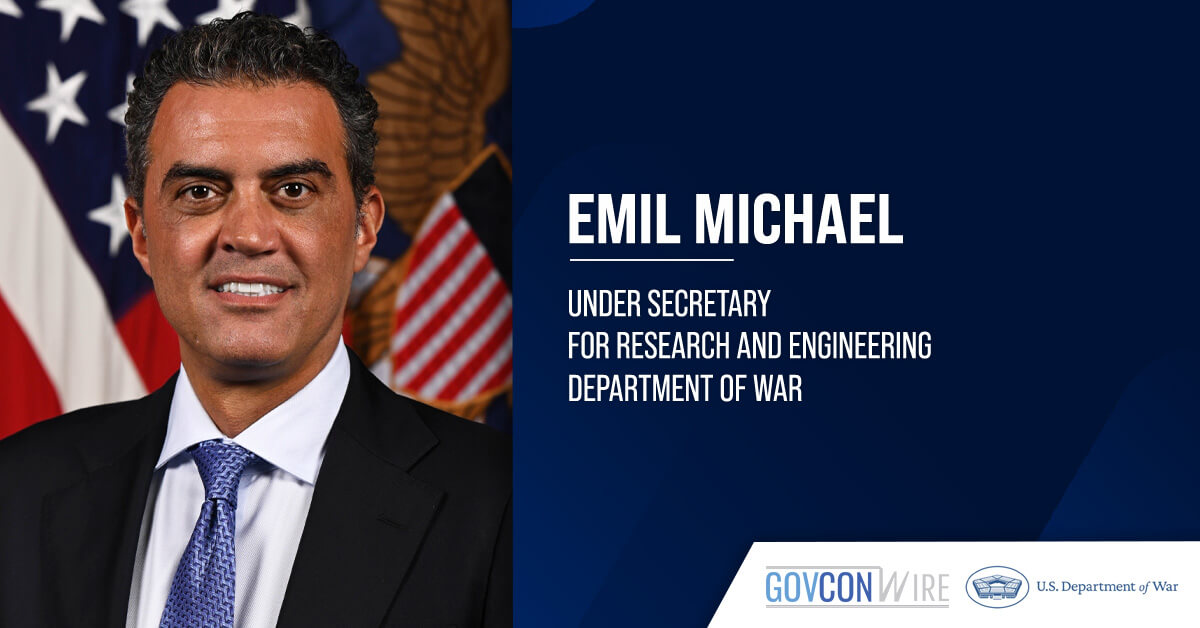

Emil Michael’s influence over the Pentagon’s technology and innovation enterprise has expanded rapidly in recent months, placing him at the center of major reforms shaping how defense research moves from concept to operational capability.
Michael, the under secretary of war for research and engineering, is set to deliver keynote remarks Thursday, Jan. 29, at Potomac Officers Club’s 2026 Defense R&D Summit before sitting down for an extended fireside chat with Under Secretary of War for Acquisition and Sustainment Michael Duffey, the Pentagon’s top weapons buyer. The pairing brings together the department’s senior technology and acquisition leaders at a moment when speed, scale and transition have become defining challenges for defense innovation. Make sure your company has a presence at the conference!
Interest in the Defense R&D Summit has surged in recent weeks, with Michael’s appearance widely viewed across industry as a key draw for contractors and technology firms tracking the Pentagon’s evolving technology priorities.
What Recent R&D Policy Moves Has Michael Overseen?
Michael’s office recently launched the Defense Patent Holiday, a pilot program designed to accelerate the transition of defense technologies from government laboratories to commercial and operational use.
The initiative provides qualified companies with access to select defense lab patents through no-fee commercial evaluation licenses, allowing firms to evaluate technical performance, market potential and scale-up challenges without upfront licensing costs. The effort targets a long-standing friction point in defense R&D, where promising technologies struggle to cross the so-called valley of death between research and procurement.
“We want to provide the innovators in industry a clear path to move technology from the lab into the hands of the American warfighter and the American consumer,” Michael said. “This ‘Patent Holiday’ program is the start of a new era of collaboration.”
The program aligns with broader efforts to shorten timelines for emerging capabilities in areas such as artificial intelligence, energy resilience, advanced communications and space-enabled systems.
How Is the Pentagon’s Innovation Ecosystem Being Reshaped?
Beyond patent policy, Michael has also taken on an expanded leadership role following a major reorganization of the Pentagon’s technology and innovation offices announced in mid-January, according to Breaking Defense.
Defense Secretary Pete Hegseth recently consolidated several innovation organizations under a unified structure led by the department’s chief technology authority. As part of the changes, the Defense Innovation Unit and the Strategic Capabilities Office were designated as Department of War field activities, aligning their work more closely with the Office of Research and Engineering.
The restructuring is intended to eliminate overlapping authorities, clarify accountability and provide industry with clearer entry points into the Pentagon’s innovation pipeline. Several legacy oversight bodies were dissolved in favor of a single action group focused on accelerating transition decisions and measurable outcomes.
Those changes directly affect how emerging technologies, including AI-enabled systems, advanced networks and space IT capabilities, move from experimentation into operational use.
What Technology Priorities Are Driving These Reforms?
Michael has consistently emphasized that near-peer competition, particularly with China, is shaping the Pentagon’s R&D investment strategy, Breaking Defense also said.
While recent national security guidance has increased focus on the Western Hemisphere, Michael has said advanced adversary capabilities abroad demand priority attention from the research and engineering community. He has pointed to artificial intelligence, autonomous systems, resilient energy, advanced communications, quantum technologies and contested space operations as areas where speed and scale will determine future military advantage.
Those priorities mirror the focus areas being explored throughout Potomac Officers Club’s 2026 Defense R&D Summit, where panels examine topics ranging from AI and energy integration to 5G-to-FutureG transition challenges and the persistent difficulty of moving breakthrough technologies into programs of record.
Why Does the Defense R&D Summit Matter at This Moment?
Michael’s keynote at the 2026 Defense R&D Summit comes as many of these reforms shift from policy announcements to execution. His appearance offers attendees a direct look at how Pentagon leadership is aligning research, engineering and commercialization efforts to accelerate delivery to the warfighter.
Following his remarks, Michael will participate in a lengthy fireside chat with Michael Duffey, whose office oversees acquisition and sustainment decisions across the department. The conversation is expected to examine how R&D priorities translate into procurement outcomes, shedding light on how industry can better align innovation efforts with acquisition realities.
For companies navigating the transition from prototype to production, the discussion offers rare insight into how the Pentagon’s technology and acquisition leaders are approaching risk, speed and scalability.
What Should Industry Take Away From Michael’s Appearance?
With expanded authority over the department’s innovation ecosystem and a growing portfolio of initiatives aimed at accelerating technology transition, Michael has emerged as one of the most influential voices shaping the Pentagon’s modernization agenda.
His keynote remarks and fireside chat with Michael Duffey will open the 2026 Defense R&D Summit, setting the tone for a full day of discussions on AI, energy resilience, advanced networks, space IT and the persistent challenge of moving breakthrough technologies across the valley of death. For defense technology stakeholders, Michael’s on-stage insights are expected to frame how industry approaches research, development and acquisition alignment in the year ahead. Register for the event today.