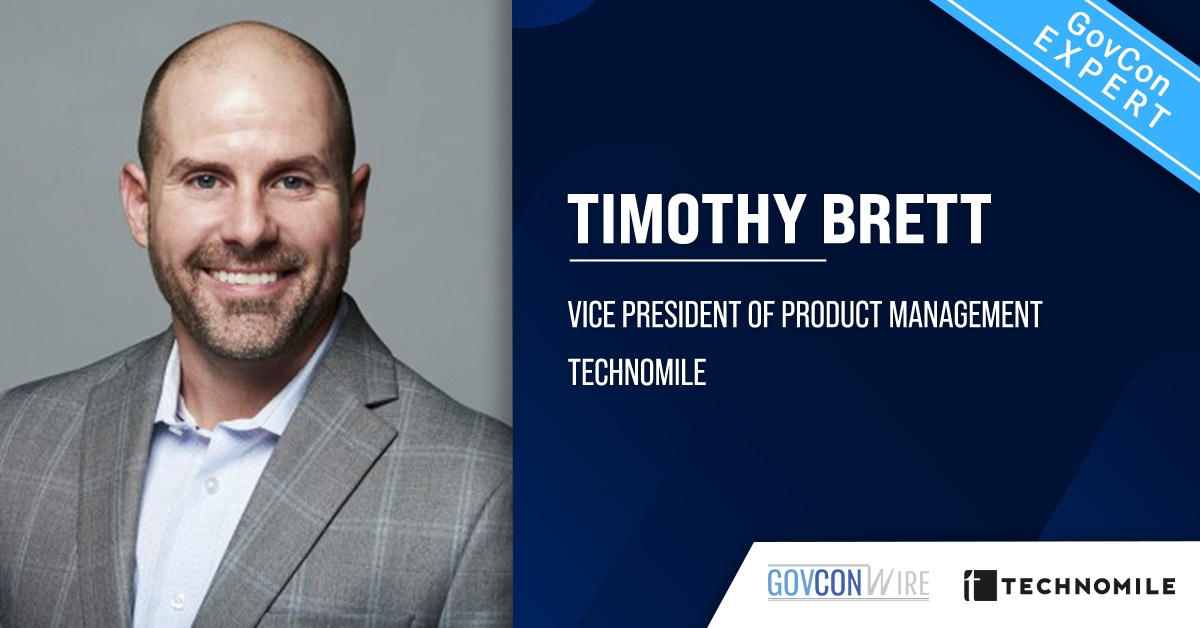

By Timothy Brett, VP of Product Management at TechnoMile and a GovCon Expert
I was only four when The Terminator hit theaters in 1984, so I didn’t see it until my teens. Even then, a machine operating independently belonged firmly to science fiction. Today it feels far less distant. Agentic AI has shades of Arnold Schwarzenegger’s character, not because it is dangerous, but because it is autonomous, goal-driven and capable of acting without waiting for a human prompt. It doesn’t simply respond. It assesses what needs to happen next, takes action and keeps moving toward an objective. As a product leader, that shift is what has my full attention.
Traditional generative AI is largely reactive. Ask it to summarize a solicitation’s performance work statement and it produces an answer based on the context it is given. It generates and responds, but it doesn’t independently determine what should happen next.
AI agents move beyond a single prompt. An agent can perform a defined task or workflow automatically, such as identifying new opportunities that match a company’s NAICS codes, adding them to the pipeline and notifying the appropriate business development lead.

Agentic AI is the broader shift. It combines agents, models, data, tools, business rules and human oversight to pursue an objective across multiple steps. Instead of executing one predefined task, an agentic system can evaluate new information, determine the next appropriate action and keep working within established boundaries.
It doesn’t replace generative AI. It builds on it, adding planning, orchestration, decision-making and continuous action.
As agentic AI reshapes how government and industry work, the Potomac Officers Club’s 2026 Homeland Security Summit on Nov. 10 will explore how DHS is putting AI to use. Register today!
The Reactive Tools We’ve Built Our Careers On
Government agencies are under pressure to do more with less, driving efforts to accelerate acquisition timelines and automate procurement activities. For contractors, that means less time to identify opportunities, assess competitive positioning and make informed pursuit decisions. As the pace of acquisition increases, the limitations of reactive systems become harder to ignore.
Yet federal contractors have long relied on fundamentally reactive software and those of us who build it share the responsibility. CRMs, capture platforms, contract repositories and compliance trackers wait for people to search, review, interpret, or update information and that delay is costly. A protest changes the expected procurement timeline, but the capture plan doesn’t reflect the impact. An amendment posted late Friday goes unread until Monday’s pipeline review. A competitor completes an acquisition that reshapes the landscape, but the account team doesn’t reassess its position for weeks.
In each case, the system did exactly what it was designed to do. It waited. It didn’t know to look for change, interpret what changed, or initiate the next action. The burden stayed on the user to ask the right question at the right time. In capture, the right time is often the moment no one was looking.
The systems aren’t broken. They’re reactive.
Agentic AI flips that model.
Imagine a capture system that doesn’t just store opportunities. It monitors them, interprets changes and acts. An agent notices a new amendment on SAM.gov, evaluates its impact, updates the opportunity record, alerts the capture manager and drafts a risk summary before anyone logs in.
This is what agentic capture looks like in practice. It isn’t a feature layered onto existing tools. It is a new operating model for how capture teams work, moving from dashboards that inform to systems that act.
A Day in the Life of Agentic Capture
Consider a new opportunity that appears to fit the company’s capabilities, but the team doesn’t yet know how strong its competitive position is.
Today, disciplined capture teams already do this work. They research the customer, analyze requirements, assess competitors, evaluate positioning, identify partners and weigh bid/no-bid decisions. The challenge isn’t the process. The challenge is the time and effort required to execute it consistently across every opportunity.
In an agentic approach, work begins as soon as the opportunity appears. Within minutes, specialized agents could:
- Analyze how the contracting office and requiring activity actually buy, including incumbent patterns, preferred contract vehicles, set-aside usage and sole source versus competitive award behavior.
- Build an opportunity-specific profile of the customer’s mission, structure and background, then keep it current by surfacing only what has changed since the last review.
- Read the solicitation, PWS and evaluation criteria and extract every stated and implied requirement, each tied to its source document and section.
- Classify each requirement as covered, partially covered, or a gap, citing the awards and company data behind the call.
- Rank the most likely bidders by set-aside eligibility, recent wins and scope relevance, always accounting for the incumbent.
- Weigh the tradeoffs of pursuing as a prime or a sub, recommend a path and identify the teaming partners that fit it.
- Draft structured call plans with objectives, discovery questions and talking points for the key customer contacts surfaced along the way.
Work that once required days of coordination, research and status meetings can begin taking shape in minutes. Notice what the agents actually did. They didn’t simply summarize information. They researched, analyzed, recommended actions and handed work to the next agent in the process. Gap analysis can’t happen until requirements are extracted. Teaming recommendations depend on the prime/sub decision. Outputs get reused while they are fresh and refreshed when they go stale. That chain of dependencies is what makes a system agentic rather than a collection of features.
The payoff is time. Directional estimates based on typical GovCon capture workloads suggest roughly 40 to 65 hours saved per active pursuit and another 30 to 70 hours over a 12-to-18-month capture cycle from automated monitoring of customer changes. These are educated estimates, not measured results, but even at the conservative end the math is hard to ignore.
That doesn’t mean every action happens without approval. Agentic capture requires governed autonomy, with clear permissions, traceable evidence and human accountability for consequential decisions. An agent can flag a capability gap, but the team decides how to close it. An agent can recommend prime or sub, but people make the call.
Why This Has to Be a Redesign, Not a Bolt-On
It’s tempting to treat this as a feature upgrade: keep the process the same and add a layer of automation. The evidence suggests that approach won’t produce the greatest gains. In its Technology Report 2025, Bain & Company found that AI-enabled improvements across the sales funnel can add up to more than a 30% increase in win rates. The research isn’t specific to federal capture, but its central lesson applies: meaningful gains come from reimagining the end-to-end process rather than automating isolated tasks within the existing one.
The right question isn’t where a chatbot could help. It’s what the capture lifecycle would look like if research, monitoring and analysis were continuous. For capture and growth leaders, that distinction matters. An agent that drafts a risk summary but still requires multiple manual handoffs before anyone can act isn’t agentic capture. It’s a faster version of the same reactive process.
What to Look for in a Real Agentic Solution
Agentic capture becomes valuable when autonomy amplifies human judgment rather than replacing it. As vendors increasingly market “agentic” capabilities, here are four criteria I would use to separate meaningful innovation from marketing language.
Data that combines public and private intelligence. An agent is only as effective as the information it can access. Look for solutions that combine public procurement data with your organization’s CRM, pipeline, account intelligence and historical pursuit information. Just as important, ensure your team maintains control over what internal data agents can access.
A process grounded in capture best practices. Successful capture follows a disciplined methodology. Agentic systems should reinforce proven practices, such as the Shipley customer, competition and company framework, rather than add a chatbot interface to existing workflows. Ask which capture activity each agent supports and why.
Security designed for federal contractors. Capture data often includes sensitive business information and may involve controlled information. Agentic capabilities should operate within environments built for federal security expectations, with clear controls around data access and usage.
Transparency and traceability. Every recommendation should be explainable. Users should be able to understand what information the agent used, how a conclusion was reached and where supporting evidence originated. If an agent can’t show its sources, a capture manager can’t defend its conclusions at a gate review.
The long-term value extends beyond efficiency. Agentic capture enables organizations to apply disciplined pursuit practices across more opportunities, lower the cost of research and qualification, increase capture coverage without proportional headcount growth and help teams focus their expertise where it creates the greatest competitive advantage.
The future of capture isn’t about replacing human judgment. It’s about extending it. When agents handle research, monitoring, analysis and coordination, capture professionals gain more time to do what humans do best: build relationships, shape opportunities and make better strategic decisions. The organizations that learn to combine human expertise with agentic execution won’t just move faster. They’ll compete differently.