
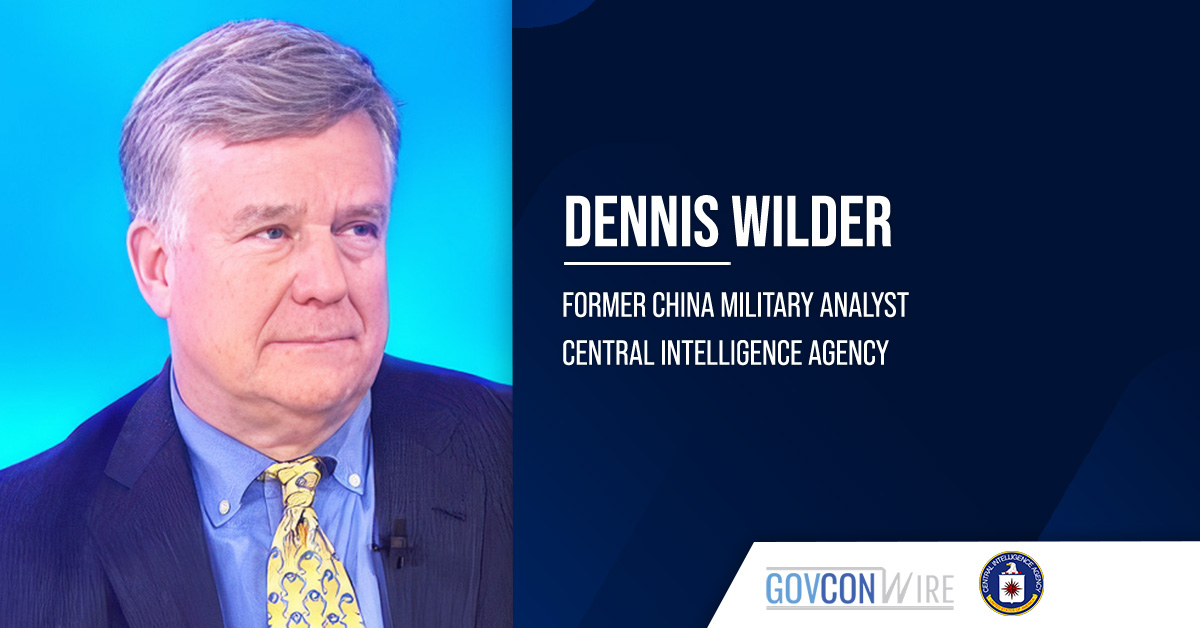

- U.S. intel agencies have struggled to penetrate the upper levels of Chinese leadership
- This makes understanding party messaging and commands in Chinese propaganda outlets essential
- Hear from former CIA official Dennis Wilder on a panel at the 2026 Intel Summit on Sept. 24!
The U.S. intelligence community struggles to gain sources in the top ranks of Chinese leadership, making open-source intelligence expertise vital to understanding their actions and reasoning, according to a former CIA official.
Dennis Wilder, Georgetown University senior fellow, Texas A&M Bush School of Government visiting professor of the practice, and former CIA deputy assistant director for East Asia and the Pacific, told GovCon Wire in an exclusive interview ahead of his appearance at the 2026 Intel Summit on Sept. 24 that there is code language for Chinese propaganda. Best leveraging this OSINT, he said, requires expertise in Chinese language and Chinese Communist Party theory and philosophy.
Get exclusive insights directly from Wilder on OSINT’s role in counterespionage during a panel discussion at the Potomac Officers Club’s 2026 Intel Summit on Sept. 24! At Open Secrets: The Power of OSINT in Counterespionage of Intellectual Property Secrets, dive into protecting the U.S. research and development enterprise and closing intelligence gaps left by other intelligence sources with Wilder; Stephen Pierce, Naval Intelligence Activity N3 director; and James Cangialosi, National Counterintelligence and Security Center deputy director. Sign up now!
Why Understanding Chinese Messaging Is Critical
While ordinary Chinese citizens don’t read the People’s Daily or People’s Liberation Army Daily, the CCP does and uses it to deliver ideological and political instructions to the party. For example, Chinese President Xi Jinping in January ousted Zhang Youxia, China’s top ranking general and vice chairman of the Central Military Commission, the CBC reported. Wilder said that pointed articles were published in the PLA Daily for three days, alluding to Zhang being a traitor without saying so explicitly.
But what the PLA Daily did allude to, according to Wilder, was something that had happened between Mao Zedong, founder of the People’s Republic of China, and one of his followers, without much explanation. While AI will be useful in sifting through and distilling information from Chinese sources, Wilder said it cannot understand historical references and allusions commonly used by CCP leadership when issuing messaging or explaining leadership decisions.
The message from CCP leadership on Zhang’s ouster came through loud and clear.
“Within China, they understood exactly what this was about,” Wilder said. “That’s the kind of thing that algorithms won’t pick up because the name is meaningless to a computer. But if you have China expertise…you realize this was signaling to the troops.”
How Does China Use OSINT for Intelligence Purposes?
China also uses OSINT coming from the U.S., via applications like social media, for its own intelligence purposes. A former U.S. Navy sailor from the USS Essex Wasp-class amphibious assault ship in January was sentenced to 16 years in prison for espionage after being convicted of selling Navy secrets to China.
Former Machinist’s Mate 2nd Class Jinchao Wei was first approached by a Chinese officer on social media in February 2022, according to USNI News. Their relationship grew through encrypted messaging apps, and a month later, Wei began sending the Chinese officer photographs and information about American Navy ships and military exercises.
Wilder said China using social media for intelligence is extremely difficult to detect.
“The problem is, if you have an insider threat, it’s very hard to detect because no one’s attacking your system, they’re giving it away,” he said.
Intelligence community business is a lucrative but competitive field. Know exactly who you’re up against and quickly size up the field by attending the Potomac Officers Club’s 2026 Intel Summit on Sept. 24. Get a read on the competitive landscape by seeing who’s in the room, what they’re pitching and how they’re positioning themselves. Watch which agencies your competitors are courting. Analyze the field in a single day. Secure your seat today for this essential GovCon forum!
How Does OSINT Create Vulnerabilities in US R&D?
Vulnerabilities in the U.S. research, development, test and evaluation, or RDT&E, enterprise for intelligence operations make tightening up U.S. OSINT even more critical. Wilder said technology professionals should be mindful of posting about security clearance certifications on social media.
While professionals use this to market themselves for jobs, Wilder said they also make themselves targets for Chinese intelligence, which will approach people posing as recruiters at business rivals.
“I see people posting ‘I have Top Secret/Sensitive Compartmentalized Information’ or ‘lifestyle polygraph,’” Wilder said about two of the most sensitive security clearance levels. “That’s probably not something you want to be advertising broadly.”