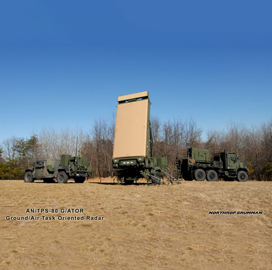
Northrop Grumman (NYSE: NOC) has secured a five-year, $249.3M basic ordering agreement with the U.S. Marine Corps to update a multimission radar technology used to detect, track and engage hostile threats.
The company will perform technical refresh of the Ground/Air Task-Oriented Radar system and provide software support, logistics, depot life cycle services, the Department of Defense said Tuesday.
DoD added that the company will help the service branch manage diminishing manufacturing sources and material shortages as part of the contract.
Marine Corps Systems Command did not obligate funds at the time of award and will determine work locations with each task order.
The department expects Northrop to finish contract work by Sept. 28, 2025.
According to the company, AN/TPS-80 G/ATOR is designed to provide a 360-degree threat surveillance coverage for military personnel.
GSA’s Polly Hall will give insights on the Revolutionary FAR Overhaul and AI in procurement during her 2026 FedCiv Summit…
The appointment follows Amy Gilliland's departure early in October.
Lockheed Martin will perform engineering, integration, qualification and testing support for the F-35 navigation system.
Oracle has committed $1 billion over four years to expand partner benefits and incentives tied to AI solution development and…
Booz Allen reported $2.8 billion in Q2 fiscal 2027 revenue, a $41 billion backlog and $2.1 billion in national security…
Sigmatech's Army contract runs through October 2036, with work locations and funding to be assigned as individual orders are issued.
Two logistics support recompetes for training aircraft are expected to fall between $1 billion and $1.5 billion.
The new award follows earlier Longbow contracts for radar electronics, mast-mounted assemblies and Apache radar sustainment services.
Leidos will support an asset tracking system covering more than 80 million government property items across over 50 agencies.
AMERICAN SYSTEMS has secured a $113.4 million follow-on task order to support a Department of War customer's critical technology work.
Scolese led the National Reconnaissance Office from 2019 to 2026 and previously directed NASA’s Goddard Space Flight Center.
Lockheed's missile backlog reached $142.5 billion after a seven-year Patriot Advanced Capability-3 contract.
You’ve already read all related articles.
VIDEO