
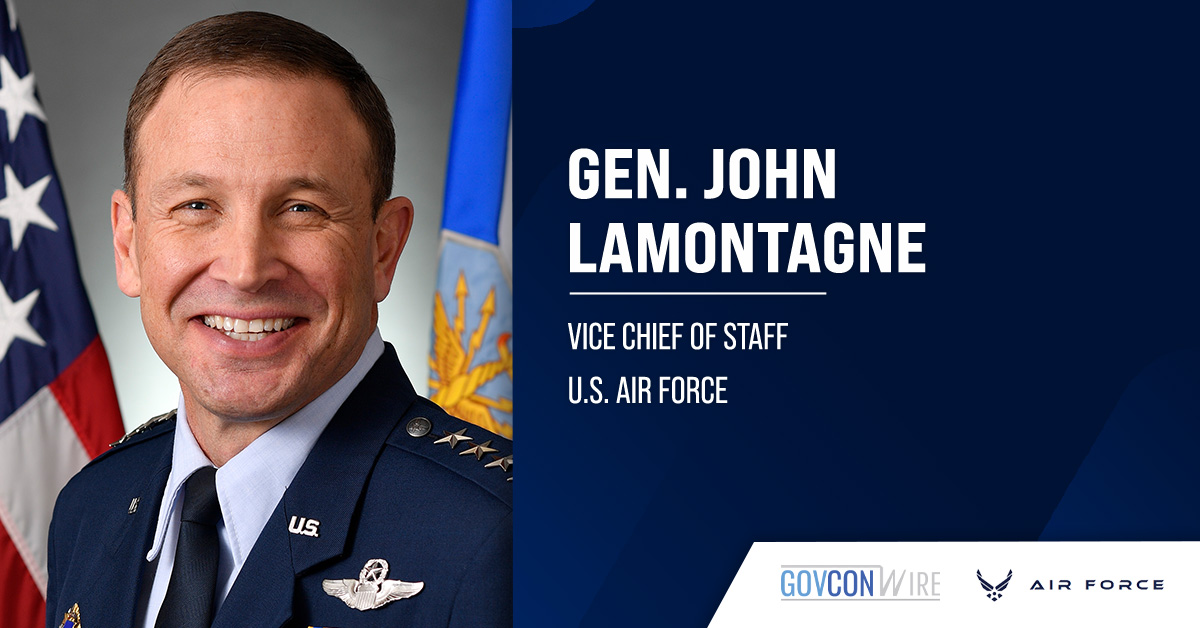

- Gen. John Lamontagne, vice chief of staff of the Air Force, discussed multi-year procurement contracts funding in a new interview
- He also talked about personnel shortages and rebuilding the service’s tanker fleet
- Lamontagne will keynote the 2026 Air and Space Summit this Thursday, July 30
The Air Force is facing a cluster of long-standing challenges that threaten its readiness to fight adversaries and defend U.S. interests at home and abroad. Legacy systems falling behind evolving threats, shortages in critical personnel and a defense industrial base that cannot keep up with military demand for aircraft and weapons.
In an interview with the Mitchell Institute for Aerospace Studies, Gen. John Lamontagne, vice chief of staff of the U.S. Air Force, goes into detail on how the service is working to overcome these obstacles, from pursuing multi-year procurement contracts to stabilize industry investment to shifting toward open mission systems architecture for faster upgrades across the fleet.

Lamontagne will keynote the 2026 Air and Space Summit this Thursday, July 30, at the Hilton McLean in Virginia. The Air Force leader is expected to discuss readiness and force reoptimization, technology investments to achieve air and space superiority, and industry collaborations to meet the service’s emerging requirements. Get your tickets before it’s too late!
Will Multi-Year Contracts Strengthen the Defense Industry?
One of the key things that Lamontagne talked about in the interview is supporting industry with multi-year contracts and a multi-year procurement strategy to provide a stable and predictable funding for the defense industrial base.
“I’d say our demand signal is outstripping their ability to produce quality airplanes on schedule, on time. It takes them a while to ‘facilitize,’ to be able to either stand up another line or to produce more airplanes over time,” he stated. “And so, because of some of those constraints, we’re unable to procure exactly how many we’d like to procure.”
Lamontagne pointed to what he called a “sawtooth kind of investment approach,” where demand goes up or down year over year. The approach, he said, prevents industry from making investments in increasing capacity.
War Secretary Pete Hegseth, a two-time Wash100 winner, has previously spoken about the impact of unstable demand signals on the defense industrial base. He said at a November event that the defense industry has become risk-averse, with a lack of urgency and fear of innovation.
Lamontagne added that Hegseth and Air Force Secretary Troy Meink, also a Wash100 awardee, are also working with industry to scale their capacity to build more aircraft over time.
How Will the Air Force Increase Pilot & Maintainer Retention?
Lamontagne also spoke about the shortage of pilots and maintainers in the Air Force. The official explained that the problem emerged, in part, due to underfunding. Insufficient access to spare parts makes the job of maintainers more difficult because, to fix an aircraft, they often have to take apart another plane to get what they need.
“It takes two hours to get [a needed component] off [another] airplane. Two hours to put it on the airplane they’re trying to fix. And when the part comes in, it’s another two hours to refit the part that they cannibalized right there at that airplane. So, three times the work to do a two-hour job,” he shared.
The Department of the Air Force has allotted $22.6 billion for the Air Force’s weapon system sustainment program in its FY27 budget request. The funding covers software updates, engineering sustainment, depot maintenance and engine overhauls, according to DAF’s posture statement for FY27.
The Air Force has also increased funding for military personnel in the FY27 budget request. The service is asking $42.3 million for enlisted basic needs allowance, $1.6 million higher than in FY26, Military.com reported.
Lamontagne revealed that the Air Force is attracting a lot of new talent, with applications at the Air Force Academy growing by 10 percent and thousands of prospects joining the delayed entry program. The Air Force, the official added, is “hitting our marks” on retention.
“Over the years, our Air Force has gotten a lot smaller,” he commented. “In 2027, we’re looking to plus up the active duty Air Force by 8,900. So, 8,900 additive billets. Some of those will go to maintenance, some will go to defenders and some other areas. And so, this is a great opportunity to reset and re-scope things for our Air Force and make us stronger than we otherwise would be.”
How Will the Air Force Rebuild Its Tanker Fleet
Lamontagne also addressed the Air Force’s approach to air refueling and the future of the service’s current KC-135 and KC-46 fleets.
He described the tanker fleet’s power projection capability as an asymmetric advantage for the U.S. military, allowing forces to operate at distances other nations cannot match. He said adversaries are working to push American tankers farther from the fight, which is driving the need to add survivability features to existing aircraft so that tankers can go into high-threat environments and deliver the gas where it is needed.
On fleet numbers, Lamontagne said the Air Force is procuring 188 KC-46s and an additional 75 added through a program extension. He noted that KC-46s will make up “probably a little more than half the tankers” in the future fleet.
He also pointed out that Congress included language in the National Defense Authorization Act directing the Air Force to increase its overall tanker numbers, which will likely slow the retirement pace of the KC-135 rather than retiring one for every new KC-46 delivered.
The Air Force is mandated to have 478 tankers in FY27, 490 in FY28 and 502 in FY29, Air and Space Forces Magazine reported. Initially, the service planned to retire a KC-135 every time a KC-46 is delivered, but Lamontagne told lawmakers in an April House Armed Services Committee hearing that the Air Force will comply with congressional requirements.
Why the Air Force Wants Open Mission Systems
According to Lamontagne, the Air Force is shifting investment priorities from vendor-lock architecture to open mission systems. Whereas updates on older equipment took months to operationalize, open mission systems provide the flexibility of upgrading aircraft any time and anywhere.
“If we’re gonna build a new airplane like the F-47 or B-21, government-owned, open mission system architecture, so that we can upgrade very, very quickly, very swiftly. That is where we’re headed on just about every platform going forward,” he shared. “That’s where we wanna go with just about all of our new procurement.”
Hear more about Air Force modernization and readiness initiatives at the 2026 Air and Space Force Summit. Aside from Lamontagne, the Air Force’s Assistant Deputy Chief of Staff for Logistics, Engineering and Force Protection Anthony Baity and Director of Integrated Capabilities Office Dr. Eliahu Niewood have joined the event’s keynote lineup. Sign up today!