
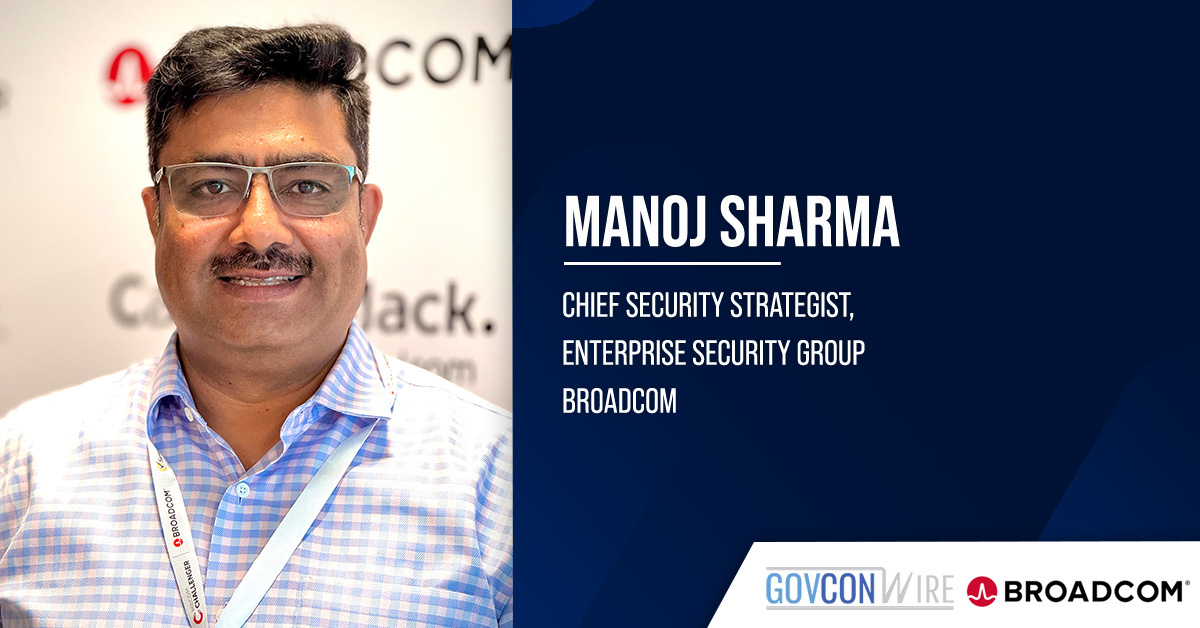

- Manoj Sharma said agencies must secure AI agents as well as users
- Sharma tied recent breaches to stolen identities and unmanaged devices
- The 2027 Defense R&D Summit will explore trusted AI, AI-driven networks and more
Manoj Sharma, chief security strategist in Broadcom’s enterprise security group, said federal agencies must continuously monitor identities and endpoints to detect threats in IT environments shaped by cloud adoption, remote work and artificial intelligence.
Securing AI agents alongside human users has become part of the identity challenge agencies face as AI use expands across government networks. The Potomac Officers Club’s 2027 Defense R&D Summit on Feb. 4 will bring together government and industry leaders for panel discussions on trusted AI, AI model and data assurance, AI-driven network connectivity and more. Book your spot now to join the conversation.
In an article published on Carahsoft.com, Sharma explained why agencies can no longer depend on a fixed network boundary and outlined how real-time visibility supports a zero trust approach to cybersecurity.
Why Should Agencies Rethink the Network Perimeter?
According to Sharma, cloud adoption and remote work dissolved the traditional network perimeter years ago, and users, data and workloads now operate across public cloud, edge locations and on-premises data centers, with employees logging in from various locations and devices. He noted that AI adds further complexity as software increasingly takes autonomous actions and makes API calls on behalf of users, often without human review of each decision.
As a result, agencies must secure AI agents in addition to the people accessing government data, the Broadcom executive stated.
“In an ideal scenario, the perimeter travels with every user, device, application and agent rather than sitting in a fixed boundary,” he wrote.
Why Do Agencies Need Real-Time Identity & Endpoint Visibility?
Sharma pointed to recent major breaches in which attackers gained access through compromised identities or unmonitored endpoints. He described zero trust as a necessary safeguard because it treats any human or machine identity as potentially compromised and requires continuous, context-based verification of every request.
“An attacker’s intent becomes an action when identity and an endpoint come together,” the chief security strategist explained.
He cited three reasons agencies need real-time visibility. Weekly or monthly reviews of password and multifactor authentication activity may not reveal that stolen credentials allowed an intruder to move laterally across systems until well after the breach. Without a single network checkpoint, identity and endpoint telemetry often serve as the only link connecting activity across cloud, on-premises and remote access environments. AI is also increasing the speed of cyberattacks, leaving agencies without continuous monitoring unable to protect their resources.
“Continuous, automated correlation is the only way to catch anomalous behavior in time to stop an attack,” Sharma added.
How Does Broadcom Support Agency Cyber Defense?
Sharma said Broadcom’s portfolio, which includes Symantec, CA Technologies, Carbon Black and VMware, offers security tools for identities, endpoints, networks and data that have been deployed across complex, highly regulated industries worldwide.
He noted that agencies combining Broadcom’s tools with a zero trust architecture gain coordinated visibility across endpoint, identity, data and network telemetry.
“With Broadcom, zero trust principles are enforced consistently no matter where a user is, and whether that user is a human or an AI agent,” he wrote.